Universe Today
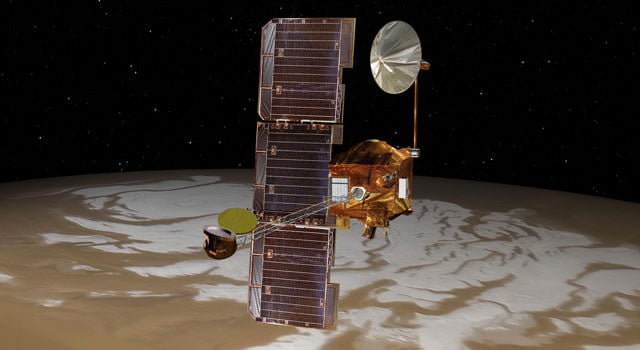
NASA's Mars Odyssey orbiter was successfully rebooted today, to thwart any potential future problems with memory corruption of its main systems, and with hopes of restoring use of back-up systems. Odyssey has been functioning normally, but its memory cache hadn't been cleared for five years. The spacecraft followed commands to shut down and then restart, a strategy that engineers hoped would clear any memory flaws. The procedure also restored Odyssey's onboard set of backup systems, called the spacecraft's "B side," allowing its use in the future when necessary. "For nearly two years, we have not known for certain whether the backup systems would be usable, so this successful reboot has allowed us to ascertain their health and availability for future use," said Odyssey Project Manager Philip Varghese of NASA's Jet Propulsion Laboratory, Pasadena, Calif.
Engineers were going to perform the reboot on March 10, but an unexpected rise in temperature of the star camera in Odyssey's navigation system prompted a postponement of the procedure. Engineers identified the cause as a heater circuit that was temporarily stuck "on." The circuit was turned off before today's reboot.
Memory corruption is caused by cosmic ray hits and other effects of the space radiation environment. This reboot was not a risk-free event, but the Odyssey team and NASA carefully weighed the risks of performing a cold reboot compared with the risk of doing nothing, and determined that the best thing was to reboot now instead of waiting for potential problems to crop up.
Odyssey, which also serves as a relay for communications for the Mars Exploration Rovers, has been orbiting Mars since 2001. Odyssey has never switched from its primary set of components, the "A side," to the backup set, which includes an identical computer processor, navigation sensors, relay radio and other components. In March 2006, the B-side spare of a component for managing the distribution of power became inoperable. Analysis by engineers identified a possibility that rebooting Odyssey might restore that component, but it had not been done until today. And now the B-side seems to be working.
The Odyssey team began a series of steps after the reboot to carefully return the spacecraft to full functioning over the next few days. Odyssey and all the science instruments should be back to studying Mars by next week.