Universe Today
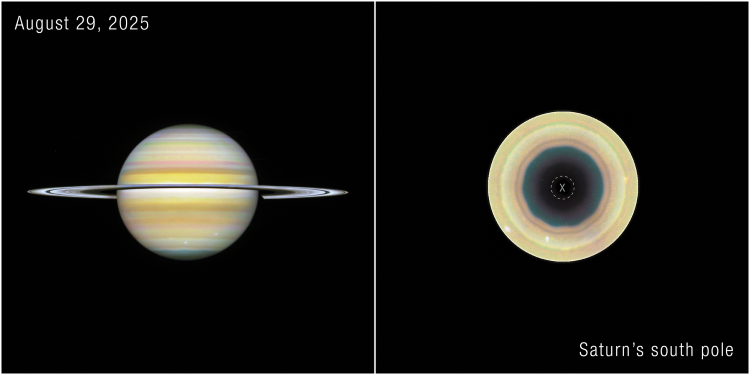
The planet Saturn is arguably the most recognizable planetary object in the entire solar system because of its massive rings. Anytime a child is asked what their favorite planet is, the answer is often “The one with the rings!” But, while Saturn’s rings are its most striking feature, the famed planet has a myriad of other unique features that often get overlooked, specifically its polar activity. This includes a long-known rotating hexagon in its north polar region, but what kinds of activity could be occurring in Saturn’s southern polar region, and what could this teach scientists about planetary formation and evolution?
Now, an international team of researchers might have discovered a new and exciting aspect about Saturn’s south pole, as discussed in a recent study published in Science Advances. For the study, the researchers analyzed images obtained from NASA’s Hubble Space Telescope (HST) and ground-based telescopes. The images obtained with HST are part of Hubble’s Outer Planet Atmospheres Legacy (OPAL) program, which was founded in 2014 and obtains annual images of the outer planets—Jupiter, Saturn, Uranus, and Neptune—with the goal of gaining insight into their respective atmospheric compositions, behaviors, and evolution. The ground-based telescope used for the study was the Calar Alto Observatory, which is located in Spain and is the largest astronomical observatory in continental Europe.
Saturn’s New Southern Polar Structure
After analyzing images obtained between 2023 and 2025, the researchers identified a new decagon-shaped (10-sided) atmospheric structure within the southern polar region of Saturn. Along with being a first-time discovery in Saturn’s southern hemisphere, this decagon contrasts the long-known hexagon (6-sided) atmospheric structure in Saturn’s northern polar region. Both atmospheric structures are formed from Saturn’s well-known jet streams, with the northern hexagon and southern decagon jet streams at 320 to 354 km/h (200 to 220 mph) and 400 to 420 km/h (250 mph), respectively.
However, the researchers observed that while the northern hexagon’s position remains mostly fixed, the southern decagon was found to be migrating in an eastward direction. The study notes the processes responsible for this eastward movement are potentially caused by the 10 corners of the decagon sway back and forth (oscillate) every 32 days. As a result, researchers postulate the southern decagon behaves more like a meandering wave that penetrates several atmospheric layers than a fixed structure like the northern hexagon.
"We've never seen anything quite like this in Saturn's southern hemisphere," said Dr. Amy Simon, who is the Senior Scientist for Planetary Atmospheres Research at NASA's Goddard Space Flight Center, OPAL’s principal investigator, and a co-author on the study. "The northern hexagon has been there every time we've looked for more than 40 years. This feature is different — it appears to be strengthening, giving us the rare opportunity to watch a giant atmospheric pattern develop."
Key Insights into Planetary Atmospheres
It’s important to note that while HST discovered evidence of the decagon from 2023, NASA’s now-retired Cassini spacecraft, which orbited Saturn and its many moons from 2004 to 2017, did not observe any shape whatsoever at Saturn’s southern polar regions. The researchers note how this new decagon could provide key insights into planetary atmospheric behavior and dynamics, most notably Jupiter’s polar cyclones arranged in unique geometric shapes around a larger cyclone at both of the planet’s polar regions.
Specifically, the researchers note how the aid of computer models could help better understand how changing wind patterns and solar radiation influences the development of the polygonal structures on Jupiter, all of which comes from this discovery of a new decagon at Saturn’s south polar region.
What new insights into Saturn and its polar decagons will researchers make in the coming years and decades? Only time will tell, and this is why we science!
As always, keep doing science & keep looking up!