Universe Today
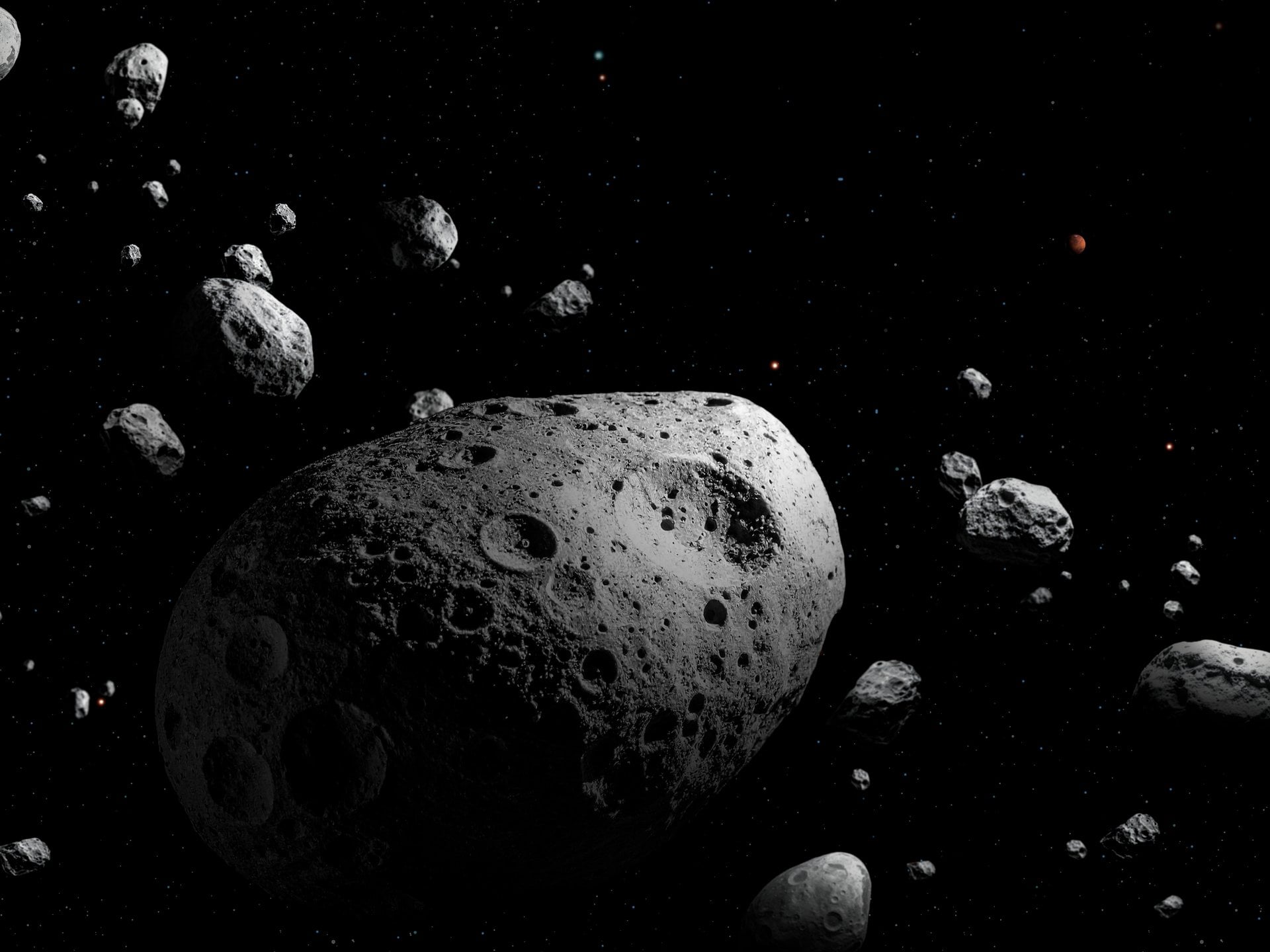
The Vera C. Rubin Observatory has discovered the fastest-spinning asteroid ever over 500 meters in size.
Dubbed 2025 MN45, it is a 710 meter long object found in the main asteroid belt between Jupiter and Mars, and it rotates every 1.88 minutes. This discovery, along with that of 18 other fast rotators, represents the first published science results from the Rubin Observatory’s Legacy Survey of Space and Time (LSST), and was released January 7, 2026 in the Astrophysical Journal Letters. The data was taken in April and May 2025, during the commissioning of the Simonyi Survey Telescope’s instruments.
The public got a first look at Rubin’s capabilities back in June 2025, but the real 10-year observing campaign starts in 2026.
“NSF–DOE Rubin Observatory will find things that no one even knew to look for,” says Luca Rizzi, an NSF program director for research infrastructure. “When Rubin's Legacy Survey of Space and Time begins, this huge spinning asteroid will be joined by an avalanche of new information about our Universe, captured nightly.”
In normal circumstances, objects in the asteroid belt tend to spin below 2.2 hours per rotation, in what is known as the spin barrier. Spinning faster than this usually results in an asteroid breaking up into smaller pieces, or splitting into a binary object.
The spin barrier is determined by several factors, including the ratio of icy to rocky material within an object, its size, and whether the asteroid is a single solid chunk or a rubble pile of tiny pieces. Astronomers believe ‘rubble piles’ are the most common type of asteroid, but with its fast spin time, 2025 MN45 is definitively not one.
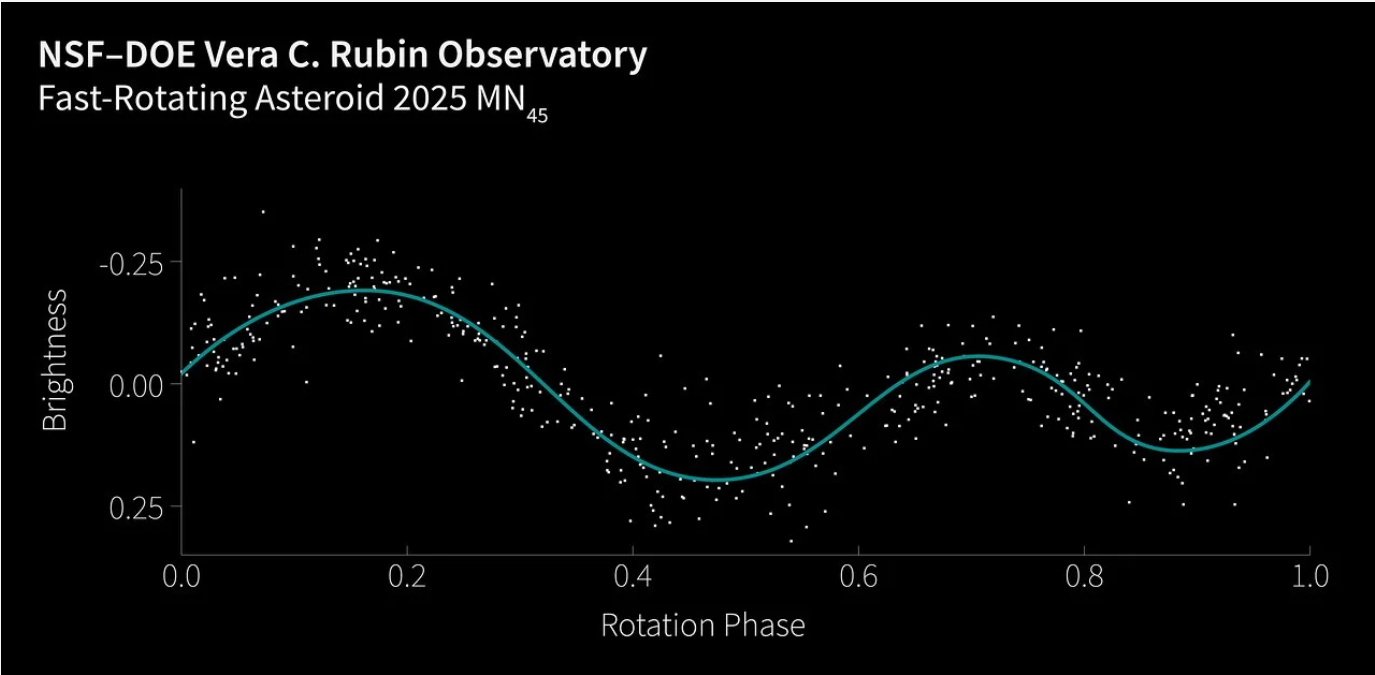 The lightcurve of 2025 MN45. The y-axis shows the asteroid’s brightness, and the x-axis shows its phase, or where it is in its rotation. When plotted, the resulting curve shows the asteroid's fluctuating brightness as it spins. Lightcurves can help scientists determine an asteroid's rotation period (the total time it takes to complete one rotation), size, shape, and surface properties. NSF–DOE Vera C. Rubin Observatory/NOIRLab/SLAC/AURA/J. Pollard Acknowledgement: PI: Sarah Greenstreet (NSF NOIRLab/Rubin Observatory)
“Clearly, this asteroid must be made of material that has very high strength in order to keep it in one piece as it spins so rapidly,” says the study’s lead author Sarah Greenstreet. “We calculate that it would need a cohesive strength similar to that of solid rock.”
Among the other asteroids discovered, a close second place goes to 2025 MJ71, which spins nearly as fast at 1.9 minutes per rotation.
Of the 19 fast rotators described in the new paper, only one is outside the main asteroid belt. Before Rubin, most known fast rotators were near Earth objects. Rubin’s unique capabilities are making detailed observations possible at a greater distance than before, and the LSST survey is expected to result in a wealth of new data about the asteroid belt and beyond.
Rubin’s key advantage, aside from having the largest digital camera ever built, is that it will survey the night sky repeatedly, catching anything that changes in the sky from night to night. These changes are called ‘transients,’ and they include asteroids (and possibly new planets), but also distant events like supernovae and the dimming or brightening of variable stars. Over ten years, LSST will also create a detailed map of the Milky Way and help astrophysicists understand dark matter, by cataloguing the sizes of distant galaxies.
Find the paper here.
Updated Jan 12: A previous version of this article indicated that the spin barrier of main-belt asteroids is 2.2 minutes. The correct time is 2.2 hours.