Universe Today
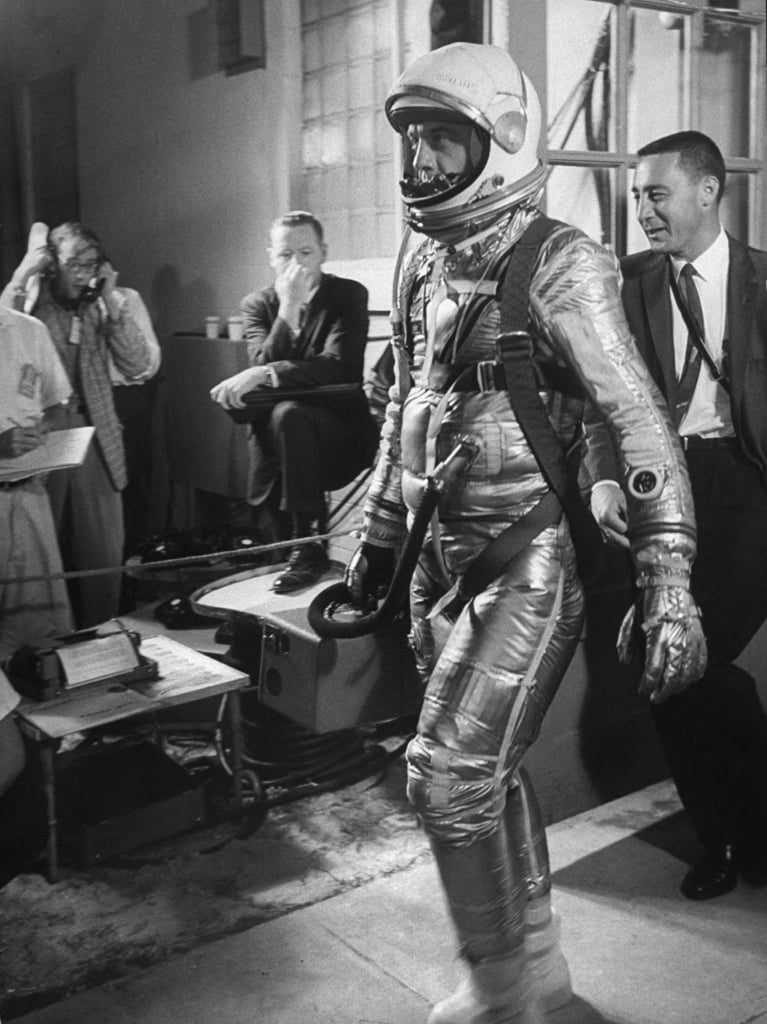
If you follow me on Twitter, you may have seen how I was oohing and aahing about a wonderful set of rare and never-seen photographs of Alan Shepard, John Glenn, and the other Mercury astronauts released by LIFE.com in honor of the 50th anniversary Alan Shepard's flight on May 5. Maybe LIFE saw my Tweets, too, as they contacted us, giving Universe Today permission to publish a few. Above, Shepard strides to the launchpad early on May 5 1961, with Gus Grissom close behind. Shepard reportedly joked to technicians who rode with him to the launch pad: "You should have courage and the right blood pressure" if you want to succeed as an astronaut. "And four legs ... You know, they really wanted to send a dog, but they decided that would be too cruel." In Shepard's right hand: a portable air conditioner to cool the inside of his pressure suit before he enters the capsule.
See more below.
In this previously unpublished photo, John Glenn crouches near Shepard's capsule, Freedom 7, prior to launch. In the book "Light This Candle: The Life and Times of Alan Shepard," author Neal Thompson portrayed the fierce competitiveness between Shepard and Glenn over who would be the first astronaut in space, which sometimes bordered on the two disliking each other. But as the first flight approached, Shepard and Glenn spent a lot of time together training, and formed a bond. Glenn even put a few items in Shepard's Freedom 7 capsule as a joke to lighten the intensity of the day, and this image shows Glenn's excitement and joy as his fellow astronaut enters the spacecraft. LIFE photographer Ralph Morse said of NASA's choice for who was making the first flight: "You know, I presumed, at that point, that they were saving Glenn, that having him circling the Earth for the first time would be better press for NASA. But you don't know about these things. They had their own reasons, of course -- complicated reasons, based on skills and personality and temperament -- for choosing one man ahead of another."
This previously unpublished image shows Shepard's Redstone rocket before liftoff. "I never have been my own favorite subject," Shepard once told LIFE, when asked how he felt about the rewards and dangers inherent in Project Mercury. "And I don't think I've found anything new about myself since I've been in this program. We were asked to volunteer, not to become heroes. As far as I'm concerned, doing this is just a function of maturity. If you don't use your experience, your past is wasted, and you are betraying yourself."
This is my absolute favorite image of this set: Shepard shares a laugh with fellow astronauts Gus Grissom (right) and Deke Slayton upon his arrival at Grand Bahama Island, shortly after his successful flight and splashdown. Oh to be a fly on the wall to know what they were laughing about!
No internet, no instant messaging, no Twitter or Facebook. The Mercury astronauts and the rest of the world had to wait for the next day's newspapers to come out to read of Alan Shepard's heroics. "Though the U.S. still has far to go to catch up with the Russians in space," LIFE magazine noted in its May 12, 1961 issue, "Shepard went a long way toward lifting American heads higher."
See many more images on the LIFE.com gallery. Thanks again to LIFE for allowing us to post these images.