Universe Today

Imagine a lighthouse that doesn't just send its beam from the top of the tower, but simultaneously fires another from a point far out at sea. That's a reasonable way to picture what astronomers have just discovered about one of the universe's most extreme objects.
Pulsars are the collapsed remnants of dead stars, objects so dense that a teaspoonful of their material would weigh a billion tonnes. As they spin, they sweep beams of radio waves across the sky like great big lighthouses, and from Earth we detect those sweeps as regular pulses. A special class called millisecond pulsars takes this to extraordinary extremes, spinning hundreds of times every second and keeping time so precisely they rival the best atomic clocks we've ever built.
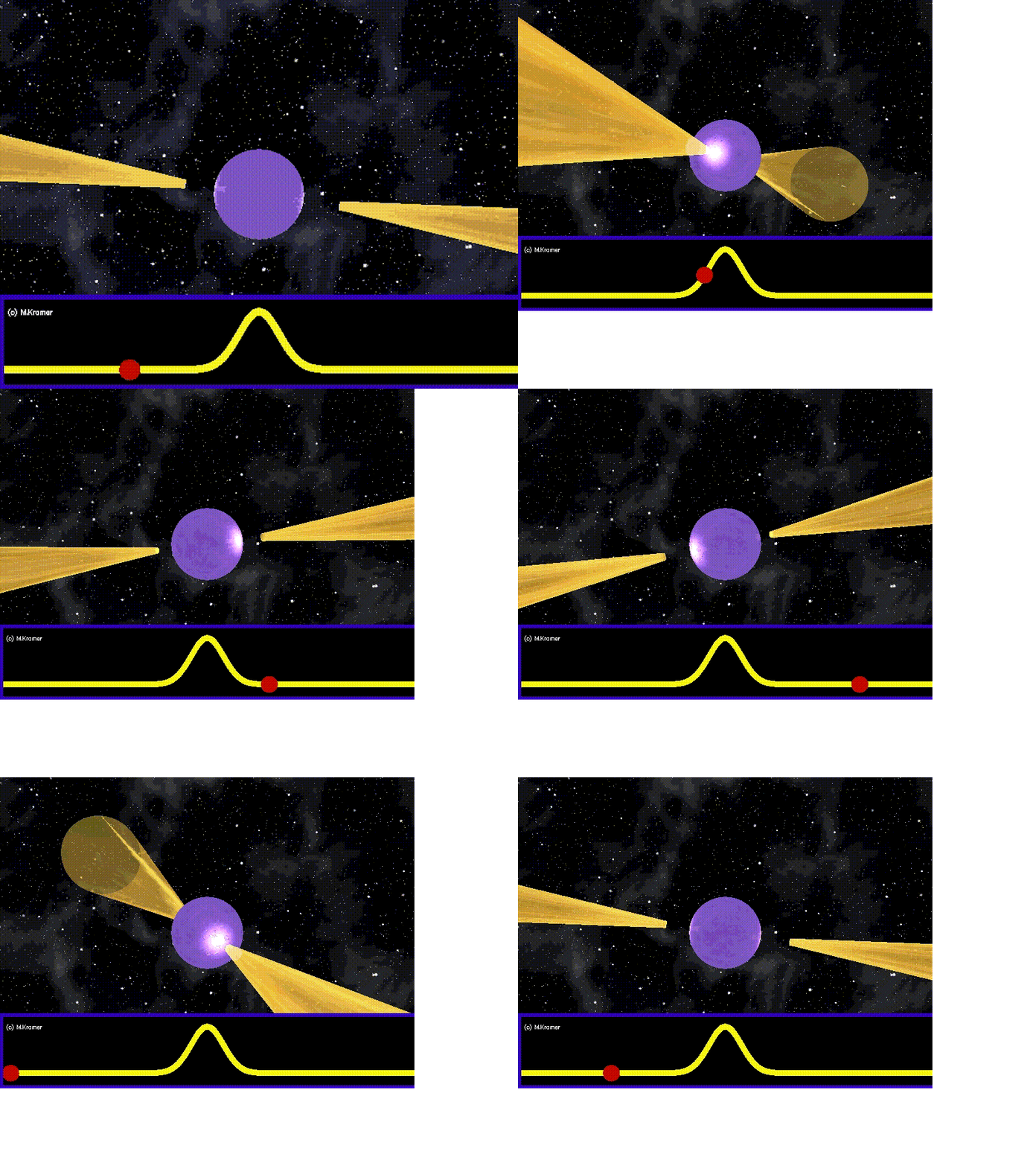 Illustration of the "lighthouse" effect produced by a pulsar (Credit : Michael Kramer)
For decades, the textbook answer to where those radio pulses came from was simple, it was near the surface, close to the magnetic poles. Tidy, logical, settled. Except it wrong.
Professor Michael Kramer from the Max Planck Institute for Radio Astronomy and Dr Simon Johnston from Australia's CSIRO analysed radio observations of nearly 200 millisecond pulsars and compared them with gamma-ray data. What they found upended the established picture entirely.
Around a third of these pulsars showed radio signals coming from two completely separate regions, with distinct gaps in between. Interestingly it was a pattern seen in only around 3% of slower spinning pulsars. Crucially, many of those isolated outer pulses lined up precisely with gamma-ray flashes detected by NASA's Fermi telescope in previous observations.
Gamma rays were already thought to originate in what's called the current sheet, a swirling region of charged particles that lies just beyond the invisible boundary where a pulsar's magnetic field would need to travel faster than light just to keep up with the star's rotation. The fact that radio and gamma-ray pulses were arriving from the same direction pointed unmistakably to a shared origin. In other words, millisecond pulsars aren't just broadcasting from their surfaces, they’re simultaneously transmitting from the very outer limits of their magnetic reach.
 Fermi on Earth, solar arrays folded (Credit : Kim Shiflett)
These objects are used as precision tools for studying gravity, probing the nature of dense matter, and even detecting gravitational waves rippling through the fabric of spacetime. Knowing where their signals actually originate and why they look the way they do matters enormously for interpreting those measurements accurately. There are still questions to answer of course and further studies will be needed. We still don’t understand how stable radio signals can form in such an energetic and chaotic outer region remains unclear. The finding also hints that nearly all millisecond pulsars that produce gamma-rays may emit radio waves too, even faintly, meaning more of them could be detectable than previously assumed.
Source : Radio signals at the edge of extreme stars come from far beyond their surfaces