Universe Today
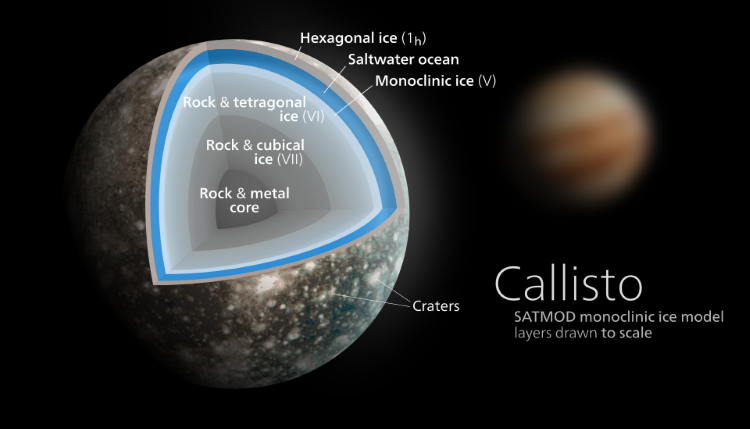
What exists beneath the surface of Jupiter’s icy moon, Callisto? This is what a recent study accepted by The Planetary Science Journal hopes to address as a team of researchers investigated the subsurface composition of Callisto, which is Jupiter’s outermost Galilean satellite. This study has the potential to help scientists better understand the interior composition of Callisto, which is hypothesized to possess a subsurface liquid water ocean, and develop new techniques for exploring planetary subsurface environments.
For the study, the researchers analyzed archival data, specifically six thermal images, obtained from July 17 to November 4, 2012, by the Atacama Large Millimeter/submillimeter Array (ALMA), which is the world’s most powerful telescope for observing in millimeter and submillimeter wavelengths, and is used for studying gas, dust, and planetary formation.
The goal of the study was to use the data to examine the top few centimeters of Callisto’s surface and subsurface and compare it to archival data obtained from NASA’s Galileo spacecraft, which explored Callisto and the other Galilean satellites from 1995 to 2003. With this new dataset, scientists could establish a baseline temperature of the uppermost regolith layers on Callisto.
In the end, the researchers not only estimated Callisto’s surface temperature is approximately 133 Kelvin (-140.15 degrees Celsius), but they also improved regolith compositions across various types of surface terrains. Finally, the researchers suggested differences in subsurface temperatures across the moon. Overall, the team successfully improved our understanding of Callisto’s surface and subsurface composition and temperature, establishing a baseline for future studies.
The study notes in its conclusions, “Future science observations of Callisto using ALMA will both considerably enhance the spatial resolution of the derived thermal images and reduce uncertainties on inferred brightness temperatures, thereby paving the way for upcoming spacecraft missions. In particular, more extensive spatial and spectral coverage by the JUpiter ICy moons Explorer (JUICE) spacecraft will allow us to extend these thermal property maps into the third dimension, thereby constraining the depth dependence of Callisto’s thermal properties.”
Discovered by Italian astronomer Galileo Galilei in 1610, Callisto is the fourth and outermost Galilean satellite and widely known as one of the most heavily cratered objects in the solar system. This distinctive aspect of Callisto helps scientists identify the lack of geologic activity on the Mercury-sized moon, in contrast to the inner three Galilean satellites: Io, Europa, and Ganymede, which all display strong evidence of interior activity, resulting in periodic resurfacing and erasing past records. Additionally, this lack of resurfacing preserves early records of the solar system’s history, which was a much more violent period during its formation.
Despite the heavily cratered surface and alleged lack of geologic activity, scientists hypothesize that Callisto contains an interior liquid water ocean like Europa and Ganymede. This evidence comes from Callisto’s interaction with Jupiter’s massive magnetic field, whose influence stretches millions of kilometers into space and encompasses all the Galilean satellites. In summary, studying Callisto is important for several reasons: early solar system history (specifically impact cratering), subsurface ocean regularity, and the ability of subsurface oceans to exist without tidal heating like what is occurring on Europa.
This study mentioned the JUICE spacecraft, which is a European Space Agency mission and was launched in April 2023 and is currently en route to Jupiter, with an estimated arrival date of July 2031. Between 2031 and 2034, JUICE will perform flybys of Europa, Ganymede, and Callisto while studying their surfaces, interiors, and interactions with Jupiter’s magnetic field using a suite of 10 instruments. While JUICE is scheduled to enter orbit around Ganymede, the spacecraft will nonetheless gather incredible data about Callisto while gaining insight into its history and potential for harboring a subsurface ocean.
What new insight into Callisto’s subsurface environment will researchers make in the coming years and decades? Only time will tell, and this is why we science!
As always, keep doing science and keep looking up!