Universe Today
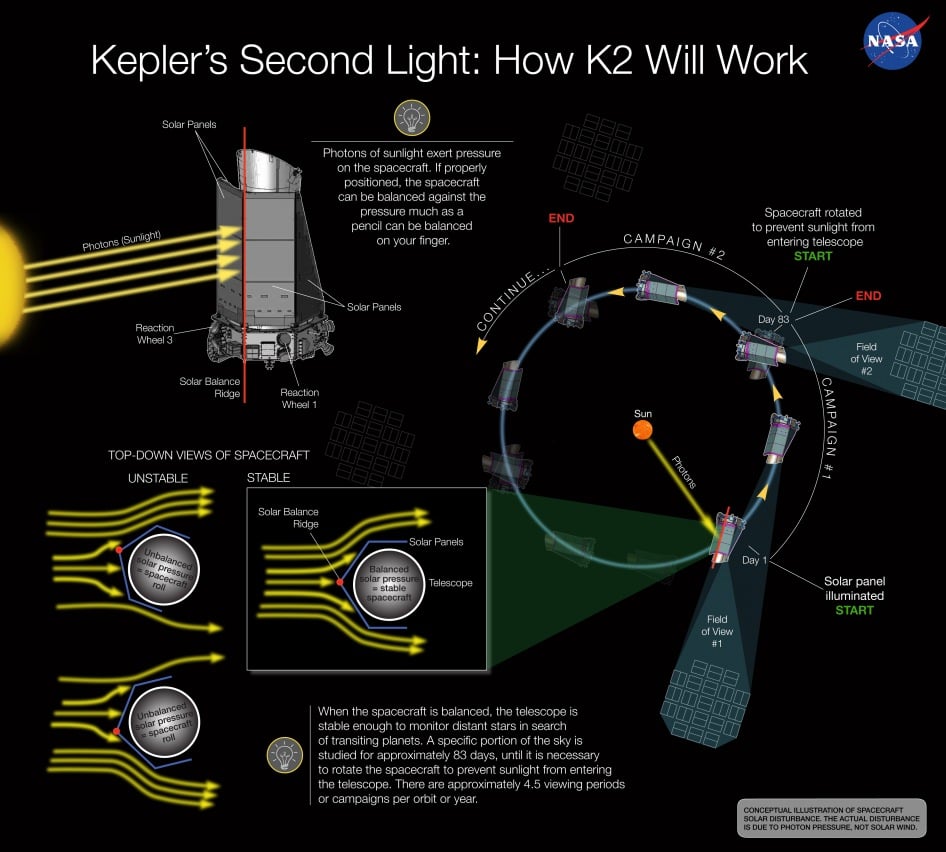
The checkout and calibration phase for the Kepler spacecraft has been completed, and now the telescope will begin one of the longest and most important stare-downs ever attempted. Kepler will spend the next three-and-a-half years staring at more than 100,000 stars searching for telltale signs of planets. Kepler should have the ability to find planets as small as Earth that orbit sun-like stars at distances where temperatures are right for possible lakes and oceans. "Now the fun begins," said William Borucki, Kepler science principal investigator for the mission. "We are all really excited to start sorting through the data and discovering the planets."
During the checkout phase scientists have collected data to characterize the imaging performance as well as the noise level in the measurement electronics. The scientists have constructed the list of targets for the start of the planet search, and this information has been loaded onto the spacecraft.
"If Kepler got into a staring contest, it would win," said James Fanson, Kepler project manager at NASA's Jet Propulsion Laboratory, Pasadena, Calif. "The spacecraft is ready to stare intently at the same stars for several years so that it can precisely measure the slightest changes in their brightness caused by planets." Kepler will hunt for planets by looking for periodic dips in the brightness of stars -- events that occur when orbiting planets cross in front of their stars and partially block the light.
The mission's first finds are expected to be large, gas planets situated close to their stars. Such discoveries could be announced as early as next year.
We'll be eagerly awaiting!