Universe Today
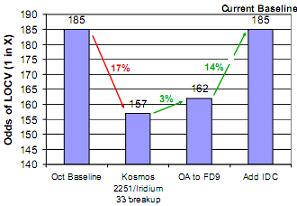
There's good news and bad news for the upcoming Hubble repair mission. The good news is that the statistical threat posed to space shuttle Atlantis and her crew by micro-meteoroid orbiting debris (MMOD) is currently no greater than last year, even with the collision of two satellites in February and other recent satellite breakups. The chance of the shuttle being hit by MMOD during a mission to Hubble is 1 in 185. But that's also the bad news. The 1 in 185 chance of a catastrophic impact to a shuttle in Hubble’s orbit is, obviously, quite high, and higher than NASA's limit of 1 in 200. The final decision of whether this risk is acceptable will be discussed at a Flight Readiness Review meeting on April 30. It is anticipated that NASA will override the limit and accept the risk. Without a servicing mission by a space shuttle crew, the telescope is not expected to last more than another year or two.
According to an article on NASASpaceflight.com, NASA analysts were able to reach this particular ratio by making use of the known probability of detecting and repairing critical Thermal Protection System damage while on orbit, factoring in the length of the mission and orientation of the shuttle during the mission (both attached and unattached to the Hubble) and even adding in how a "rescue mission" would come into play in the event of a catastrophic impact.
NASA guidelines say the Space Shuttle Program cannot accept a Loss of Crew and Vehicle (LOCV) ratio in excess of 1 in 200.
Immediately after the Kosmos/Iridium satellite collision and factoring in other recent breakups which include the Chinese ASAT/Fengyun 1C, the Kosmos 2421, the risk of LOCV increased to 1 in 157 for Atlantis.
But with the long delay for STS-125, mission planners were able to investigate and implement several mitigation tactics and changes to the flight's activities that brought the risk back down to 1 in 185 chance.
The NASA team is also looking at different options that will reduce the risk, which include eliminating one EVA day (which would reduce risk by ~6 percent to 1 in 196), eliminating two EVA days (which would reduce risk by ~12 percent to 1 in 208), or eliminating the crew off duty day after the Hubble is released (which would reduce risk to 1 in 201).
Delaying the mission would likely have no effect on the statistical risk. The mission was already delayed when data handling processor on the spacecraft failed in September 2008 and again due to Hurricane Ike in October 2008. With the mitigation tactics, the 1 in 185 chance is no higher than it was determined to be last September.
NASA also analyzed the risk for STS-400 rescue flight, which is 1 in 294. That ratio is only if the crew does an inspection of the Wing Leading Edge panels and Nose Cap and has a short mission duration of just seven days. If the STS-400 crew does not perform any TPS inspection, the LOCV ratio rises to 1 in 217.
But everything is going full-steam-ahead for the mission; Atlantis is on launch pad 39 B being prepared for the mission, Endeavour will be sent to pad 39 A tomorrow (Friday) to prepare for the STS-400 rescue mission, if needed (otherwise Endeavour will move to pad 39 B for the next shuttle mission, STS-127 to the ISS scheduled for June) and the the STS-125 crew is in full training and preparations for the flight.
Credit: NASASpaceflight.com