Universe Today
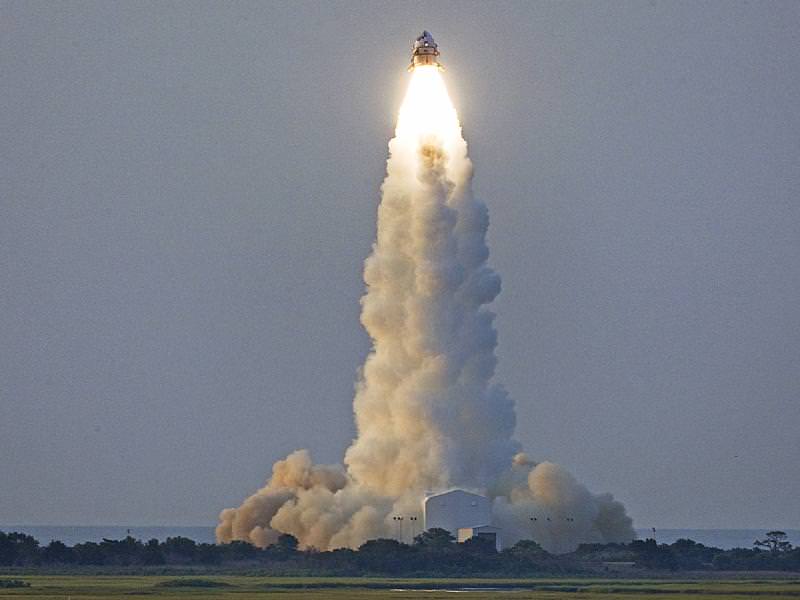
While the Constellation program is undergoing design reviews, NASA conducted a successful test on an alternative abort system for the Orion spacecraft to provide options and additional data on how to best protect astronauts in the event of a problem on the launch pad or during ascent. A simulated launch of the Max Launch Abort System, or MLAS, took place Wednesday morning at 6:26 a.m. EDT at NASA's Wallops Flight Facility, Wallops Island, Va. The 10 meter high (33-feet) MLAS vehicle was launched to an altitude of about 1.5 km (1 mile)to simulate an emergency on the launch pad. A mock-up of the Orion crew vehicle successfully separated from the launch vehicle seven seconds into the flight and parachuted into the Atlantic Ocean. While there were some concerns about the various pieces of the MLAS possibly hitting each other, the test went without a hitch.
Meanwhile, the Ares I-X rocket is in the process of being "stacked" for a test flight later this summer.
NASA's first choice for the escape pod is the LAS, or Launch Abort System, which has a single solid launch abort motor in a tower mounted at the top of the launch vehicle stack of the Orion and Ares I rocket. The LAS will be capable of automatically separating the spacecraft from the rocket at a moment's notice to make possible a safe landing.
Today's launch was a technology demonstration, and the MLAS is not intended to be a replacement for the LAS.
Read our previous article about test of the LAS
NASA says the data from today's MLAS pad abort test is helpful in several ways for the Constellation program. MLAS is the first demonstration of a passively-stabilized launch abort system on a vehicle in this size and weight class. It is the first attempt to acquire full-scale aero-acoustic data -- the measurement of high loads on a vehicle moving through the atmosphere at high velocity -- from a faired capsule in flight. The test is also the first to demonstrate full scale fairing and crew module separation and collect associated aerodynamic and orientation data.
UPDATE: Here's the video of the launch -- the first part is a preview, and the launch stuff starts about 2:00 minutes in:
Source: NASA