Universe Today
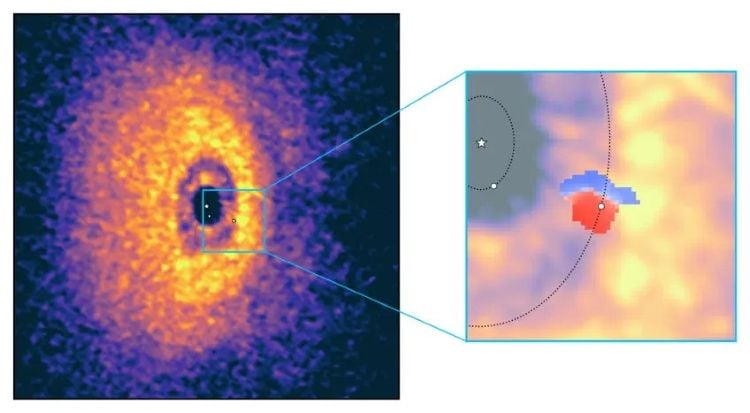
The formation and evolution of planets is the driving force behind both where and how we might find life beyond Earth. This complex and lengthy process first begins with a massive ball of gas and dust that swirls until it flattens into a disk, followed by rocks ranging in size from pebbles to kilometer-scale objects clumping together in a process known as accretion, as they too swirl around within the larger disk and form rocky planets closer to the star and the farther out planets collect the gas, ice, and dust that the star couldn’t evaporate. Until now, researchers have been limited to visualizing the swirling gas and dust forming planets through computer models.
Now, an international team of researchers just announced a remarkable discovery that could change how astronomers understand planetary formation and evolution. This discovery involves the first direct image of a planet forming in a swirling ball of gas and dust, also called a protoplanet. Their discovery, which is discussed in a recent study published in The Astrophysical Journal Letters, focused on the protoplanets WISPIT 2b, which is re located about 430 light-years from Earth, is estimated to be about five times as massive as Jupiter, and was directly imaged using the Atacama Large Millimeter/submillimeter Array (ALMA) observatory in northern Chile.
A companion protoplanet, WISPIT 2c, orbits interior of WISPIT 2b at 15 astronomical units (AU) and is estimated to be 8 to 12 Jupiter masses, while WISPIT 2b is located about 57 AU from its host star. While WISPIT 2b’s discovery was announced in August 2025, WISPIT 2c’s discovery was announced shortly afterwards in March 2026.
“We clearly see both planets shaping their environment,” said Dr. Myriam Benisty, who is the Director of the Max Planck Institute for Astronomy in Germany and lead author of the study. “WISPIT 2c has carved a cavity, and WISPIT 2b a gap. Around WISPIT 2b, we find swirls of gas that had been predicted by simulations of disk-planet interactions, but never actually seen before. Now there is an image of them!”
There is a distinct difference between a cavity and a gap within a protoplanetary disk, as a cavity indicates a total clearing of gas and dust while a gap indicates a decrease in disk material but still enough for a protoplanet to keep forming. The image obtained by ALMA demonstrates these with symbols of the locations of the host star, WISPIT 2c with its cavity, and WISPIT 2b with its gap. The major difference is WISPIT 2b is shown swirling in the gas and dust it is collecting, with blue and red denoting gas that is moving towards us and away from us, respectively.
This discovery comes as directly imaging planetary objects have advanced greatly in just the last decade. While this primarily involves directly imaging exoplanets by blocking out the intense glare of their hist stars, imaging protoplanets are far more difficult given their much smaller size. However, what makes ALMA unique is its ability to combine data from its 66 radio dishes to create extremely high-resolution images like the WISPIT 2 system.
One of the real conundrums that planetary scientists are trying to solve regarding planetary formation is a process called accretion, which involves the clumping of rocks into bigger rocks, and eventually planets. However, these rocks vary in size from pebbles to kilometer-scale rocks, so this first direct image of a protoplanet could begin the process of understanding the geological process behind how planets form and evolve.
How many more direct images of protoplanets will ALMA make and what new insights about protoplanets will researchers make in the coming years and decades? Only time will tell, and this is why we science!
As always, keep doing science & keep looking up!