Universe Today
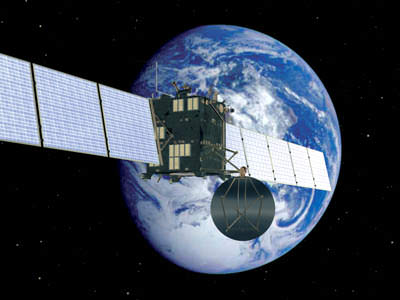
The weird mystery of the flyby anomaly just got even weirder. Since the early 1990's scientists and mission controllers have noticed that some spacecraft experience unexpected changes in speed during Earth-flybys. The unexplained variation is extremely small and has occurred as either speed gained or lost, but this variant is not predicted by fundamental physics. The anomaly doesn't happen to every spacecraft but scientists were hoping to gain more insight into the anomaly when the Rosetta spacecraft swung by Earth on Nov. 13 to pick up a gravitational boost for its journey to rendezvous with a comet in 2014. However, in a major disappointment – which had deepened the mystery -- the Rosetta spacecraft did not experience the flyby anomaly during this swingby of Earth, even though the same spacecraft did experience the anomaly when it flew by Earth 2005, but didn't in 2007.
"It's a mystery as to what is happening with these gravity events," said Trevor Morley, lead flight dynamics specialist working on Rosetta. "Some studies have looked for answers in new interpretations of current physics. If this proves correct, it would be absolutely ground-breaking news."
For the Earth swingbys where the anomaly has been detected, Morley said the main manifestation has been "the inability to get anything like a reasonable fit of an orbit to an arc of radiometric data that encompasses both the pre- and post-perigee (closest to the Earth) intervals."
For those cases when an anomaly has been seen, the change has been very slight, but noticeable. "In every case, a reasonable data fit could be established only by inserting an artificial velocity change along the direction of the orbital velocity in the vicinity of perigee," Morley said.
For this flyby, the team made allowances for the software to estimate an impulsive maneuver at perigee, aligned along the orbital velocity. But after analyzing the radiometric data gathered by ESA and NASA ground stations, nothing anomalous was seen.
"The difference in the quality of the data fit was absolutely negligible," Morley said. "For Rosetta's third and final Earth swingby, there was no anomaly."
Several ideas have been tossed around in an attempt to explain why the anomaly occurs, but no one has been able to pin the cause down as of yet.
Ideas range from tidal effects of the near-Earth environment, atmospheric drag, or the pressure of radiation emitted or reflected by the Earth, to much more extreme possibilities, such as dark matter, dark energy or previously unseen variations in General Relativity.
One American research team, led by ex-NASA scientist John Anderson, is even looking at the possibility that Earth's rotation may be distorting space-time - the fundamental fabric of our Universe - more than expected, and affecting nearby spacecraft. But there is as yet no explanation how this could happen.
Plus no one can explain why some flybys experience the anomaly and others don't.
The mystery continues!
Source: Rosetta Blog