Universe Today
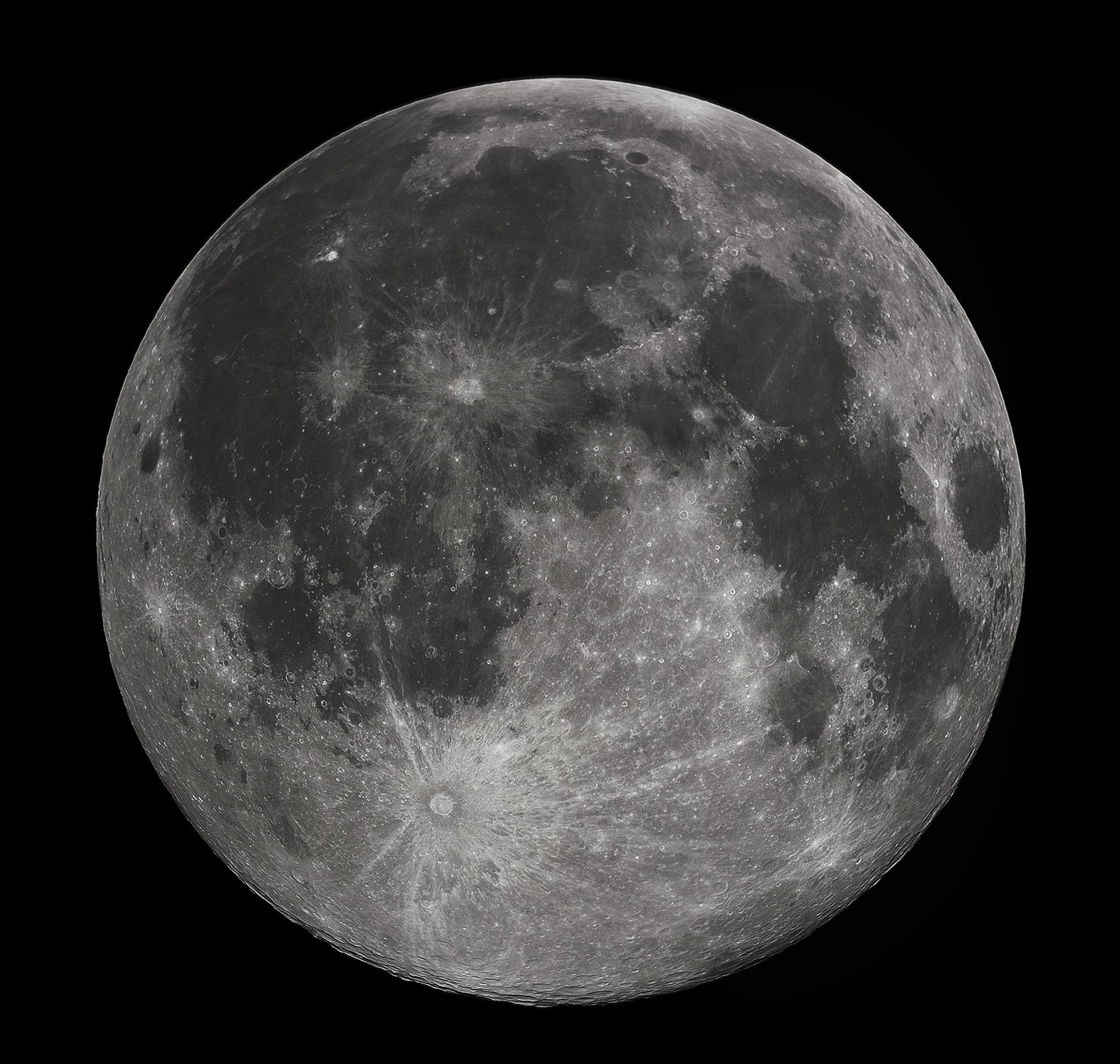
A half century after NASA’s Apollo 17 lunar module lifted off the Moon’s northeastern near side quadrant, planetary scientists still don't completely understand when or how our Moon first formed.
They do agree that it involved a major impactor --- an object dubbed Theia by lunar scientists --- that likely struck our Earth some 4.51 billion years ago. But the estimated size of Theia now ranges from a proto-Mercury-sized object all the way up to an object that was about half the size of present-day Earth. In fact, the latest hydrodynamic models indicate that a larger impactor offers the most palatable explanation as to why the Apollo moon rocks seem to be so chemically similar to what we find in olivine-rich volcanic basalts here on Earth.
Earth was hugely affected by this massive impact; it really reset the history of our planet, Wim van Westrenen, a lunar and planetary scientist at Vrije Universiteit Amsterdam, tells me during a recent sit-down interview in his office.
In a giant impact, the initial Moon was just a glowing ball of magma, thousands of degrees in temperature.
It’s not even rock yet, so it must cool down before you can form minerals which we tried to date, van Westrenen tells me. He says the real question is how much time did it take post impact to form those minerals?
As van Westrenen admits that’s very difficult to pin down.
Even so, lunar scientists are still learning lots from the Apollo rock samples. The Genesis rock --- a 4.46-billion-year-old rock picked up in 1971 by NASA’s Apollo 15 Moon walkers --- is one of the most famous Apollo samples. It's made almost exclusively of the white mineral plagioclase which tends to float to the top of the magma because it’s so lightweight.
You need a huge amount of magma to make a lot of the white stuff, and then that needs to all flow to the top, because now it sits on the surface, says van Westrenen. That's the best explanation for making these white rocks, including the Genesis rock, he says.
The white plagioclase color that is visible when looking at the moon is due to the reflections of plagioclase crystals.
The fact that we have a whole body covered in plagioclases suggests that we're actually looking at the roof of an ancient, huge body of magma, says van Westrenen.
Van Westrenen’s lab specializes in the creation of high pressures and extremely high temperatures to analyze and recreate conditions inside the Moon in hopes of learning more about lunar geological evolution.
Our group was the first ever to provide a full experimental study of what happens when a deep magma ocean on the Moon solidifies and what minerals form at which point, says van Westrenen. We think that the whole moon was actually molten; 1700 kilometers of magma all the way down to the center, he says.
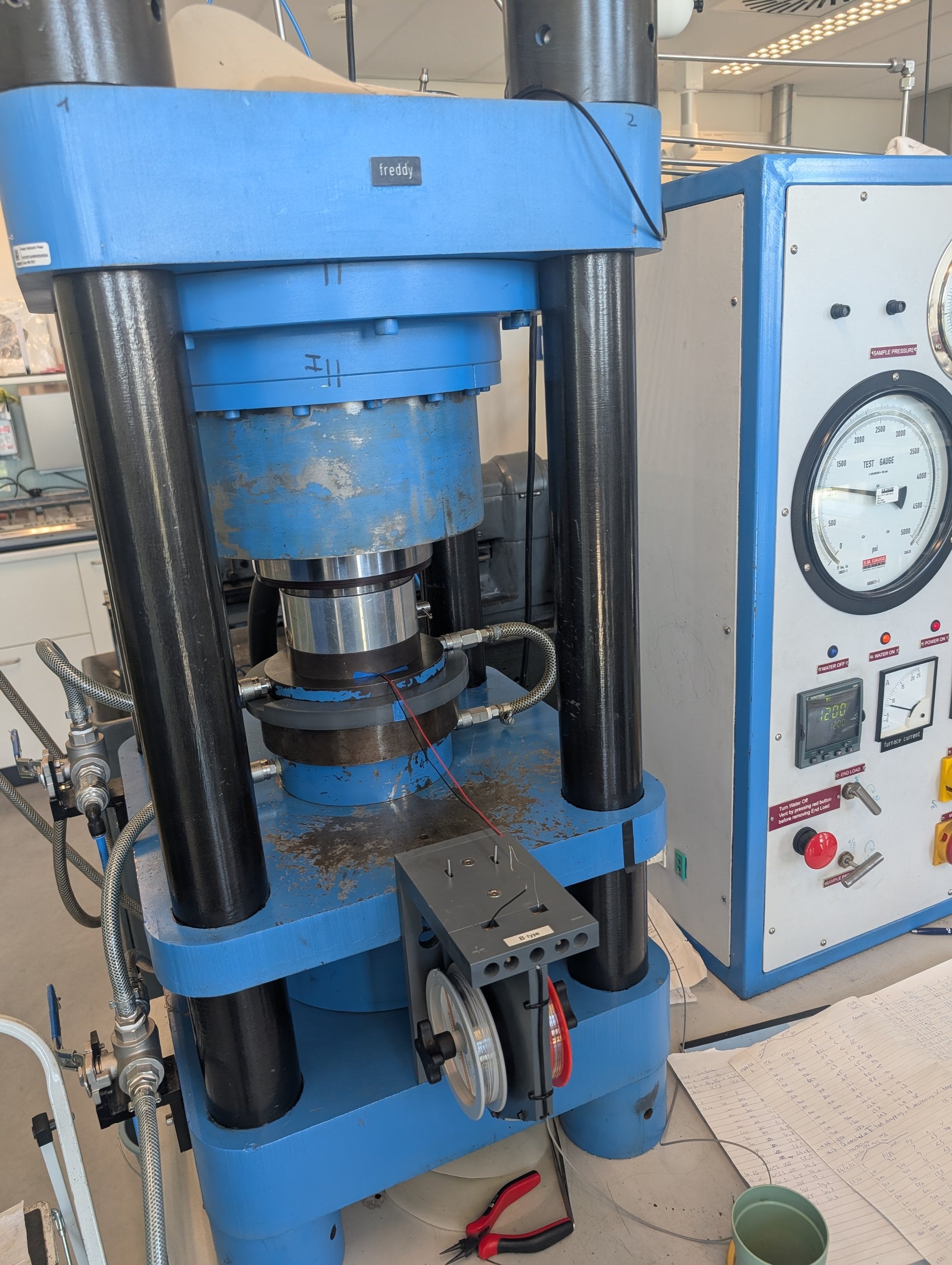 The high pressure and high temperature chamber in van Westrenen's lab. Credit: Bruce Dorminey
In the lab, van Westrenen and colleagues use resistive heating to send an electric current through graphite to heat a few cubic millimeters of material to temperatures of more than 1700 degrees Celsius. That’s some five times as hot as a conventional oven. The lab can also create pressures of 250,000 Earth atmospheres.
In contrast, the Moon’s maximum internal pressure is thought to be about 50,000 Earth atmospheres which allows the researchers to virtually travel to the middle of the Moon in the laboratory.
Even so, one of the key problems in understanding the formation of our Earth-Moon system is that although hydrodynamic numerical simulations create the current Earth- Moon system’s physical properties, they fall short in matching the known bodies chemical compositions.
All the classical simulations predict that the Moon should have a very different chemical composition from what we see, says van Westrenen. The Moon rocks are far more Earth-like than they should be, he says.
As For The size Of The Moon Forming Impactor?
The paradigm now is either Earth was almost done forming, and the Moon would have been the result of a small, Mercury-sized impactor that hit our planet at a high rate of speed and a high angle. Or at that time, Earth was only half made.
So, you would have to smash in another half Earth to complete the Earth to its current size, says van Westrenen. The Moon would then have formed from a small amount of completely mixed Theia/half Earth debris left orbiting the now-completed full Earth, he says.
After the impact, lighter silicate material is thought to have formed the Moon with denser material forming the Earth and descending to make the Earth’s large iron-rich core.
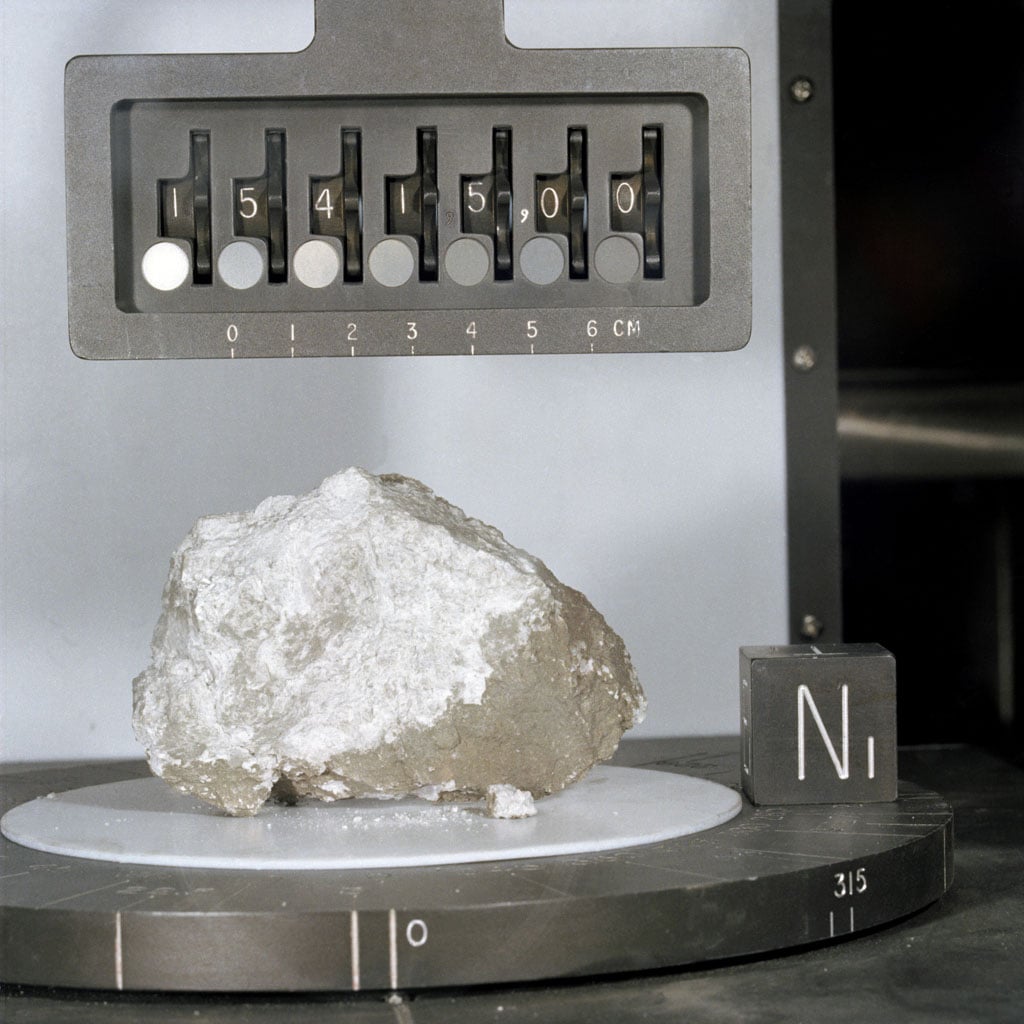 The Apollo 15 sample 15415, better known as the Genesis Rock. Credit: NASA
That's still correct, but these same classic 25-year-old models predict that most of the silicate rocks originated from Theia, not from Earth, says van Westrenen.
What would cause the moon to be mostly made up of Earth type material?
To make the Moon in a classic giant impact, Theia needs to hit Earth with a sort of glancing blow, where half of Theia misses the Earth, says van Westrenen. Half crashes into the side of the Earth while the other half sort of moves past and then goes into orbit around the proto-Earth which forms the Moon, he says.
But in this scenario, the Moon should be mostly made up of rocks from the Theia impactor. But that’s not what geologists see. Theia would have to have originated from elsewhere in the solar system; thus, its chemical makeup would be different from Earth. Yet Earth and the Moon remain strangely chemically similar.
The Bottom Line?
How the Moon formed is still not totally resolved, even though humans walked on its surface decades ago, says van Westrenen. Every human can see the Moon, but not everyone realizes that its formation is directly linked to our own planet's history, he says.