Universe Today
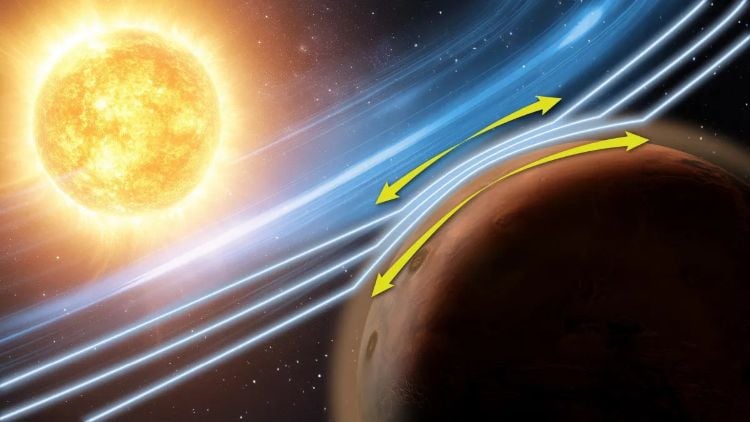
A cloaked alien invasion force is approaching Earth and coming up on Mars. The first officer looks through a viewfinder and says, “Captain, the fourth planet’s atmosphere is behaving strangely. As though it were trying to block incoming energy.” The captain takes a moment, then his (already big) eyes get wide and he exclaims, “It’s a defense shield! The Earthlings are hiding on the fourth planet and are prepared to attack us! Abort the invasion!” The first officer responds, “Aye aye, Captain!”
While the tale above is clearly fictionalized (aliens probably don’t say “Aye aye”), it briefly describes a unique atmospheric phenomenon called the Zwan-Wolf effect and occurs when the solar wind interacts with the Earth’s magnetic field, the latter of which shields the Earth from harmful space radiation. But now, a team of researchers have identified the Zwan-Wolf effect occurring on Mars. But, since Mars lacks a magnetic field, the Zwan-Wolf effect was found occurring within the Red Planet’s atmosphere, with scientists discussing these incredible findings in a recent study published in Nature Communications.
For the study, the researchers used NASA’s MAVEN (Mars Atmosphere and Volatile Evolution) spacecraft to analyze data obtained in December 2023 involving the solar wind interacting with the Martian ionosphere. A planet’s ionosphere is the region of the upper atmosphere comprised of positively charged ions and negatively charged electrons that is created from the solar radiation colliding with the planet’s upper atmosphere and breaking apart gas molecules, with their ions and electrons free to roam.
The Zwan-Wolf effect has been observed and studied to occur within Earth’s magnetic field for several years, as the effect causes the magnetic field to squeeze from the solar wind. However, this effect has never been observed on Mars since it lacks a magnetic field. Now, MAVEN successfully observed the Zwan-Wolf effect within the Martian ionosphere when a powerful solar storm struck the Martian atmosphere in December 2023. While the researchers hypothesized that the Zwan-Wolf effect could occur regularly on Mars, these regular occurrences are undetectable with current instruments, but this powerful solar storm produced a Zwan-Wolf effect strong enough for MAVEN to detect it.
“No one expected that this effect could even occur in the atmosphere,” said Dr. Christopher Fowler, who is an assistant researcher professor at the University of West Virginia and lead author of the study. “That’s what makes this even more exciting. It introduces interesting physics that we haven’t yet explored and a new way the Sun and space weather can change the dynamics in the Martian atmosphere.”
Along with using the Zwan-Wolf effect to learn more about the Martian atmosphere and how it interacts with the Sun and solar wind, this study could provide key insights into planets lacking a magnetic field. The only other planet in the solar system with an atmosphere and without a magnetic field is Venus, which lacks plate tectonics that prevents a magnetic field from forming. This prevents heat from circulating within Venus’ interior, also called convection, which is one of two characteristics required to produce a magnetic field. The other characteristic is a liquid iron core, which Venus possesses.
Launched in November 2013 and arriving at Mars in September 2014, the MAVEN spacecraft’s primary mission objective was to ascertain how Mars lost its atmosphere, whether currently or long ago when the atmosphere was much thicker than it is today. While MAVEN went silent for unknown reasons in December 2025, MAVEN confirmed a longstanding hypothesis that the Martian atmosphere was stripped away by the solar wind, resulting in the Red Planet losing its ability to maintain liquid water on its surface.
What new insights into the atmospheric effect on Mars will researchers make in the coming years and decades? Only time will tell, and this is why we science!
As always, keep doing science & keep looking up!