Universe Today
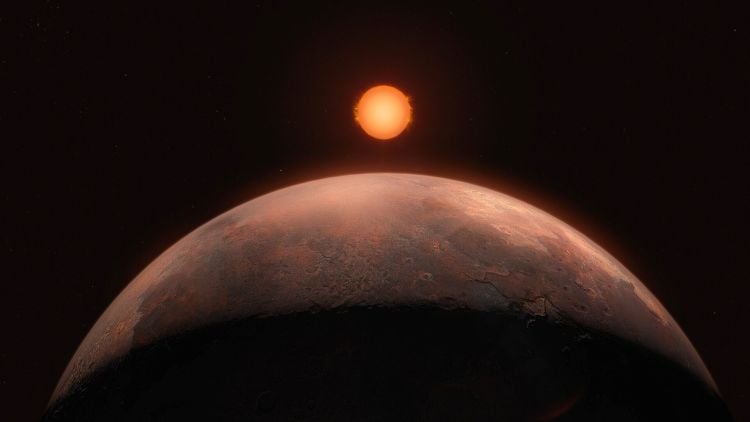
The criteria for finding an Earth-like planet unofficially comes down to two things: water and the habitable zone. But a phenomenon known as atmospheric escape often “escapes” the minds of many astronomy fans, and it turns out that atmospheric escape is one of the key characteristics for finding an Earth-like world. Although extensive research has been conducted on how the planet Mars might have lost its atmosphere, and potentially the ability to sustain life, how would the atmosphere enveloping a Mars-like exoplanet respond to stars different from our own?
Now, an international team of more than three dozen researchers might be one step closer to understanding atmospheric escape and how it not only influences planetary atmosphere evolution, but potentially the evolution of life. In a study recently submitted to The Astrophysical Journal, the collaborative team used computer models to simulate a Mars-like exoplanet (referred to as an exo-Mars in the paper) orbiting Barnard’s star, which is an M-type red dwarf star located approximately 6 light-years from Earth, about 14 percent the mass of our Sun, and is estimated to be between 7 to 10 billion years old.
For context, our Sun (which is a larger, G-type star) is approximately 4.6 billion years old. It is because of its age that Barnard’s star is so inactive compared to younger M-type stars, which exhibit larger solar flares and activity than our Sun. It is this inactivity compared to younger M-type stars that astronomers chose Barnard’s star to model their exo-Mars, the latter of which the team used the same planetary parameters as the planet Mars, including its same mass, radius, and thin carbon dioxide-heavy atmosphere.
However, the team placed their exo-Mars at a much closer orbital distance from Barnard’s star at 0.087 astronomical units (AU) compared to the actual Mars orbiting our Sun at 1.52 AU. The reason for this closer distance was to simulate the same level of solar activity and radiation as Mars receives from our Sun.
In the end, despite the less-active Barnard’s star, the researchers found that the atmosphere of exo-Mars would take approximately 350,000 years to remove a present-day Mars atmosphere enveloping exo-Mars and would take approximately 50 million years to remove an exo-Mars atmosphere equivalent to Earth’s atmosphere. While the team’s exo-Mars orbits just outside Barnard’s star’s habitable zone, they hypothesize that any planet orbiting within the habitable zone would likely have their atmosphere stripped like exo-Mars. Currently, Barnard’s star is estimated to have four small, rocky worlds orbiting inside the inner edge of the habitable zone, potentially putting the fates of their atmospheres even worse than the modeled exo-Mars.
The study notes, “Exo-Mars loses atmosphere very rapidly, and it is difficult to imagine that the four planets would lose atmosphere significantly more slowly than exo-Mars. Primary atmospheres seem similarly unlikely, since primary atmospheres are comprised of hydrogen and helium, which are lighter than CO2 [carbon dioxide] and thus should escape more easily, and were likely removed much earlier in the star’s evolution when the stellar XUV [X-ray/Extreme Ultraviolet] flux and wind rates were ∼ 100 times larger.”
Billions of years ago, Mars was hypothesized to have been a warmer and wetter planet, with vast rivers and large lakes of liquid water cascading across the Red Planet’s surface. While scientists estimate that these potentially habitable conditions existed for hundreds of millions of years, it is estimated that the Martian cooled significantly early in Mars’ history, resulting in a loss of volcanic activity and the magnetic field meant to shield the atmosphere and surface from the harsh solar radiation. Presently, Mars is a cold and dry world, devoid of liquid water or habitable conditions of any kind.
Studying how Mars-like worlds orbit and interact with other types of stars enables researchers to gain greater understanding into how life on exoplanets could form and evolve, and even how it might not come to pass. Additionally, studying how M-dwarf stars age and evolve is crucial for finding Earth-like exoplanets, as M-type stars are not only the most common type of star in the galaxy, but they also have lifetimes estimated to surpass our Sun by potentially trillions of years.
What new insight into Mars-like exoplanets and M-dwarf stars will researchers make in the coming years and decades? Only time will tell, and this is why we science!
As always, keep doing science & keep looking up!