Universe Today
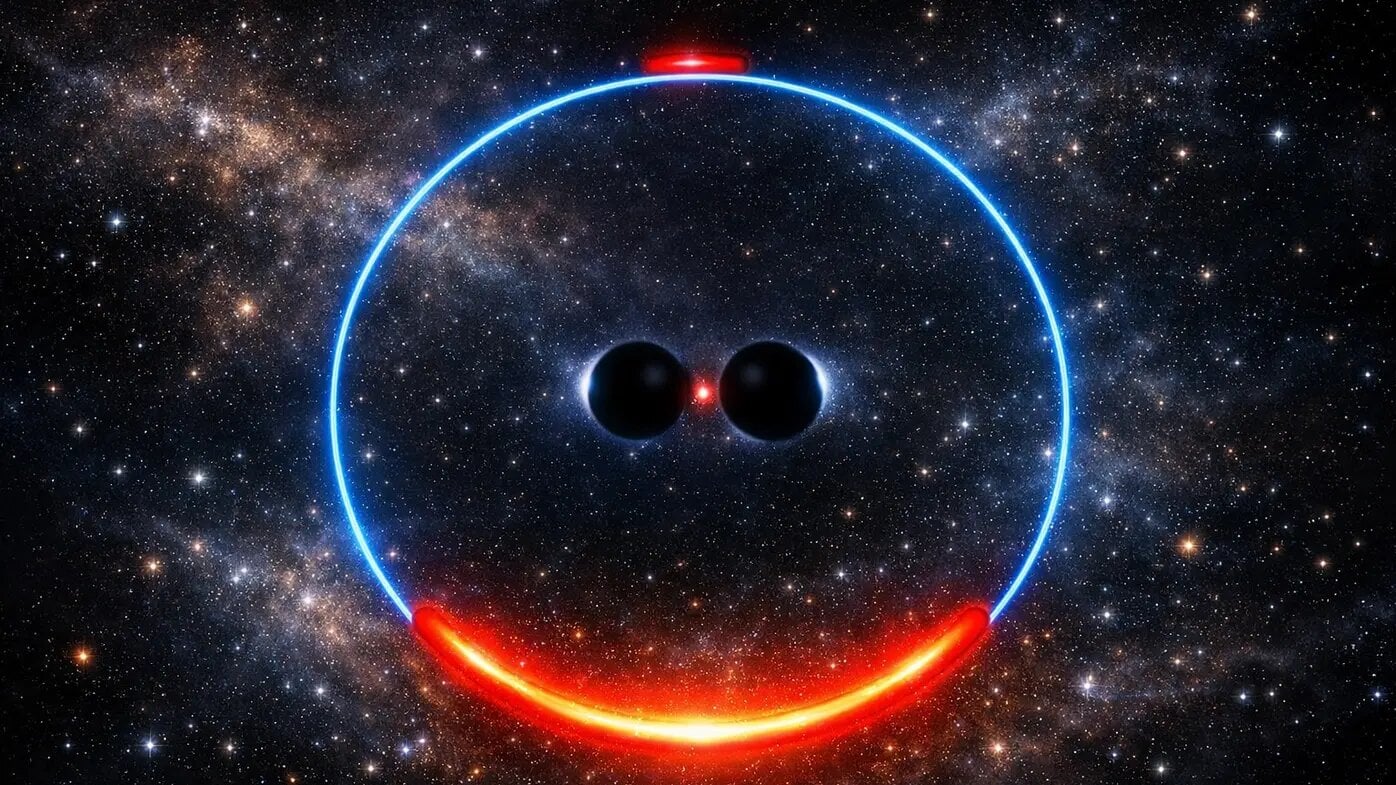
Most galaxies have a supermassive black hole at their center, but some galaxies have two. These supermassive binaries form when two galaxies collide and merge. We can detect some of these binaries, such as by observing the periodic changes of a quasar or by observing the binary directly, such as in the case of NGC 7727. But most supermassive binaries remain hidden. They are too far away to be observed directly or too inactive to be observed by jets. And while gravitational wave observatories can detect the mergers of stellar-mass black holes, we can't yet detect the mergers of supermassive black holes. But a new study shows how we might detect some of them.
The idea is based on gravitational lensing, where the mass of an object deflects a path of light similar to the way the glass lens of a telescope focuses starlight. Gravitational lensing is most commonly seen when a distant quasar is lensed by a foreground galaxy. A similar effect known as microlensing occurs when a mass passes in front of a more distant star.
In this case, the study looks at what would happen as the supermassive black holes orbit each other against the background of stars within their galaxy. The black holes always lens nearby starlight, but when the two black holes are positioned just so, they can act as a particularly strong lens. This could cause a background star to appear much brighter than usual. Since this alignment occurs every orbit or half orbit, the brightness would occur periodically.
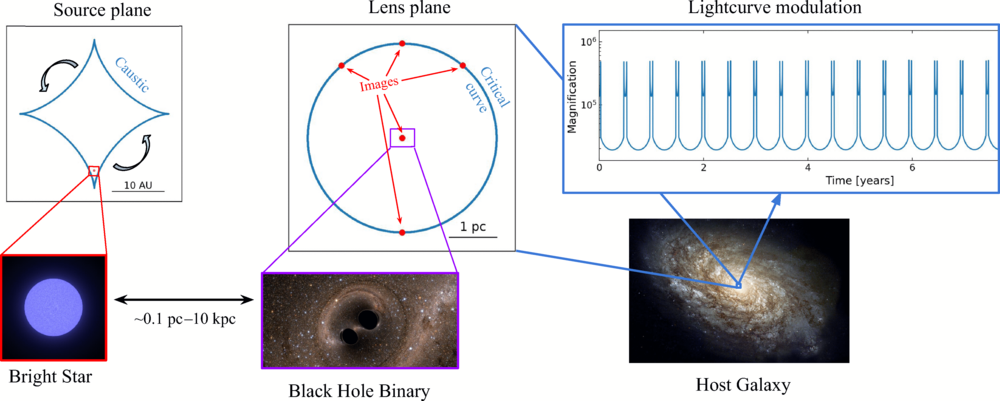 How binary black holes can gravitationally lens a background star. Credit: Wang, et al.
It's not quite this simple, since there could be more than one star with just the right alignment, and the black holes and stars are all moving, so alignments would change over time. But the authors show that quasiperiodic flashes could still occur. Based on simulations, the authors predict that, given our current technology, we should be able to detect quasiperiodic starlight flashes in about 50 nearby galaxies. The flashes should occur within periods of less than a decade or so.
Given that timescale, it's not surprising that we haven't detected this yet. You'd need to watch lots of galaxies over a long time frame. Fortunately, we will be doing exactly that in the near future. For example, the Vera Rubin Observatory will capture images of thousands of galaxies on the order of a few days. Not only will this capture the periodic flashes, it will allow astronomers to construct the shape of the black hole orbits in time. This will allow us to look for the gravitational waves of specific binaries as our gravitational telescopes improve.
Reference: Wang, Hanxi, Miguel Zumalacárregui, and Bence Kocsis. "Black Holes as Telescopes: Discovering Supermassive Binaries through Quasiperiodic Lensed Starlight." Physical Review Letters 136.6 (2026): 061403.