Universe Today
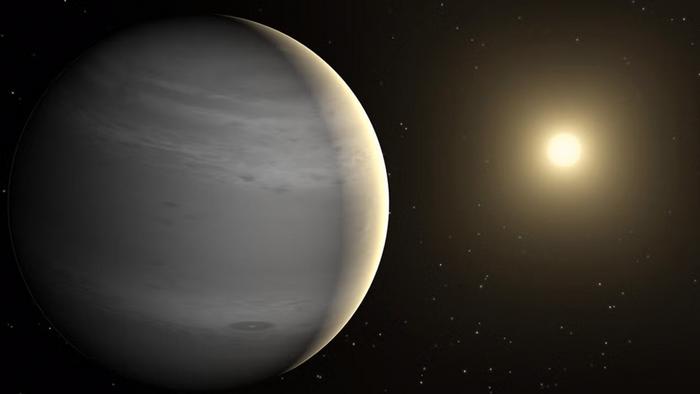
It’s 2165, and methane is in high demand, especially after the Titan Treaty of 2145 made it illegal to harvest methane from Saturn’s moon, Titan. But the advent of interstellar travel has made exoplanetary exploration far easier, enabling corporations to identify and harvest methane from exoplanets. However, it’s far cheaper and easier to harvest methane from exoplanets with reasonable (also called temperate) temperatures, because it means higher quantities of methane. The Exoplanet Exploration Corporation decides to send its first ship to one such exoplanet loaded with methane that could bring their quarterly financial statements back into the green.
The above fictionalized tale describes the Saturn-sized exoplanet TOI-199b, which is a gas giant located approximately 335 light-years from Earth, has a mass and radius of 0.17 and 0.81 Jupiters, respectively, and orbits a G-type star in 104.9 days. While this distance is inside the interior of the star’s habitable zone, it’s far enough away where its temperature is far cooler than typical gas giants that orbit close to their stars. As a result, TOI-199b’s temperature is approximately 79 degrees Celsius (175 degrees Fahrenheit) but exploration of these more temperate gas giant exoplanets has been slim pickings. However, a recent study published in The Astronomical Journal could shed light on these intriguing and (so far) rare worlds.
For the study, the researchers used NASA’s James Webb Space Telescope (JWST) to observe the atmosphere of TOI-199b as the planet passed in front of its host star. This is a method called transmission spectroscopy, with spectroscopy being the study of how matter interacts with light. Astronomers use transmission spectroscopy to study what molecules are present in an exoplanet’s atmosphere by observing the wavelengths of specific molecules that are absorbed by starlight, with their data displaying these molecules as being blocked out.
In the case of TOI-199b, the astronomers identified methane with its gaseous atmosphere. After comparing these findings to longstanding models of temperate gas giant exoplanets, the team found a match between both, confirming hypotheses about temperate gas giants containing methane. TOI-199b is also designated as the first temperate gas giant exoplanet containing methane, with carbon dioxide and ammonia being potential candidate molecules within the exoplanet’s atmosphere.
“With additional observations of this planet, we could establish the relative abundance of these various gases in its atmosphere,” said Dr. Renyu Hu, who is an associate professor of astronomy and astrophysics at Penn State University and a co-author on the study. “This more complete picture of a temperate gas giant’s atmosphere can then be used to improve our models and potentially better understand how planets and their atmospheres form and evolve, including for Earth. The success of this first study of a temperate giant planet’s atmosphere also gives us confidence to dedicate more resources and observation time to study other similar planets. We can then see if this planet is unique or if there are general shared characteristics for this type of planet.”
As noted, TOI-199b orbits its star in approximately 105 days. For context, Mercury and Venus orbit our Sun is 88 and 225 days, respectively, so TOI-199b’s orbit lies somewhere between both those planets. While the researchers note that TOI-199b is the first temperate gas giant exoplanet with methane, other exoplanets with varying temperatures that contain methane include WASP-80b, which is designated a “warm Jupiter” with approximate temperatures of 550 degrees Celsius (1,025 degrees Fahrenheit), and K2-18b, which is a sub-Neptune exoplanet with approximate temperatures ranging from -7 to 43 degrees Celsius (20 to 110 degrees Fahrenheit).
What new insights into TOI-199 b and other methane exoplanets will researchers make in the coming years and decades? Only time will tell, and this is why we science!
As always, keep doing science & keep looking up!