Universe Today
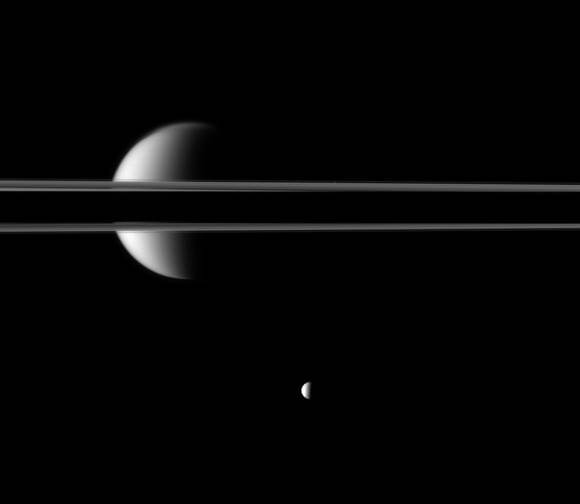
There's nothing up the sleeves of the Cassini imaging team in this image; it is real! Is the moon Titan being cut in half by Saturn's rings? What is actually happening here is that the middle part of the rings are made dark as Saturn casts its shadow across them. Cassini was just in the right place at the right time, making it appear as though Titan is being sliced in half! The night side of the planet is to the left, out of the frame of the image. Illuminated Titan can be seen above, below and through gaps in the rings. Click the image for a larger version.
As an added benefit in this shot, Mimas (396 kilometers, 246 miles across) is near the bottom of the image, and Atlas (30 kilometers, 19 miles across) can barely be detected near the thin F ring just above the center right of the image. Lit terrain seen here is the area between the leading hemisphere and Saturn-facing side of Titan (5,150 kilometers, 3,200 miles across). This view looks toward the northern, sunlit side of the rings from just above the ringplane.
Below are a few more magical images from Cassini:
Here the moon Enceladus appears strung along a wispy ring of Saturn, likely the G ring. Look close and Enceladus' plumes are visible, too.
Two of Saturn's small moons appear to be sitting on Satun's thin F ring in this image.
From the CICLOPS website:
Pandora (81 kilometers, 50 miles across) is on the left, and Epimetheus (113 kilometers, 70 miles across) is on the right. This view looks toward the northern, sunlit side of the rings from just above the ringplane. Both moons are closer to Cassini than the rings are. Pandora is slightly closer to Cassini than Epimetheus here.
The image was taken in visible light with the Cassini spacecraft narrow-angle camera on Nov. 23, 2009. The view was acquired at a distance of approximately 1.3 million kilometers (808,000 miles) from Pandora and Epimetheus. Image scale is 8 kilometers (5 miles) per pixel.
For more great images from Cassini (which I contend is actually an artist and not a magician!) go to the CICLOPS website and NASA's Cassini website.