Universe Today
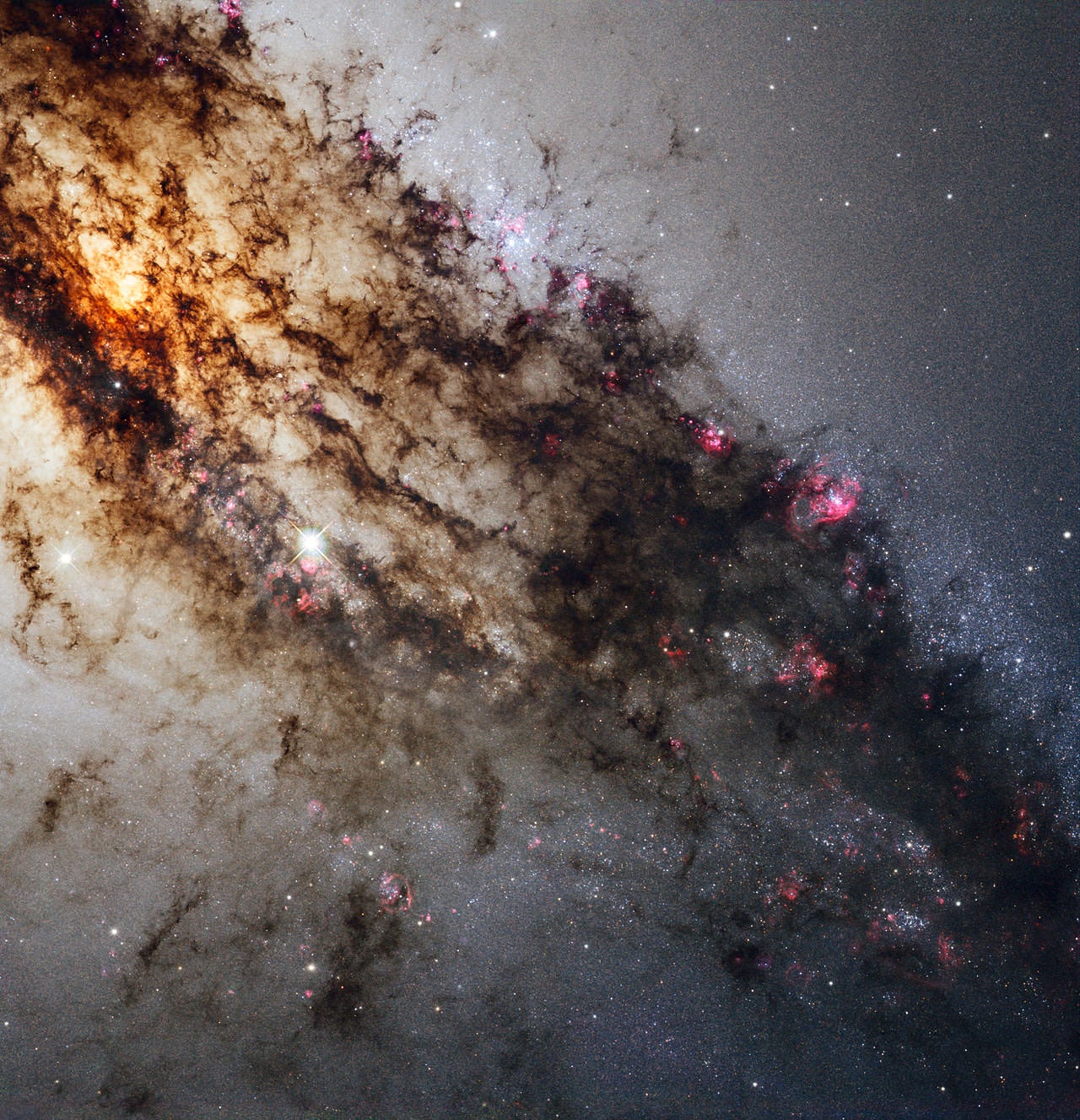
From a HubbleSite press release:
Resembling looming rain clouds on a stormy day, dark lanes of dust crisscross the giant elliptical galaxy Centaurus A. Hubble's panchromatic vision, stretching from ultraviolet through near-infrared wavelengths, reveals the vibrant glow of young, blue star clusters and a glimpse into regions normally obscured by the dust.
The warped shape of Centaurus A's disk of gas and dust is evidence for a past collision and merger with another galaxy. The resulting shockwaves cause hydrogen gas clouds to compress, triggering a firestorm of new star formation. These are visible in the red patches in this Hubble close-up.
At a distance of just over 11 million light-years, Centaurus A contains the closest active galactic nucleus to Earth. The center is home for a supermassive black hole that ejects jets of high-speed gas into space, but neither the supermassive or the jets are visible in this image.
This image was taken in July 2010 with Hubble's Wide Field Camera 3.