 Universe Today
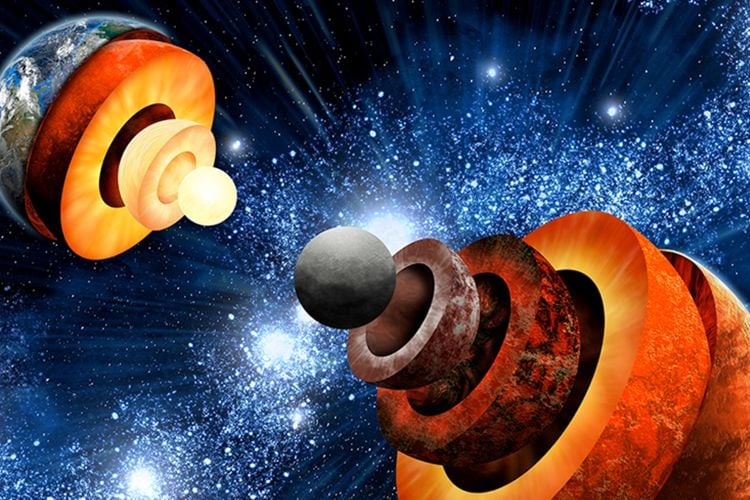
Studying the interiors of planets is essential for understanding planetary formation, evolution, and their ability to potentially host life as we know it. To accomplish this, researchers use a combination of Earth as an analog, computer models, meteorites, and data collected from other planetary bodies for studying their interior compositions. As a result, scientists have determined that the elements of magnesium and silicon are the most abundant planetary building blocks. And, under extreme pressures like the interior mantle of our planet, it forms magnesium oxide (MgO) crystals. But how does this same process occur under different pressures and temperatures on other planets like gas giants and larger rocky exoplanets called super-Earths?
Now, a collaborative team of researchers from the Lawrence Livermore National Laboratory (LLNL) and Johns Hopkins University might be one step closer to solving this conundrum. As discussed in a recent study published in Physical Review X, the researchers unveiled intriguing findings that could solve a 12-year investigation regarding the geochemical processes that occur deep inside planets, specifically related to the formation of magnesium oxide. This study is a third study in a series that builds off two previous studies, a 2015 study published in Physical Review Letters and a 2024 study published in Science Advances.
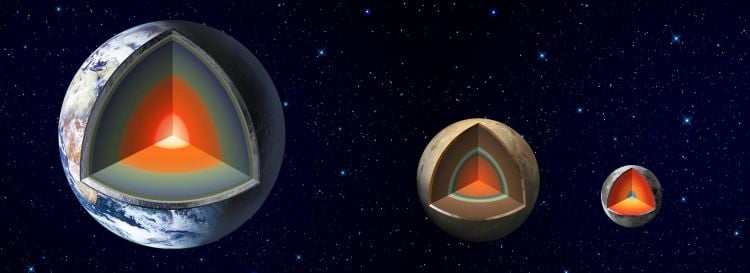 Artist's impression of the interior layers of Earth, Mars and the Moon. (Credit: NASA/JPL-Caltech)
For the study, the researchers conducted a series of laboratory experiments using lasers on a cubic crystal structure of magnesium oxide to compress and simulate the extreme temperatures and pressures it experiences in planetary interiors. For example, the researchers tested as high as 572 Gigapascals (GPa) and 13,000 Kelvin (K) (12,927 degrees Celsius/23,300 degrees Fahrenheit), which are much higher than the pressures and temperatures near the center of the Earth at about 360 GPa and 6,000 K (5,727 degrees Celsius/10,340 degrees Fahrenheit), respectively.
The laser compressed the MgO cube from various directions, which challenged longstanding scientific theories that the extreme temperatures and pressures made the direction of compression irrelevant. The three directions included diagonally along the face, perpendicular to a cube face, and along the diagonal through the face.
 Credit: NASA/Lunar and Planetary Institute
In the end, the researchers found that the direction of the incoming laser onto the MgO cube resulted in different responses regarding its compression. For example, while the cube’s transformation along the diagonal through the cube, whereas the other two directions resulted in different responses, specifically disordered and irregular crystal growth behind a shock wave from the compression. While this finding refuted longstanding theories regarding the behavior of crystals based on direction, the researchers also found that the MgO cube melted at 572 GPa and 13,000 K, which set a new experimental known material record for pressure and temperature.
“Magnesium oxide is an important ingredient in our understanding of planetary interiors,” said Dr. June Wicks, who is a professor in Johns Hopkins’ Department of Earth and Planetary Sciences and a co-author on the study. “These experiments help us determine where it can remain solid and where it becomes liquid, which matters for how planets transport heat and evolve.”
As noted, magnesium and silicon comprise the most abundant elements in planetary interiors, with its combined form of MgO revealing the temperatures and pressures of those same planetary interiors. The three main geologic layers of a rock planetary object are the crust, mantle, and core, with the Earth having a liquid outer core and a rocky inner core, with MgO forming near the bottom of the mantle near the core-mantle boundary. However, this process is different depending on the type of planet.
 Credit: NASA/JPL-Caltech
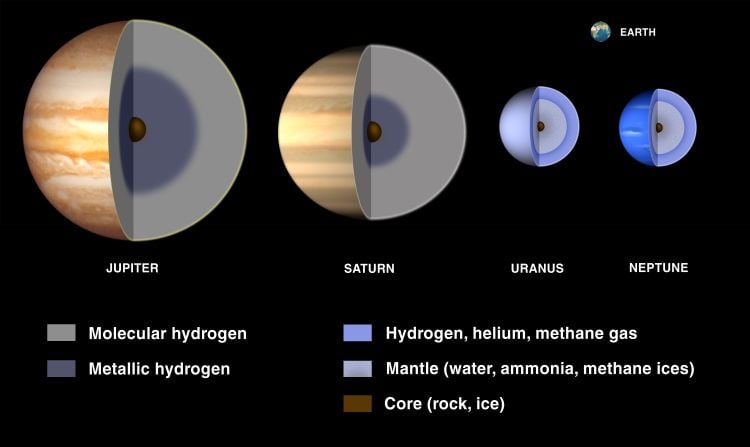
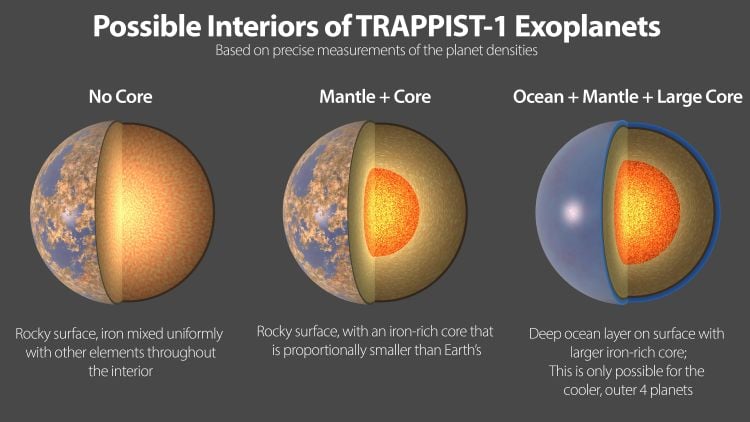
For example, on super-Earth exoplanets, MgO can transform into a conductive liquid within the mantle (whereas this conductivity exists within the Earth’s outer core), resulting in magnetic fields much stronger than Earth’s. Additionally, MgO on gas giants like Jupiter and Saturn can exist either as a solid or liquid deep within their cores and depending on the temperatures.
What new insights into planetary interior processes will researchers make in the coming years and decades? Only time will tell, and this is why we science!
As always, keep doing science & keep looking up!