Universe Today
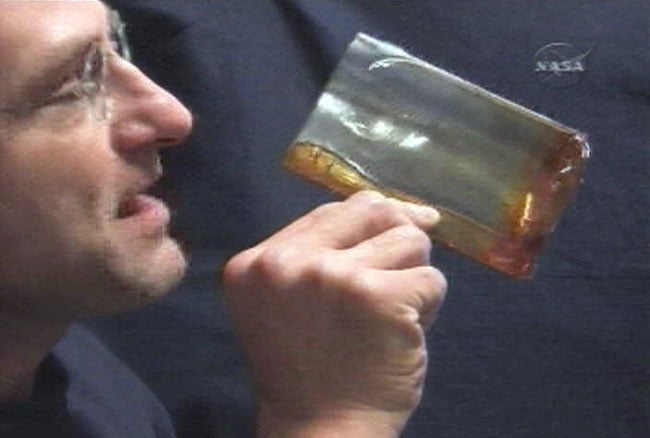
Seriously, for all you coffee addicts, this is science. You may recall how astronaut Don Pettit (known as Mr. Fixit in space) invented a
Zero-G coffee cup
. But there's an experiment on board the International Space Station called the Capillary Flow Experiment that is delving even further into how liquids behave in space.
Coffee is not the only liquid that behaves quite differently in space as opposed to on Earth. There are things like cryogenic fuels, thermal coolants, water and urine, too. As NASA says, "The behavior of fluids is one of the most un-intuitive things in all of space flight."
This poses a challenge for engineers designing spacecraft systems that use fluids. "Our intuition is all wrong," said physics professor Mark Weislogel of Portland State University, who working with the Capillary Flow Experiment. "When it comes to guessing what fluids will do in new systems, we are often in the dark."
Weislogel and his colleagues are now looking at interior corners on containers and how that affects liquid flow. Just like on Pettit's Zero-G coffe cup (see video below), if two solid surfaces meet at a narrow-enough angle, fluids in microgravity naturally flow along the joint —no pumping required.
NASA says this capillary effect could be used to guide all kinds of fluids through spacecraft, from cryogenic fuel to recycled waste water. The phenomenon is difficult to study on Earth, where it is damped by gravity, but on the space station large scale corner flows are easy to create and observe.
Who says coffee isn't like your morning rocket fuel!
See more at Science@NASA.