Universe Today
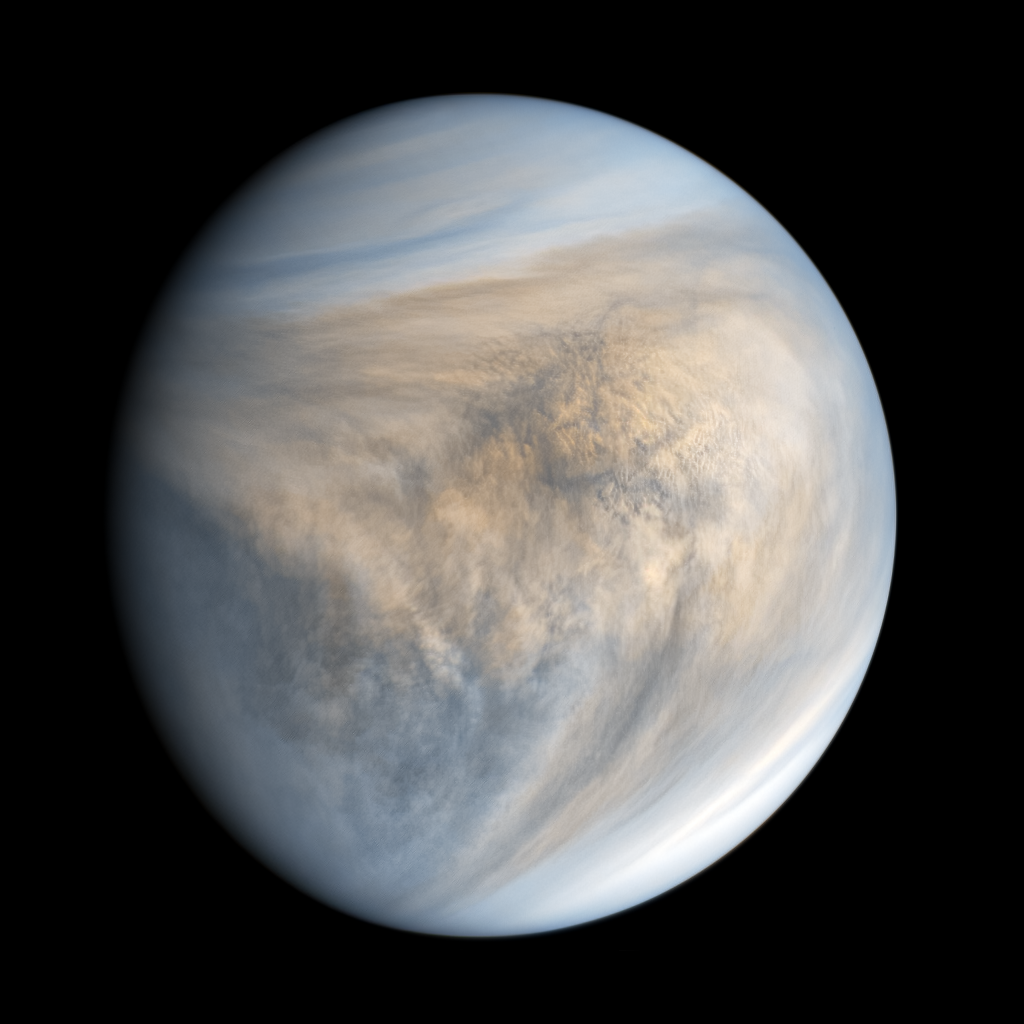
Preliminary results of a study presented at the recent European Geosciences Union General Assembly in Vienna indicate that hellish Venus-type planets may be about twice as common as habitable planets that form with oceans.
Preliminary work demonstrates that it's quite plausible to form a carbon dioxide dominated atmosphere after a magma ocean phase of the planet's evolution, Sean Jordan, a postdoctoral fellow in exoplanet studies at ETH Zurich in Switzerland, told me at the recent EGU26 conference in Vienna. So, it's expected that that these atmospheres should be quite common, he says.
As Jordan, the lead author of the study noted during his presentation, there are loads of rocky exoplanets since the galaxy is great at making rocks. And there are at least a few dozen that are considered potential extrasolar Venus like planets. But none have been confirmed as such.
Jordan and colleagues readily acknowledge that there's going to be lots of variability between extrasolar Venus-type planets. And even if they aren't geochemically or photochemically variable, since they are going to be found in all kinds of interstellar environments, they are also going to be found around a wide variety of host stars.
We just happen to harbor a Venus that sits interior to our solar system’s so-called habitable zone orbiting our Sun, a G-2 yellow dwarf star thought of as typical.
Our preliminary results demonstrate that it's quite easy to construct a model scenario where a Venus-like atmosphere forms, straight from their magma ocean phase of planetary evolution, says Jordan.
As For The Most Pressing Question?
At the moment, extrasolar researchers are discovering rocky bodies in close orbits around red M-dwarf stars. Trouble is, we don’t know if they have atmospheres and if they do, are they able to hold onto them for any length of time?
Perhaps in a few years' time we'll find out that none of these rocky exoplanets around M stars have atmospheres, says Jordan.
The question is whether in a given orbital space, a planet can hold onto its atmosphere in the face of its parent star’s high energy stellar radiation and particle fluxes that are continually stripping away that atmosphere.
This is why we can't say for sure whether we've detected a Venus-like atmosphere on an exoplanet yet or not, says Jordan.
But as Jordan pointed out in his EGU presentation, Venus science has long been hamstrung by a lack of data from the planet itself.
Venus has been criminally underexplored, but we still have a level of detail about the composition and chemistry of this deep atmosphere down to trace abundance gasses, Jordan noted in his talk.
As for those who scoff at spending more time and energy on a planet that heretofore has been seen as totally inhospitable?
There’s a real synergy between a more comprehensive understanding of our own Venus and a comprehensive understanding of the plethora of extrasolar Venuses that have yet to be confirmed orbiting other sunlike stars.
As Jordan puts it: “Our understanding of all the planets in the solar system and all the planetary processes in general is going to help inform what we expect to happen on exoplanets. As we discover more about exoplanets and their atmospheres, then this will contextualize everything we have here in the solar system that we can scrutinize in greater detail.”
As for those who wonder why Venus went ‘wrong,’ Jordan’s response is that it's not necessarily true that Venus ever went wrong; it could simply have been born that way.
 Venera 13 lander image. Credit: USSR/NASA via Wikipedia
It's much easier for us to build a model where we end up with Venus as it is straight out of a magma ocean phase of its early evolution and formation, says Jordan. But it's quite difficult to construct a model where it can form and condense oceans, and then go through the runaway greenhouse boundary, he says.
As for when to expect a better understanding of the number of exo-Venuses out there?
Assuming that at least some of the proposed missions to our own Venus happen, and that we get future space telescopes, it's going to take a couple of decades in order to truly answer this question, says Jordan.
Does the galaxy lend itself to making more inhospitable rocky planets that kind of straddle the inner boundary of the habitable zone than an Earth 2.0 which is clearly habitable on long time scales?
It's not like there's a preference for planets to orbit just inside the runaway greenhouse boundary compared to just outside of it, says Jordan.
The question is arguably more how planets form atmospheres and evolve to end up with an earth-like atmosphere that condenses water oceans and establishes a stable temperate climate over long timescales.
That's quite a delicate system, and it's possible that that's quite difficult to form in comparison to a more Venus-like atmosphere, says Jordan.