Universe Today
Our first satellites were little more than repeater stations that propagated our radio and tv signals around the world. But now we live in an age where a fleet of orbiting space telescopes and satellites seeks out and examines light from across the cosmos. When a powerful burst of energy flashes elsewhere in the Universe, satellites detect it, record it, and then scientists analyze it in excruciating detail.
In 2023, NASA's Fermi satellite detected a distant blast of high energy light, a gamma-ray burst (GRB) from a far-off group of galaxies. Gamma-ray bursts are the most luminous and energetic explosions in the Universe. They can only be generated in extreme situations.
Many types of objects in the cosmos have their extreme sub-types. Quasars are the extreme version of active galactic nuclei, for example, and hypernovae are like an extreme version of supernovae. Neutron stars are extremely dense versions of stars, though they're more like stellar remnants.
When two extremely dense neutron stars crash into each and merge, they release an enormous amount of energy as a kilonova explosion. That generates a short gamma-ray burst (GRB), and gravitational waves. But they do something else, too, that's very important to the Universe: they forge heavy elements like gold.
The GRB detected in 2023 is named GRB 230906A. The Chandra x-ray observatory and the Hubble teamed up to pinpoint its location and the results of those observations and analysis are in new research in The Astrophysical Journal Letters. It's titled "A Merger within a Merger: Chandra Pinpoints the Short GRB 230906A in a Peculiar Environment." The lead author is Simone Dichiara, assistant research professor of astronomy and astrophysics at Penn State University.
 This is the Fermi/GBM light curves of GRB 230609A in two energy bands: 8–100 keV are hard x-rays and 400–10,000 keV is gamma-rays. The purple shaded regions highlight the first peak and the main episode. Image Credit: Dichiara et al. 2026. ApJL
"We report the precise X-ray localization of GRB 230906A, a short-duration (T90 ∼ 0.9 s) gamma-ray burst (GRB) with no optical or radio counterpart," the researchers write. Only the Chandra Observatory has the power to pinpoint the x-ray location, and it took deeper examination by the Hubble to reveal a faint galaxy at the position of the x-ray localization. "Compared with standard GRB galaxies, its faintness, compact size, and color would suggest a high-redshift (z ≳ 3) host," the authors explain.
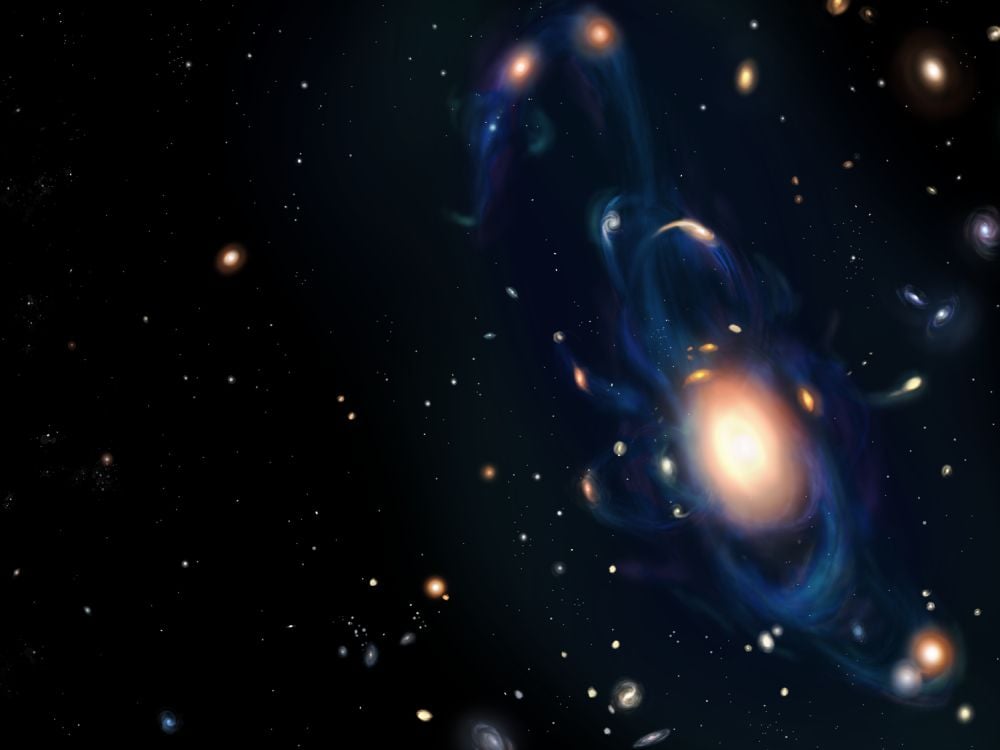
But their observations didn't end there. Next, the researchers used the Very Large Telescope (VLT) and its Multi-Unit Spectroscopic Explorer (MUSE) to examine the region. Those observations showed that the faint galaxy detected by the Hubble wasn't alone. It was part of a group of galaxies "with clear signs of interactions and mergers among group members," according to the authors. The group is about 8.5 billion light-years away.
The researchers found that the GRB came from a galaxy in an extended tidal stream of gas, dust, and stars almost 600,000 light-years long that comes from the galaxy group's central member. "The probability of a chance alignment is small; we thus argue that the GRB and its galaxy reside within the group," the authors write.
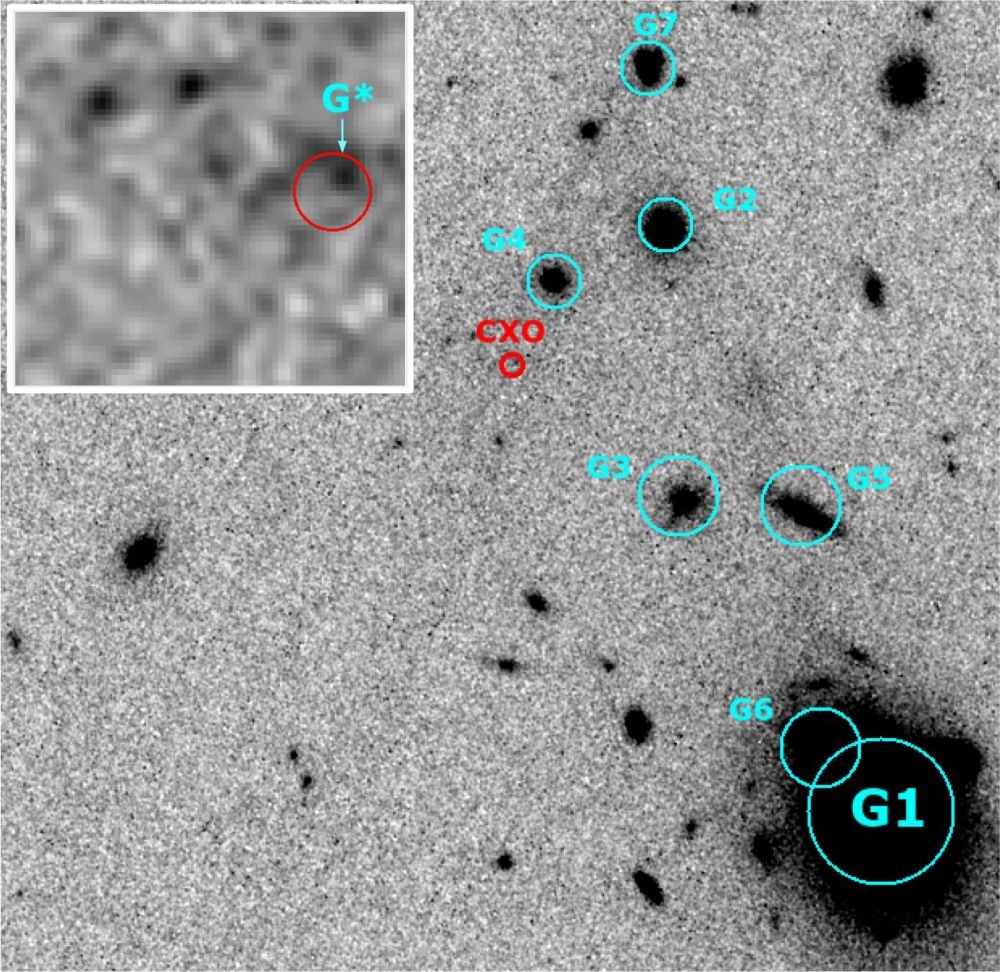 This Hubble image shows the GRB 230906 field. The red circle is where the Chandra localized the GRB. A zoom-in on the putative host galaxy is shown in the upper left insert. The other galaxies are labelled in order of the likelihood that they hosted the neutron star merger, with G1 being most likely. Unmarked galaxies have an extremely low probability of being the host. Note that the tidal stream is not visible in this image. Image Credit: Dichiara et al. 2026. ApJL
When galaxies merge, the action creates long tails and streamers of stirred up gas. These are easily visible in many telescope images of merging or interacting galaxies. These streams are ideal conditions for star formation, where gas is compressed into dense knots that become stellar cores, and eventually stars.
The researchers say that this is a peculiar location to find a small galaxy and a GRB. "The identification of a galaxy group within a GRB field is not a common occurrence," they explain. They think that the stream hosted an enhanced burst of star formation, and that around 700 million years ago, a compact binary star formed that was the progenitor to a pair of supergiant stars. These stars eventually exploded as supernovae, leaving behind a binary neutron star. The binary neutron stars were caught in a mutual death spiral, and when they eventually merged the event released the short GRB detected by Fermi.
“This could be an indication that tidal interaction between galaxies can trigger star formation and two neutron stars that evolve from the new stars can end up merging into each other, making these big explosions and energetic emissions that we observe,” lead author Dichiara said in a press release.
There was more to the merger than GRB 230906A. Neutron star mergers create kilonova explosions that foster what's called the r-process. r-process refers to rapid neutron capture, nuclear reactions that create about half of the atomic nuclei heavier than iron. Basically, before an unstable nuclei can decay, the r-process lets the nuclei capture another neutron and become stable. This is one way Nature generates elements like gold and other heavy elements.
“This could provide a natural explanation for why we see an enhanced rate of production of heavy elements in the halo of interacting galaxies,” Dichiara said.
One of the most amazing realizations one can have concerns massive stars, their exotic behaviour and interactions, and life on Earth. At some point in the past, in the vicinity of where our Sun formed, neutron stars merged and exploded in a kilonova explosion. Those explosions generated some of the atoms that not only formed Earth, but are part of our individual bodies now.
“We got a rare glimpse into how destruction can be a catalyst for creation,” said paper co-author Jane Charlton, professor of astronomy and astrophysics at Penn State. “The gold that we have on Earth was produced in an explosive event of this nature. The heavy elements in our body, like iron for example, come from about 10,000 stars that were in our galaxy and died. It took billions of years, but that iron persisted on Earth and, as our bodies formed and evolved, they used that material.”
This merger, kilonova explosion, and GRB occurred at an extreme distance from us, and the exact distance isn't clear. But future observations could determine it more accurately, if we keep building better infrared space telescopes that can measure redshift with greater accuracy.
So does it make sense to hunt for neutron star mergers and GRB in merging galaxies? Possibly. Galaxy mergers aren't exactly common, but there are plenty of examples of them, and that could be where astrophysicists find more GRBs.
“It's very common for galaxies to have neighbors. That's not unusual at all, but having them collide is,” said Charlton. “Our own Milky Way galaxy has a neighbor, the Andromeda galaxy, and four or five billion years from now, it will merge with the Milky Way galaxy. This very thing could be happening, and tidal tails will form, kicking up heavy elements and enriching the universe.”