 Universe Today
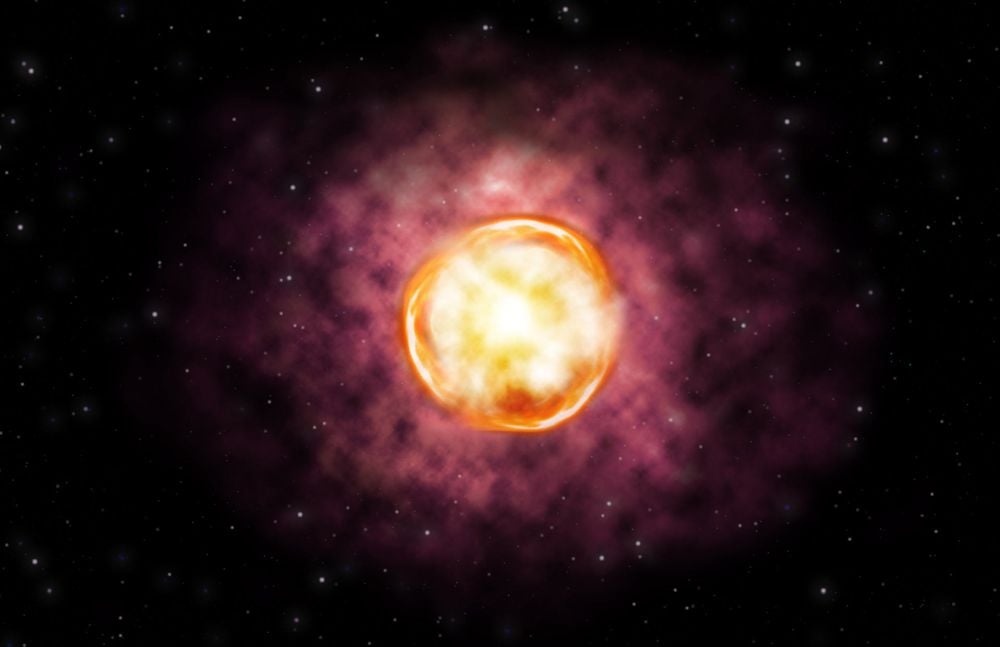
When the first gravitational wave (GW) was detected back in 2015, scientists said they had opened a new window into the Universe. While most of astronomy is based on detecting electromagnetic energy, GW are different. They're ripples in spacetime predicted by Einstein.
GW detectors have let us detect mergers between black holes (BH), which emit GW when they collide. Astronomers can use these waves to determine the masses of the black holes. There have been hundreds of GW detections now, and collectively, they're like a census of BH masses.
Astrophysical theory shows that massive stars between about 50 and 130 solar masses should collapse and become black holes. So there should be black holes detectable in this range. But gravitational wave observations show that stellar BH with more than about 45 solar masses are extremely rare. It's called the Forbidden Gap. What can account for this?
New research in Nature may have figured it out. It's titled "Evidence of the pair-instability gap from black-hole masses," and the lead author is Hui Tong. Tong is from the School of Physics and Astronomy at Monash University in Australia.
"Stellar theory predicts a forbidden range of black-hole masses between ∼50–130 M⊙ due to pair-instability supernovae, but evidence for such a gap in the mass distribution from gravitational-wave astronomy has proved elusive," the authors write.
But that's changing thanks to the GW census. It shows that BH above about 45 solar masses are, in fact, rare. The gap shows that something is preventing BH in this mass range from forming. There's a lot going on inside massive stars, and some of what happens there can explain the gap.
Stars are balancing acts between the outward pressure of fusion and the inward force of gravity. In main sequence stars, these forces are balanced. But over time, gravity wins this battle inside massive stars. The core eventually collapses and forms a black hole.
But the extreme temperatures inside the most massive stars create an environment different from stars with more modest masses. In this environment, atomic nuclei and gamma rays can collide and create electrons and positrons. This lowers the star's internal pressure, leading to its collapse. But instead of collapsing into a black hole, it explodes as a pair-instability supernova, a predicted type of supernova. The explosion is so powerful that the star is completely destroyed.
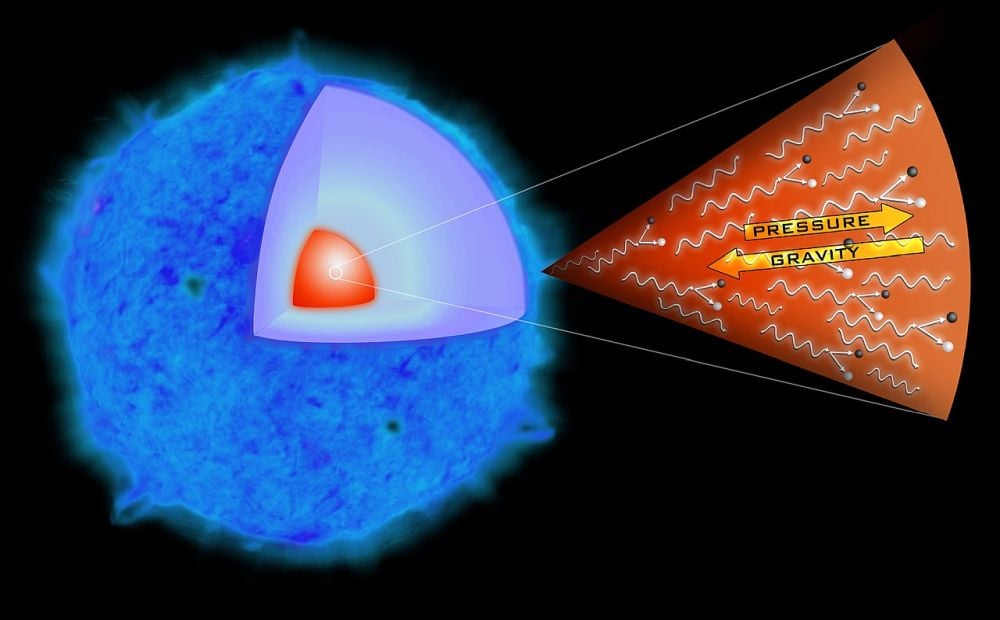 This image illustrates what happens inside a pair-instability supernova. In a very massive star, gamma rays produced in its core can become so energetic that some of their energy is drained away and produces pairs of electrons and positrons. This lowers the star's radiation pressure, and the star partially collapses under its own powerful gravity. After the collapse, runaway thermonuclear reactions (not shown here) occur and the star explodes. Nothing, not even a black hole, is left behind. Image Credit: By NASA/CXC/M. Weiss - http://chandra.harvard.edu/photo/2007/sn2006gy/more.html, specifically http://chandra.harvard.edu/photo/2007/sn2006gy/sn2006gy_ill.tif, Public Domain, https://commons.wikimedia.org/w/index.php?curid=2082949
The critical point is that not even a BH is left behind. This creates the BH forbidden mass gap. If pair-instability destroys stars of a certain mass, then BH with the same mass should be absent.
The story would be relatively simple if it ended there. But it doesn't. Astronomers still find a few BH in the mass gap. Where do they come from?
The answer is binary black holes. "While the gap is not present in the distribution of primary masses m1 (the bigger of the two black holes in a binary system), it appears unambiguously in the distribution of secondary masses m2, where m2 ≤ m1," the authors write. In this situation, the secondary BH is likely more "pristine" while the primary may be the result of a previous merger. The BH spin rates tell the tale.
"The location of the gap lines up well with a previously identified transition in the binary black-hole spin distribution; binaries with primary components in the gap tend to spin more rapidly than those below the gap," the authors explain. They say that thier findings support the idea that there's a sub-population of hierarchical BH mergers. In some binaries, the primary BH is the product of a previous BH merger. These are the ones that populate the Forbidden Gap.
The few BH that seem to ignore the no trespassing signs in the Forbidden Gap create a new mystery in astrophysics. It suggests that astrophysical models are incomplete.
The naturally-occuring questions are how common are these extreme pair-instability explosions? How efficiently do BH grow through mergers?
Only more sensitive GW detectors can answer those questions, along with an even larger sample of gravitational waves.

