 Universe Today
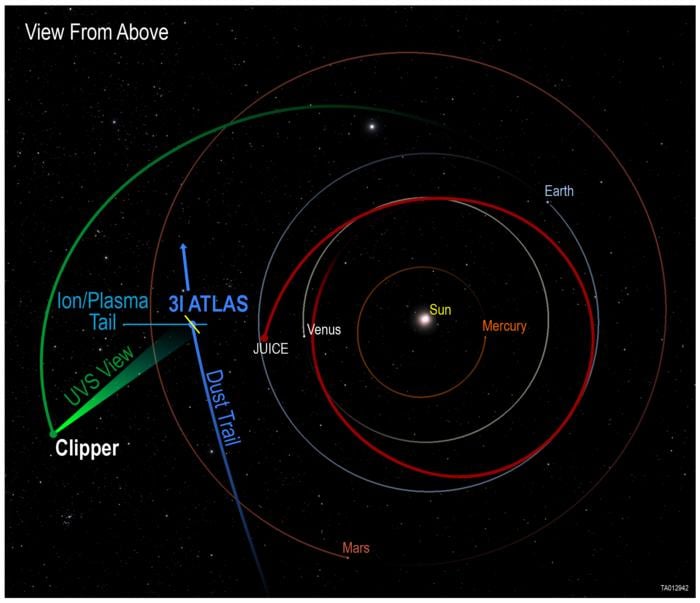
Researchers have been trying to look at interstellar object 3I/ATLAS from every conceivable angle. That includes very unconventional ones. Recently, while 3I/ATLAS passed out of view of the Earth, it moved into a great vantage point for one of our interplanetary probes. Europa Clipper, whose main mission is to explore Jupiter’s active moon, turned its gaze during its six-year journey back towards the center of the solar system and observed 3I/ATLAS as it was reaching its perihelion, and out of sight from the Earth.
Realizing that it could do so did not take long. Only a week after first finding this interstellar visitor, rocket scientists at NASA’s Jet Propulsion Laboratory had mapped its entire trajectory through the solar system. Armed with that information, Europa Clipper’s operational team realized the craft would have a unique vantage point during the later part of this year.
As it makes its way to Jupiter, it is currently curving slightly outside the orbit of Mars. 3I/ATLAS is making its way past the Red Planet, passing slightly inside its orbit, and has already garnered plenty of attention from instruments based there. But, Europa Clipper has some instruments that are uniquely well suited to studying the intricacies of the comet, and it just so happened to be able to observe it after it had moved out of sight from Mars, but before it was again visible from Earth.
The Ultraviolet Spectrograph (UVS) was originally designed to analyze the composition of Europa’s atmosphere and surface. But for the purposes of comet observation, it can detect transitions from atoms and molecules, such as when water breaks into hydrogen and oxygen.
Fraser discusses the actual science behind 3I/ATLASInsights like those are particularly critical, as from its vantage point, Europa Clipper was able to see the comet’s two “tails”. One, which follows behind the comet’s path, is made up primarily of dust parts that have fallen off the comet itself. The other, which extends from the comet directly away from the Sun, is made up of particles that have been directly plasmatized by the Sun’s rays.
Both of these tails are of interest to scientists, as they offer some of the best clues both to what 3I/ATLAS is made of and the chemical processes that are happening on the comet as it passes close to a star for the first time in potentially billions of years. Tracking how closely those processes conform to expectations of how they work in our own solar system is one of the critical insights that 3I/ATLAS can give us about the makeup of the galaxy outside our own neighborhood.
Europa Clipper also won’t be the only craft observing our visitor during that critical gap in observations from Earth and Mars-based platforms. The Jupiter Icy Moon Explorer (JUICE), operated by ESA, also happened to be in position to observe 3I/ATLAS at the same time, but from a more typical view looking away from the Sun, as it passes back through Earth’s orbit on its way out to Jupiter. JUICE has its own version of the UVS instrument, and the additional data from a different angle will inherently complement that taken by Europa Clipper.
Fraser discusses 3I/ATLAS's perihelion, around the time of the Europa Clipper observations.This extra observational time from these two space probes is honestly just lucky - if they happened to be further on in their journey, they wouldn’t have such a front-row seat to this once-in-a-lifetime flyby. While the results and analysis from this event haven’t yet been published, it likely will be in the next few months. Granted, they probably won’t stop sensationalists from continuing to claim that 3I/ATLAS is some sort of alien spacecraft, but as we continue to gather more evidence that it’s not, both Europa Clipper and JUICE will play a critical role in proving that something unforeseen didn’t happen when the object was blocked from our sight from other vantage points. And before long, Europa Clipper itself will pass through the comet's dust tail - who knows what additional observations it will be able to make from that unique vantage point.
Learn More:
SwRI/Eureka Alert - Europa Clipper instrument uniquely observed interstellar comet 3I/ATLAS
UT - Hera And Europa Clipper Will Pass Through 3I/ATLAS' Tail
UT - Astronomers Pinpoint 3I/ATLAS's Path Based on Data from Mars

