 Universe Today
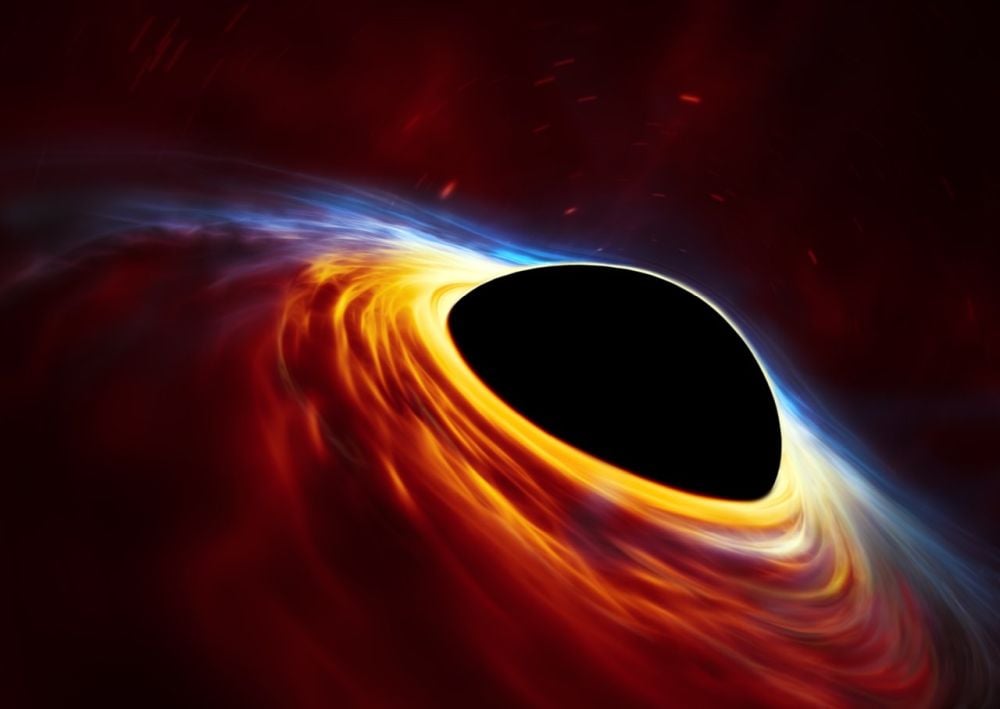
We know dark matter is out there. It's just a placeholder term for something we don't understand, some ghostly mass that explains how galaxies rotate so quickly without flying apart.
Fritz Zwicky coined the term 'Dark Matter' based largely on his observations of galaxies in the Coma Cluster. Zwicky found that the galaxies were moving rapidly. After calculating the masses of these galaxies from all of their stars and dust, he realized that they weren't massive enough to hold themselves in the cluster. They should fly apart and the cluster should disintegrate.
But they don't fly apart, and Zwicky said that some unseen type of mass must be present to account for that, and he called it dark matter. The idea wasn't widely accepted at that time and remained a curiosity for decades.
Then in the 1970s, Vera Rubin and Kent Ford examined individual spiral galaxies and measured how fast their stars were moving around the galactic center. Stars furthest from the center should move more slowly than those nearer the center, because more mass is concentrated in the center. But that's not what they found. They found that the rotation speed of stars was surprisingly consistent no matter how far from the center they were. That means the outer stars were also moving fast, so fast that they should fly off into intergalactic space. Galaxies should tear themselves apart.
![This is a fairly typical rotation curve for a spiral galaxy named UGC11455. Velocity is on the vertical axis, and distance from center is on the horizontal axis. The solid black line is what the curve should be if the galaxy contained only normal, baryonic matter, meaning stars and gas. The blue symbols are measurements of the actual speed of the stars and gas in the galaxy at different distances from center. Unseen dark matter accounts for the gap between the two. Image Credit: By ScienceDawns - Own work. Data from.[1][2], CC BY-SA 4.0, https://commons.wikimedia.org/w/index.php?curid=180471173](/article_images/Rotation_Curve_UGC11455_20260630_170944.jpg) This is a fairly typical rotation curve for a spiral galaxy named UGC11455. Velocity is on the vertical axis, and distance from center is on the horizontal axis. The solid black line is what the curve should be if the galaxy contained only normal, baryonic matter, meaning stars and gas. The blue symbols are measurements of the actual speed of the stars and gas in the galaxy at different distances from center. Unseen dark matter accounts for the gap between the two. Image Credit: By ScienceDawns - Own work. Data from.[1][2], CC BY-SA 4.0, https://commons.wikimedia.org/w/index.php?curid=180471173
This is a fairly typical rotation curve for a spiral galaxy named UGC11455. Velocity is on the vertical axis, and distance from center is on the horizontal axis. The solid black line is what the curve should be if the galaxy contained only normal, baryonic matter, meaning stars and gas. The blue symbols are measurements of the actual speed of the stars and gas in the galaxy at different distances from center. Unseen dark matter accounts for the gap between the two. Image Credit: By ScienceDawns - Own work. Data from.[1][2], CC BY-SA 4.0, https://commons.wikimedia.org/w/index.php?curid=180471173
This became known as the galaxy rotation problem.
Rubin's and Ford's work was influential. Only more mass could solve the galaxy rotation problem, and the idea of dark matter became widely accepted. It was a new type of non-baryonic matter that didn't interact with light. That's not much of a description, and dark matter's exact nature is still a mystery. Rubin's work confirmed the existence of dark matter, and people are still working on it, still debating ideas about its nature.
Though dark matter can only be detected by its gravitational effect on normal mass like stars and gas, (and by bending spacetime in gravitational lensing) that effect can be detected and measured. We've known about dark matter halos around galaxies since the 1970s. They're the invisible spheres that lead to the formation of galaxies, like invisible scaffolding. We also know that dark matter is the structural backbone for the large-scale structure of the Universe.
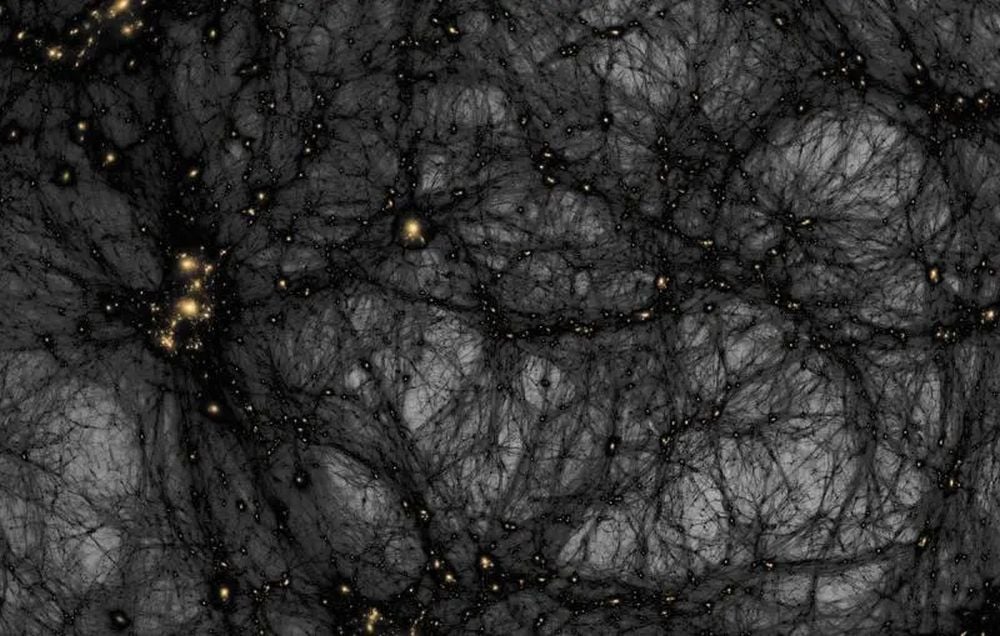 This artist's illustration shows how dark matter is the backbone of the Universe. Its network of filaments is the structure upon which galaxies and galaxy groups and clusters form. Image Credit: Ralf Kaehler/SLAC National Accelerator Laboratory, American Museum of Natural History
But now there's evidence that dark matter also gathers around supermassive black holes (SMBH). It's in new research in Physical Review D titled "Novel method to trace the dark matter density profile around supermassive black holes with AGN reverberation mapping." The lead author is Mayank Sharma, a Virginia Tech graduate student in physics.
SMBH are densities that drag and warp space-time itself. Gas and dust fall toward them, forming a heated, rotating accretion disk. We can see it happening by the bright flashes that erupt from heated material, some of which is drawn beyond the event horizon. Those flashes travel across the Universe, sometimes taking billions of years to reach us.
In this work, Sharma and his colleagues show that along with all of the regular matter that is drawn toward SMBH, creating the ancient, distant light shows, dark matter would be, too.
They used a technique called 'reverberation mapping' to measure how much dark matter is near SMBH in other galaxies. "We propose a new method to determine the dark matter density profile in the vicinity of distant supermassive black holes (SMBHs) using reverberation mapping (RM) measurements of active galactic nuclei (AGN)," the authors write. "The mapping of multiple emission lines allows the measurement of the enclosed mass within different radii from the central SMBH, which can be used to infer or constrain the dark matter density profile on subparsec scales."
Light from an AGN comes in two separate pulses. The first is directly from heated material in the accretion disk. The second comes when that initial pulse slams into the surrounding interstellar medium (ISM). That material then re-emits the light like a sound echo.
Astronomers can detect the first pulse and then the second one a moment later. Light moves at a constant speed, so the delay between the two pulses tells them how far away from the SMBH the gas is. Based on the relationship between lightspeed, distance, and mass, they were able to measure the amount of dark matter near the SMBH. They did this for 14 galaxies.
“These galaxies are definitely showing a hint that there is extra material that cannot be explained by just the supermassive black hole,” lead author Sharma said in a press release.
So far, these results are only a hint that dark matter gathers near SMBH. "We find that for five objects, the observed enclosed mass does grow with radii, hinting towards the presence of a dark matter component at the 1-2σ level," the authors write. The researchers say this is evidence for "a universal dark matter profile." But they also point out that it's only weak-to-moderate statistical evidence for some amount of dark matter close to the five SMBH.
"We stress, however, that the majority of sources in our sample do not show preference for a model with increasing mass over a constant mass model," the authors write.
The researchers also say that despite the weak or moderate evidence that their study provides, the method they used may turn out to be more fruitful in the future. "Our work establishes the first link between the observational technique of RM and the theoretical framework of dark matter spikes, both of which aim to study the same spatial scales in extragalactic SMBHs," they explain.
Finding more dark matter near SMBH doesn't change cosmology. It doesn't change how much dark matter there is in the Universe, and it doesn't favour or disfavour the Lambda-CDM framework. It just changes how dark matter is distributed in the Universe. The dark matter in these galaxies is already accounted for in the halo, these results just show that more of it could be concentrated around a galaxy's SMBH.
But if these dark matter spikes are real, it turns SMBH into a sort of dark matter lab. It's another location or situation where physicists can study it. These results could feed into models of SMBH growth, or even into dark matter particle detections.

