Universe Today
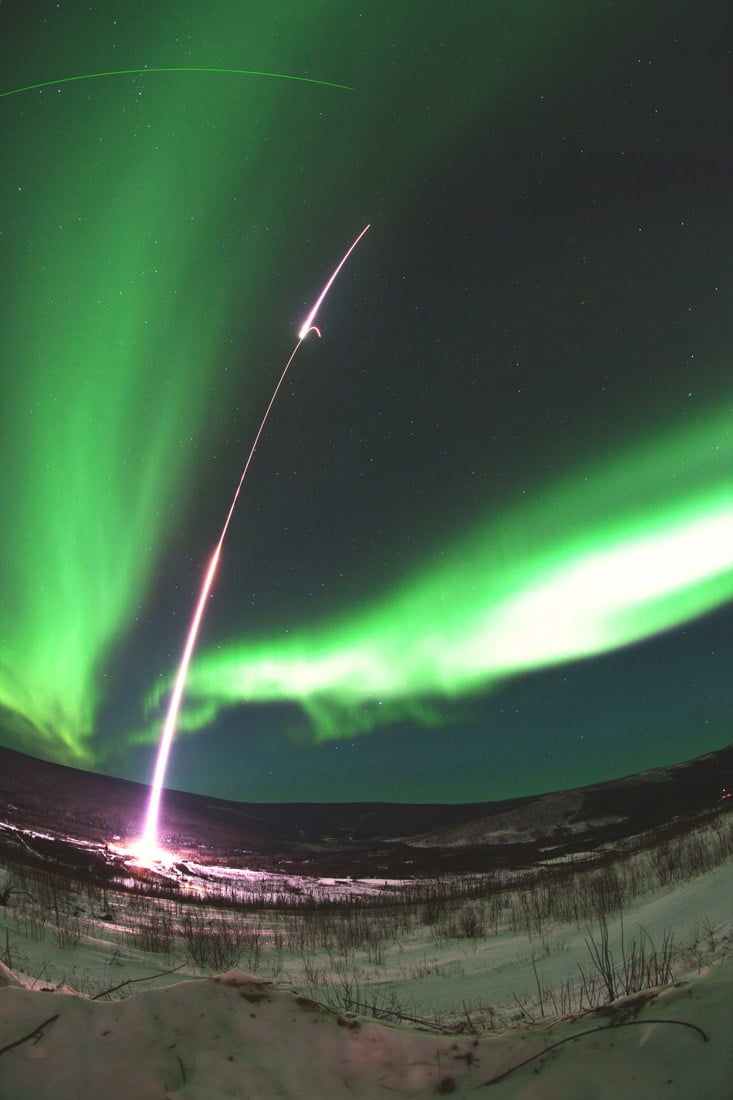
Over the weekend, a two-stage sounding rocket launched into a sky shimmering with green aurora. On board were instruments that will help shed new light on the physical processes that create the Northern Lights and further our understanding of the complex Sun-Earth connection.
“We’re investigating what’s called space weather,” said Steven Powell from Cornell University. “Space weather is caused by the charged particles that come from the Sun and interact with the Earth’s magnetic field. We don’t directly feel those effects as humans, but our electronic systems do.”
The rocket launched on Feb. 18, 2012 from the Poker Flat Research Range in Fairbanks, Alaska. The rocket sent a stream of real-time data back before landing some 200 miles downrange shortly after the launch.
Instruments sampled electric and magnetic fields that are generated by the aurora. While the Sun heads toward solar maximum, emissions from the Sun are more likely to head Earth's way and cause more interference with GPS transmissions, satellite internet and other signals.
“We are becoming more dependent on these signals,” Powell said. “This will help us better understand how satellite signals get degraded by space weather and how we can mitigate those effects in new and improved GPS receivers.”
Other instruments studied charged particles in Earth's ionosphere that get sloshed back and forth by a specific form of electromagnetic energy known as Alfvén waves. These waves are thought to be a key driver of "discrete" aurora - the typical, well-defined band of shimmering lights about six miles thick and stretching east to west from horizon to horizon.
These waves are akin to a guitar string when "plucked" by energy delivered by the solar wind to Earth's magnetosphere high above.
"The ionosphere, some 62 miles up, is one end of the guitar string and there's another structure over a thousand miles up in space that is the other end of the string,” said Marc Lessard, who worked with graduate students from the University of New Hampshire's Space Science Center to monitor the launch. “When it gets plucked by incoming energy we can get a fundamental frequency and other 'harmonics' along the background magnetic field sitting above the ionosphere."
The rocket was a 46-foot Terrier-Black Brant model that was sent right through the aurora 350 km (217 miles) above Earth.
This is not the first sounding rocket flight from Poker Flats to launch into an aurora. In 2009 two rockets flew through aurorae to help refine current models of aurora structure, and provide insight on the high-frequency waves and turbulence generated by aurorae.