Universe Today
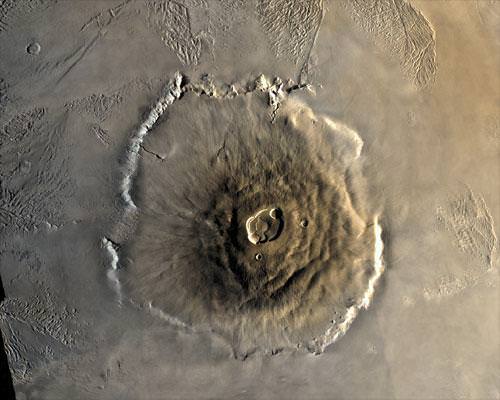
From orbit, Olympus Mons dominates the landscape of the Tharsis region on Mars. At 24 kilometers (15 miles) high, and 550 kilometers (340 miles) in diameter, the huge volcano is over three times larger than Mount Everest. But Olympus Mons has a structure that is somewhat lopsided: it is elongated to the northwest, shortened to the southeast. A new study reveals that the 'lopsidedness' may mean warm magma and possibly water could be close enough to Olympus Mons' surface to support thermophilic (heat-loving) bacteria like those found near hydrothermal vents on Earth.
While no volcanic activity has ever been seen or detected in Olympus Mons by orbiting spacecraft, the surface of the northwestern scarp has been dated from 115 million years old down to a region that is only 2 million years old. This is very recent in geological terms, suggesting that the mountain may yet have some ongoing volcanic activity.
To try and understand why Olympus Mons in lopsided, researchers Patrick J. McGovern and Julia K. Morgan from the Lunar and Planetary Institute, Universities Space Research Association, constructed detailed computer simulations of the volcano. They found the only way it could have the shape it does is if, when it was actively erupting, lava piled on top of layers of weak, water-laden clay sediments.
These layers could be hiding a trapped reservoir of water, if indeed Mars was once warmer and wetter. Whether that reservoir could still be warm, and if it could possibly hold life life remains uncertain. As of now, no orbiting satellites have any instruments that can penetrate the surface to look for a heat source.
This research was published in February 2009 in the journal Geology.