Universe Today
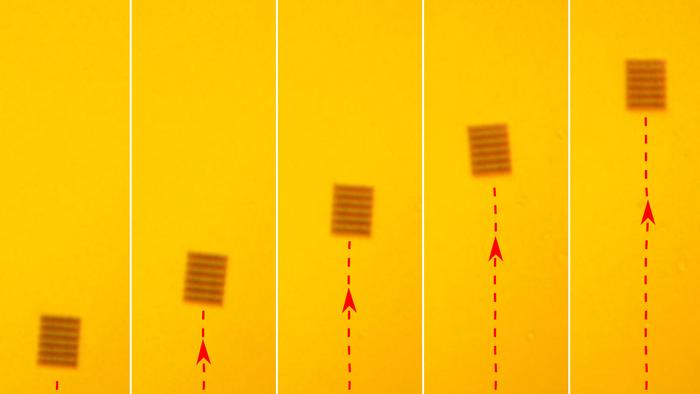
Alpha Centauri is the nearest star system to our own, sitting just over four light years away and it’s fascinated astronomers and storytellers alike for generations. With conventional rockets, reaching it would take hundreds of thousands of years, even for the Orion spacecraft it would take around 100,000 years. But a team of researchers at Texas A&M University think they may have taken the first tentative step towards a technology that could get us there in just twenty years.
Their secret……is to use light itself.
 This image of the sky around the bright star Alpha Centauri AB also shows the much fainter red dwarf star, Proxima Centauri, the closest star to the Solar System and maybe the destination for our first interstellar craft driven by light propulsion (Credit : Digitised Sky Survey 2)
The idea that light can push things isn’t new. Sunlight exerts a tiny but measurable pressure on everything it touches, and spacecraft fitted with solar sails have already demonstrated that photons alone can provide useful thrust in the frictionless environment of space. But the Texas A&M team have taken that concept somewhere genuinely new. They have created microscopic devices, which they call "metajets", that can be lifted and steered in three dimensions using nothing but a laser beam and no physical contact whatsoever.
Think of it like this. When a ball bounces off a wall, it transfers some of its momentum to the wall as it changes direction. Light does exactly the same thing when it reflects of something like a solar sail. The force involved is vanishingly small in everyday life, but in the weightlessness of space, even tiny forces accumulate. Given enough time and a powerful enough laser, that adds up to extraordinary speed.
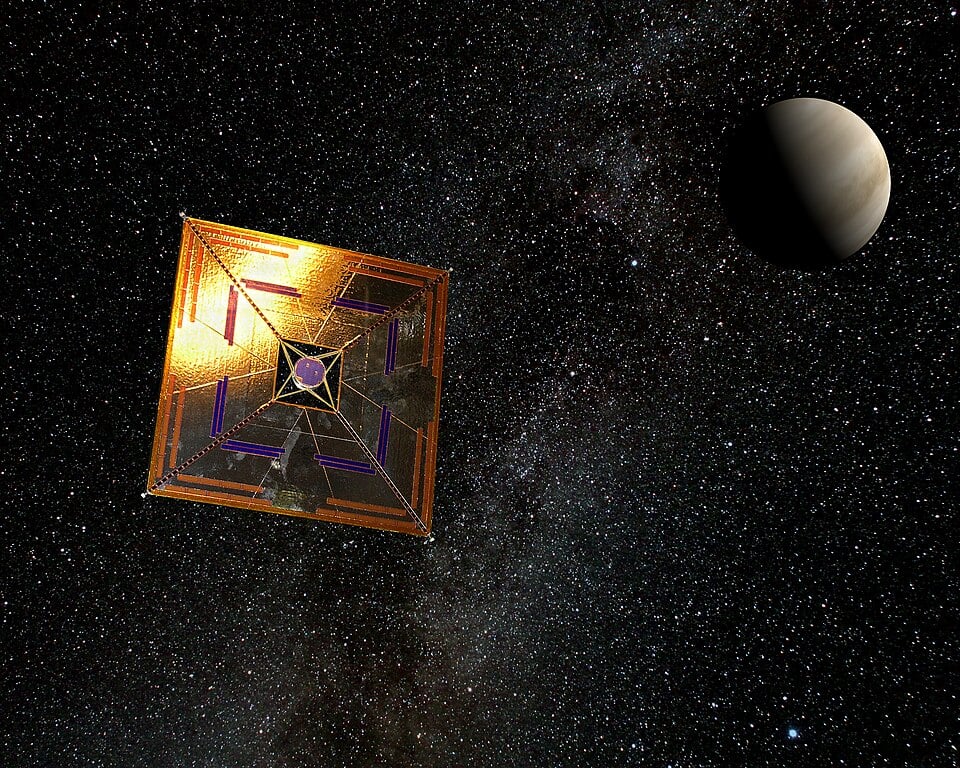 Artist impression of IKAROS, the first space probe with a solar sail in flight featuring a typical square sail configuration of almost 200 m2 (Credit : Andrzej Mirecki)
What makes the metajets special is how they are built. Each one is coated with an ultrathin material etched with nanoscale patterns so precise that they can bend and redirect light in exactly the way the engineers want. By designing those patterns carefully, the team can control not just whether the device moves, but where it goes. In the laboratory, they achieved full three dimensional manoeuvrability with the metajets moving sideways and lifted vertically at the same time, something that previous light propulsion approaches could not manage.
If this technology can be scaled up and, drawing upon an idea called Breakthrough Starshot, it may be possible to use a laser powerful enough to accelerate a tiny, wafer thin spacecraft to a significant fraction of the speed of light. At those velocities, Alpha Centauri becomes a twenty year journey rather than a hundred thousand year one.
The researchers themselves are the first to acknowledge that scaling from a microscopic laboratory device to an actual interstellar spacecraft is a colossal engineering challenge. But every revolution in space travel began with a proof of concept that once seemed impossibly small.
Source : Light-powered propulsion expands space exploration possibilities