Universe Today
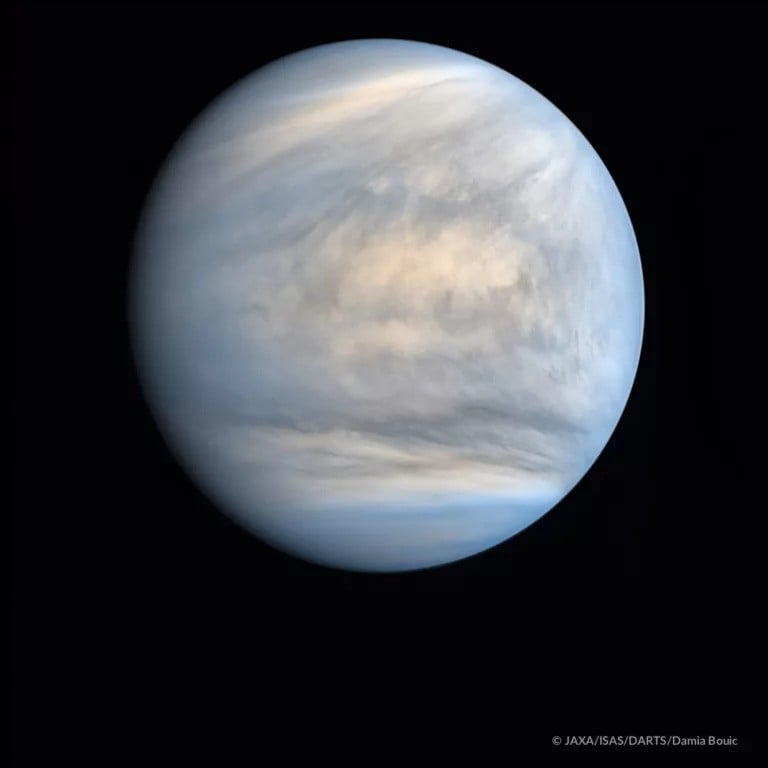
The planet Venus is arguably the most mischievous planetary body in the solar system. This is because like Saturn’s largest moon, Titan, Venus is shrouded in a thick atmosphere that can’t be viewed with optical telescopes and require radar images to see the surface. Unlike Titan, whose atmosphere looks quite dull, Venus’s swirling and awe-inspiring clouds give observers the impression that its surface is covered in wonderous features. However, the truth is far from ideal, as Venus’s surface is a living hell with searing temperatures and crushing pressures. But, unlike its surface and Titan, Venus’s atmosphere provides many more ideal conditions, even Earth-like conditions. But while life would be hard to exist on its surface, could we find life in the atmospheric clouds of Venus?
Now, an international team of researchers led by the Massachusetts Institute of Technology (MIT) might have shed new light regarding whether life could exist in the clouds of Venus. As discussed in a recent study published in the Proceedings of the National Academy of Sciences, the researchers provided evidence that non-Earth-like planets could be just as viable of hosting life as we know it along with Earth-like planets. While astrobiologists have long focused on liquid water being the driver in the search for life beyond Earth, this study proposes that life might exist even under the harshest environmental conditions.
For the study, the researchers focused on whether peptides, which consist of short amino acid chains, could survive within the sulfuric acid clouds of Venus. To accomplish this, the researchers conducted a series of laboratory experiments using nuclear magnetic resonance (NMR) spectroscopy, which examines the molecular structure and physical composition of chemical compounds.
Through this, the researchers successfully observed three peptides successfully forming the necessary folded structures enabling them to remain stable for several weeks under environmental conditions of 98 percent sulfuric acid. The team attributes this to the lack of water within the system, with water being known for breaking apart peptide chemical bonds. Folding is important because it enables amino acids to form specific structures that eventually become chemical reactions.
“Life needs to have specially shaped proteins so that they have a specific target they can latch onto and perform their function,” said Dr. Sara Seager, who is a Professor of Planetary Science at MIT and a co-author on the study. “Before this, people thought that peptides couldn’t survive in sulfuric acid, so showing peptides are not only stable, but also fold, is a really big deal.”
Along with being a study co-author, Dr. Seager is responsible for kickstarting research into whether biological processes could be stable in acidic environments began with a 2023 study published in the Proceedings of the National Academy of Sciences. Additionally, Dr. Seager is the Principal Investigator for the Morning Star Missions to Venus, which consists of several privately funded missions to Venus to ascertain the planet’s habitability, specifically focusing on its atmosphere and clouds.
As noted, while the surface of Venus is a hellish landscape, its atmosphere and clouds provide much more favorable, Earth-like conditions. This includes both temperature and pressure, and specifically at altitudes of 48 to 60 kilometers (30 to 37 miles). The concept of life being possible within the clouds of Venus goes back more than 75 years when German physicist and science writer, Heinz Haber, proposed the possibility of life in the clouds of Venus in his 1950 paper titled “Epitome of Space Medicine”. This was followed by a 1967 paper published in Nature by Harold Morowitz and Carl Sagan that also discussed the possibility of life in the clouds of Venus. More recent studies have focused on how life could survive under such harsh conditions, specifically acidic environments, including this most recent study.
What new insights into Venus and its atmospheric prospects for life will researchers make in the coming years and decades? Only time will tell, and this is why we science!
As always, keep doing science & keep looking up!