 Universe Today
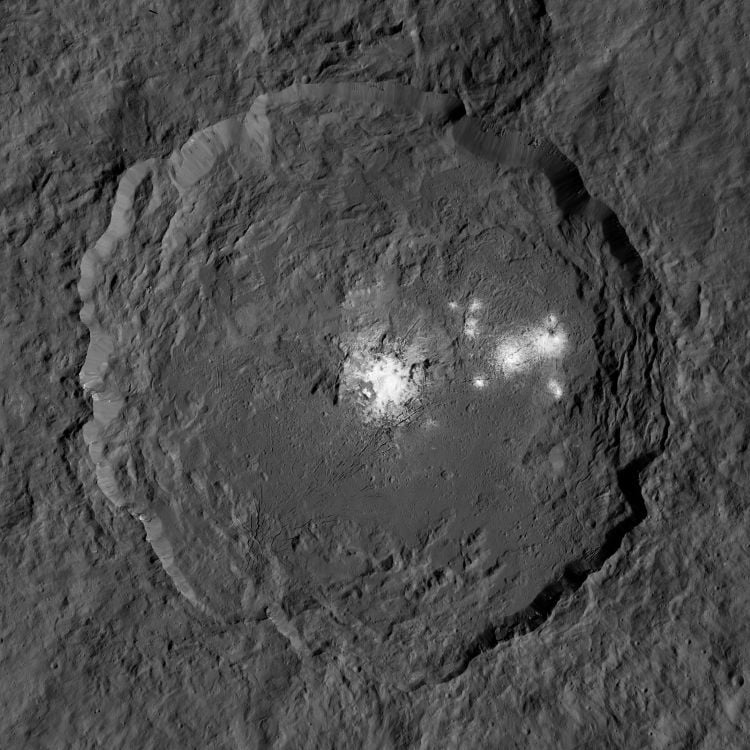
The dwarf planet Ceres is arguably one of the most overlooked and underappreciated planetary objects in the entire solar system. This could be because while Ceres has the same dwarf planet designation as Pluto, Ceres is largely considered an “asteroid” since it resides the in main asteroid belt. However, along with being the largest object in the main asteroid belt, Ceres’ mass comprises between 25 to 30 percent of all the mass of the entire main asteroid belt. Despite its lack of recognition, Ceres’ interior is layered like most rocky planets, including Pluto, and its surface displays evidence of past water ice activity (also called cryovolcanism) with several “bright spots”, which are highly reflective salt deposits. But what can these salt deposits teach scientists about Ceres’ formation and evolution?
Now, a pair of researchers from the California Institute of Technology (Caltech) might have inched our way to better understanding a connection between Ceres’ water ice activity and surface salt deposits. As discussed in findings published in the Journal of Geophysical Research: Planets (JGR: Planets), the researcher presented evidence that past data might have been incorrect regarding the amount of salt deposits previously observed by NASA’s Dawn spacecraft, which explored Ceres from 2015 to 2018.
For the study, researchers used a combination of Dawn spacecraft data and a series of computer models to examine the evolution of surface water ice and salt deposits on Ceres’ surface. The primary motivation behind the study was to fill a longstanding knowledge gap regarding observational results of surface water ice and salt deposits versus what’s actually happening. Specifically, this study focused on the transition of water ice to salt deposits through evaporation (scientifically called sublimation) and whether data collected from Dawn accurately estimated the amount of water ice and salt.
In the end, the researchers found that the salt deposits might be hidden by the water ice deposits they’re mixed with, with the salt deposits potentially existing in larger amounts than previously hypothesized, estimated to be between 30 to 50 percent greater. Additionally, they found that landslides (scientifically called mass wasting) contribute to more surface ice being exposed, which then evaporate, leaving behind the salty bright spots observed by Dawn. They note some water ice deposits could have been observed by Dawn that could have been recently exposed from landslides.
“We proposed a qualitative model of long-term surface evolution of Ceres' salty ices based on observations that is akin to thermal segregation [sorting] on icy satellites,” the study notes. “Ice in deposits with salts sublimates more readily and may move to colder areas, resulting in a feedback that creates compositional differences between colder, icy surfaces and warmer, salt-richer regions. Ongoing replenishment of ice at the optical [visible] surface is required to reconcile multiple detections with geologically negligible lifetimes of ice. The finding resolves an existing paradox about how salt-rich deposits arise in the Ceres near-surface; they are likely not initially salt-rich but instead result from enrichment of salt at the optical surface by sublimation of salty ices.”
Essentially, the salt-water ice deposits are sorted based on heat and evaporation, the salt within water ice mixture causes the water ice to evaporate faster, leaving behind the salt deposits. This creates a feedback loop that results in different mixture amounts and types among separate water ice and salt deposits. Additionally, the surface water ice is exposed from landslides, adding to this evaporation feedback loop. Finally, the study fills a longstanding misunderstanding between how salt deposits are formed and evolve, in that they don’t start out with heavy amounts of salt. Instead, they start out with low amounts of salt but have their salt contents increase from the evaporation of water ice that also contains salt.
What new insights into Ceres’ salt deposits and water ice will researchers make in the coming years and decades? Only time will tell, and this is why we science!
As always, keep doing science & keep looking up!