 Universe Today
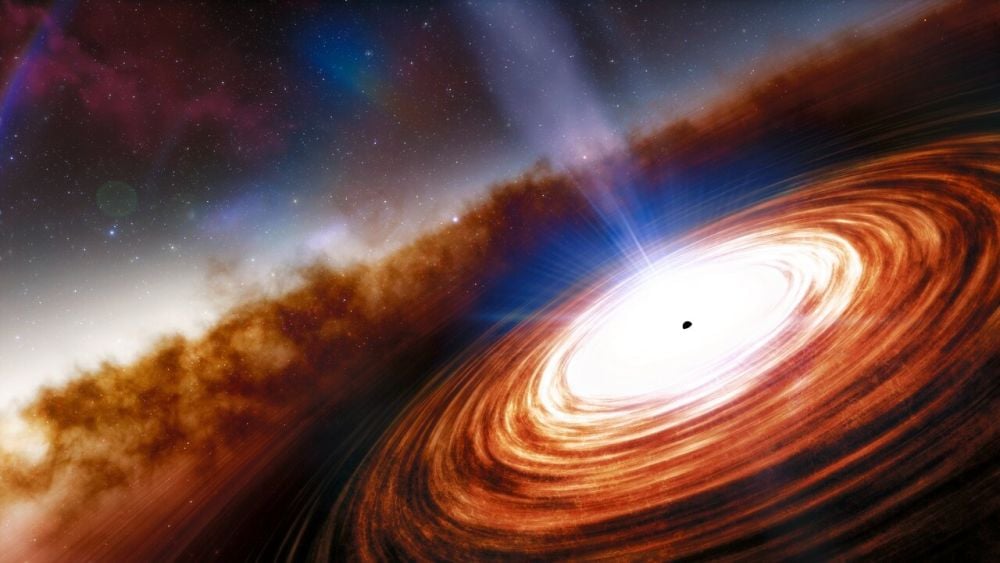
Ever since the JWST revealed a population of SMBH in the early Universe that were overmassive, scientists have been working hard to explain them. These black holes existed when the Universe was only about 2 billion years old, during Cosmic Noon, and according to our models of black hole growth, there simply wasn't enough time for them to grow so massive.
There are only two overall explanations for this. One is that our understanding is off, and conditions were different in the early Universe. The other is that the JWST didn't really see the overmassive black holes (OBH).
New research in The Astrophysical Journal says that observational bias might be behind these detections. It's titled "Beyond the Monsters: A More Complete Census of Black Hole Activity at Cosmic Dawn," and the lead author is Madisyn Brooks, a PhD student in Physics at the University of Connecticut.
"JWST has revealed an abundance of low-luminosity active galactic nuclei (AGN) at high redshifts (z > 3), pushing the limits of black hole (BH) science in the early Universe," the authors write. "Results have claimed that these BHs are significantly more massive than expected from the BH mass–host galaxy stellar mass relation derived from the local Universe."
The BH mass–host galaxy stellar mass relation is the relationship between a BH's mass and its galaxy's stellar mass. In the local Universe, this mass relationship is well-understood. A BH is about 0.1% of the mass compared to the stellar mass in the galaxy's bulge. But at high redshifts, the JWST found galaxies where the black hole is 1:10 or even 1:1 relative to the host stellar mass. That's an enormous discrepancy, where the BHs are 10 to 100× "too massive" for their galaxies.
The discovery of these OBHs led to the idea of heavy seeds. In this scenario, the puzzling Little Red Dots also discovered by the JWST are the heavy seeds that led to the OBHs. That explanation has gained momentum, but this new research presents a different understanding of the OBHs.
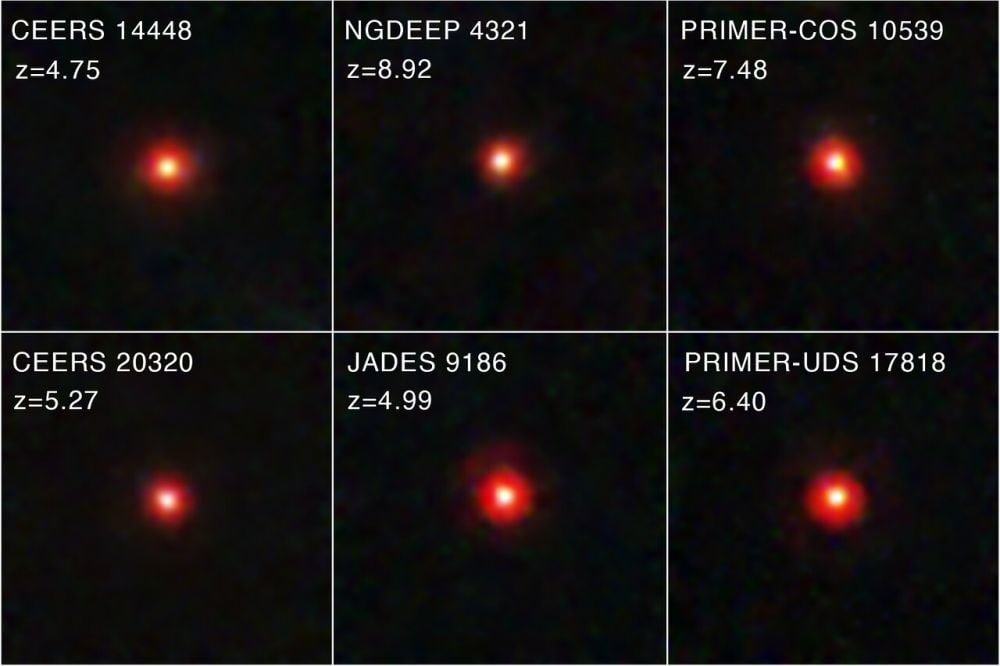 These are some of the JWST's Little Red Dots, found in several of the space telescope's extragalactic surveys. Scientists theorized that these LRDs could be the heavy seeds for the OBHs the space telescope found at Cosmic Noon. Image Credit: NASA, ESA, CSA, STScI, D. Kocevski (Colby College)
But there's a problem with the JWST's observations of OBHs. "These observations are subject to significant selection bias, since only the most luminous AGN can be detected in current JWST surveys, representing the rare tail of the larger AGN population," the authors write. "Measuring the global MBH–M* relation therefore requires a more sophisticated approach that probes AGN content across the broader galaxy population."
"We present a comprehensive census of the BH populations in the early Universe through a detailed stacking analysis of galaxy populations," the authors write. They used spectroscopy from four of the JWST's extragalactic deep field surveys: CEERS, JADES, RUBIES, and GLASS. In total, the researchers based their work on 2,000 separate galaxies.
Stacking means they combined the spectra of many faint galaxies grouped by luminosity and redshift from the four JWST surveys. This is different from observing single galaxies at a time. Stacking averages the noise presented by outliers and reveals more signals that could be lost in any individual observation.
The researchers are saying that the JWST's detections of OBH are outliers that are skewing our understanding. "Our results indicate that individual detections of AGN are more likely to sample the upper envelope of the MBH–M* distribution, while stacking of “normal” galaxies and searching for AGN signatures can overcome the selection bias of individual detections," they write.
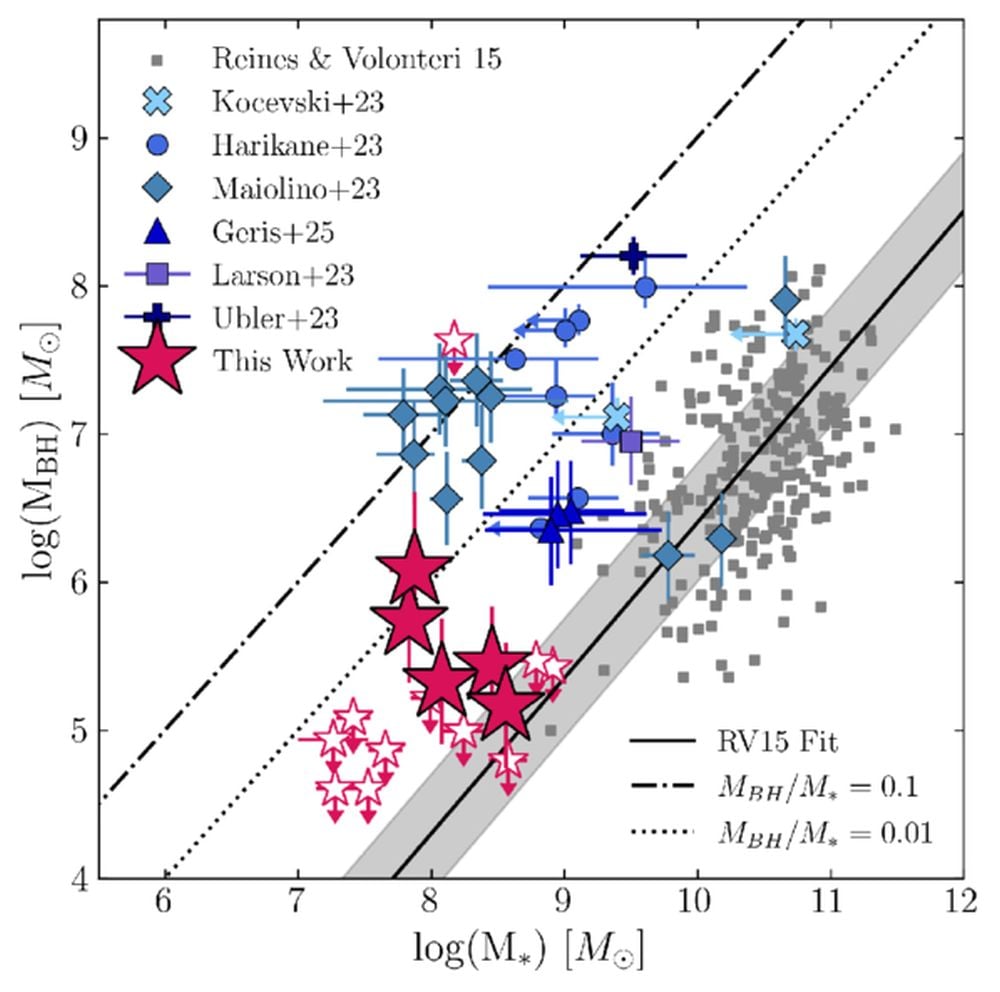 This figure from the research illustrates some of the findings. It shows BH mass as a function of stellar mass. Red open and filled stars are from this work. Stacks with detected broad Hα emission are shown with red filled stars, and 3σ BH mass upper limits are shown with red open stars. Grey squares are local AGN. Other markers are from previous research, and the JWST's observations of OBHs in the early Universe. The MBH–M relation in the local Universe is shown by the solid black line. The results show that early Universe OBHs are not really that overmassive and are closer to the relation in the local Universe. Image Credit: Madisyn Brooks et al 2026 ApJ 1002 129.*
To the authors, this suggests that the MBH–M* relation found in the early Universe isn't representative. "... a median galaxy hosts a BH that is at most a factor of 10 times overmassive compared to its host galaxy," they write. This is much closer to the relation in the local Universe.
If they're correct, then there's also no need for heavy seeds to explain the early Universe black holes, because they were never that overmassive to begin with. Some of them push the envelope of the MBH–M* relation in the local Universe, but can still be explained by Eddington accretion.
"We investigate the seeding properties of the inferred BHs and find that they can be well explained by light stellar-remnant seeds undergoing moderate Eddington accretion," the authors explain.

