Universe Today
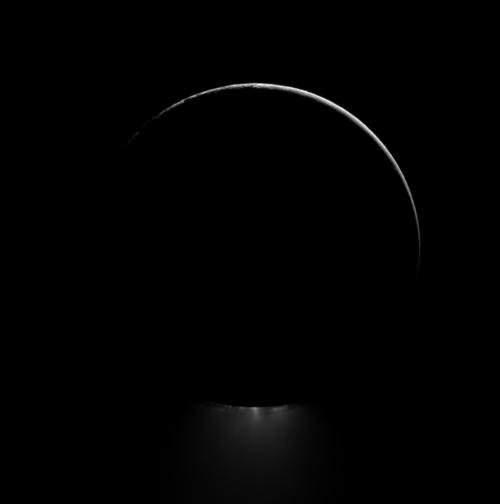
On May 2, the Cassini spacecraft will be swooping past the moon we all love to love -- Enceladus -- and coming within 74 kilometers (46 miles) of its fractured, jet-spewing surface. The images should be spectacular, and the science should be just as enticing. With Cassini's radio science experiment, scientists hope to learn more about how mass is distributed under Enceladus' south polar region, the very interesting place which features jets of water ice, water vapor and organic compounds spraying out of long fractures.
This is the last close flyby of Enceladus until 2015, so we have to take advantage of the views!
Cassini scientists will be looking specifically for a concentration of mass in that region could indicate subsurface liquid water or an intrusion of warmer-than-average ice that might explain the unusual plume activity. They’ll also be observing the plumes and looking for hot spots to try and understand the global energy balance of Enceladus.
They also hope to learn more about the moon's internal structure by measuring variations in the gravitational pull of Enceladus against the steady radio link to NASA's Deep Space Network on Earth.
Additionally, Cassini's composite infrared spectrometer instrument will be observing the side of Enceladus that always faces away from Saturn to monitor for hot spots. The imaging camera team also plans to take images of the plume to look for variability in the jets.
Cassini will also be flying by Dione at a distance of about 8,000 kilometers (5,000 miles), enabling the imaging cameras to create several mosaic images of the icy moon, and the composite infrared spectrometer to monitor heat emission.
We’ll try to post images and info as they become available!