Universe Today
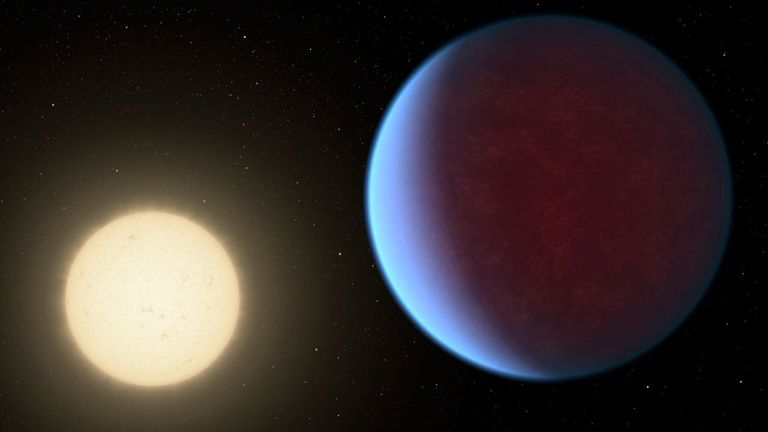
Imagine trying to spot a firefly hovering next to a lighthouse from several kilometres away. That's essentially the challenge astronomers face when searching for Earth like planets around other stars. The planet is there, it’s just completely lost in the overwhelming blaze of its host star. Solving that problem is the whole point of a tiny but extraordinarily precise piece of glass called an optical vortex phase mask.
NASA's planned Habitable Worlds Observatory, a future space telescope designed specifically to hunt for signs of life beyond our Solar System, will need to image faint exoplanets directly. To do that, it must suppress incoming starlight by a factor of ten billion. Even a perfect mirror can't achieve that on its own. When light passes through a telescope's circular aperture, it spreads outward into a ringed pattern of light called an Airy pattern, a fundamental consequence of the physics of waves. Those rings can be millions of times brighter than a nearby exoplanet, and they have to go.
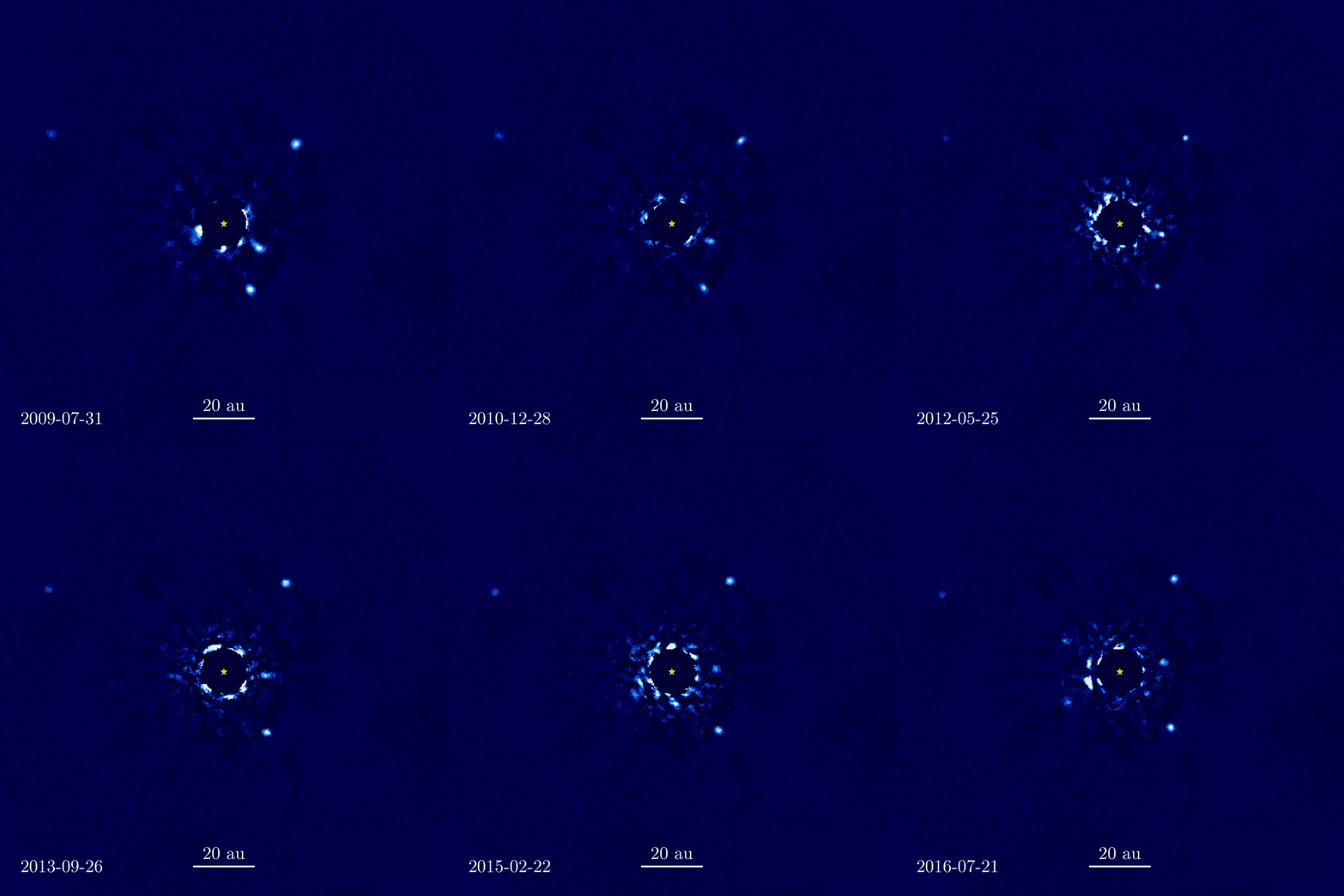 Motion interpolation of seven images of the HR 8799 system taken from the W. M. Keck Observatory over seven years, featuring four exoplanets (Credit : Jason Wang (Caltech)/Christian Marois)
That's where the vortex phase mask comes in. Placed at the focal point of the telescope, it applies a carefully engineered delay to the starlight, one that increases continuously as you move around the centre of the mask, like the rising thread of a screw. The result is that the starlight cancels itself out through destructive interference, and what's left can be blocked by a simple aperture stop, leaving only the faint planet light to reach the detector. Light from the exoplanet, arriving at a slight angle, misses the mask's centre and passes through unaffected.
The most promising version of this technology uses a thin layer of liquid crystal polymer, whose long molecular chains can be precisely oriented to manipulate light differently depending on its polarisation direction. Because the delay is produced geometrically rather than by the material's chemical properties, it works across a wide range of wavelengths and that’s crucial for a telescope that needs to analyse the full colour spectrum of a planet's atmosphere.
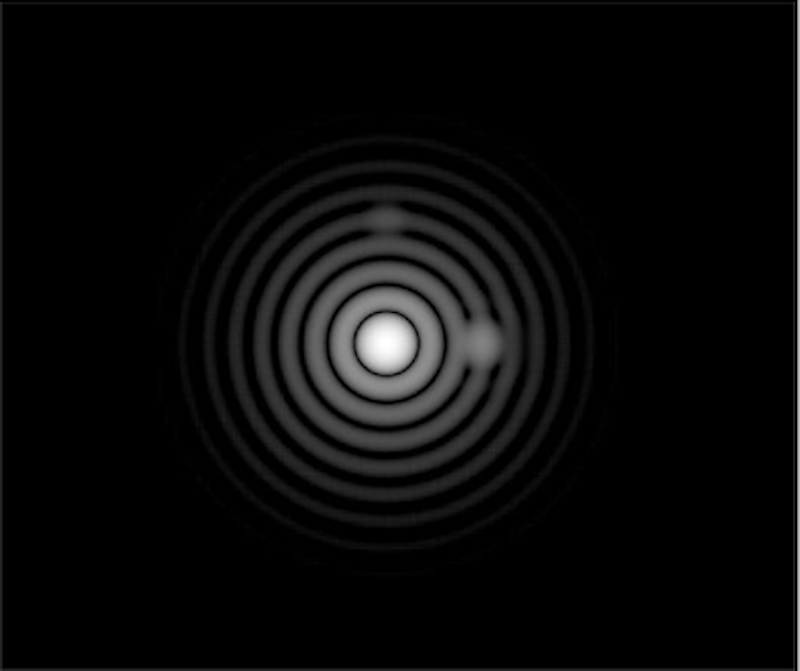 A logarithmically scaled simulation of the image of a star with two nearby exoplanets, as seen by a telescope with a circular aperture. The centred multi ringed Airy pattern is due to diffraction of the starlight. Off-axis exoplanets fainter by 100 times and 1000 times are seen at 3 o’clock on the 3rd Airy ring, and at 12 o’clock on the 4th Airy ring, respectively. An Earth like exoplanet would be 10 million times fainter than the dimmer of the two exoplanets shown (Credit : Gene Serabyn, NASA JPL)
Researchers at JPL have already achieved starlight suppression of around one part in a billion in the laboratory. The target for the Habitable Worlds Observatory is one part in ten billion. That final factor of ten is the frontier they're now working to cross.
Alongside the liquid crystal approach, the team is also investigating glass masks shaped like helical screw surfaces, and entirely new artificial materials that are engineered to have optical properties that simply don't exist in nature.
The technology is still several years from readiness, but the direction of travel is clear and most definitely promising. The masks that will one day reveal oceans, atmospheres, and possibly life on another world are already taking shape in a laboratory in Pasadena.
Source : Optical Vortex Phase Masks for the Detection of Habitable Worlds