 Universe Today
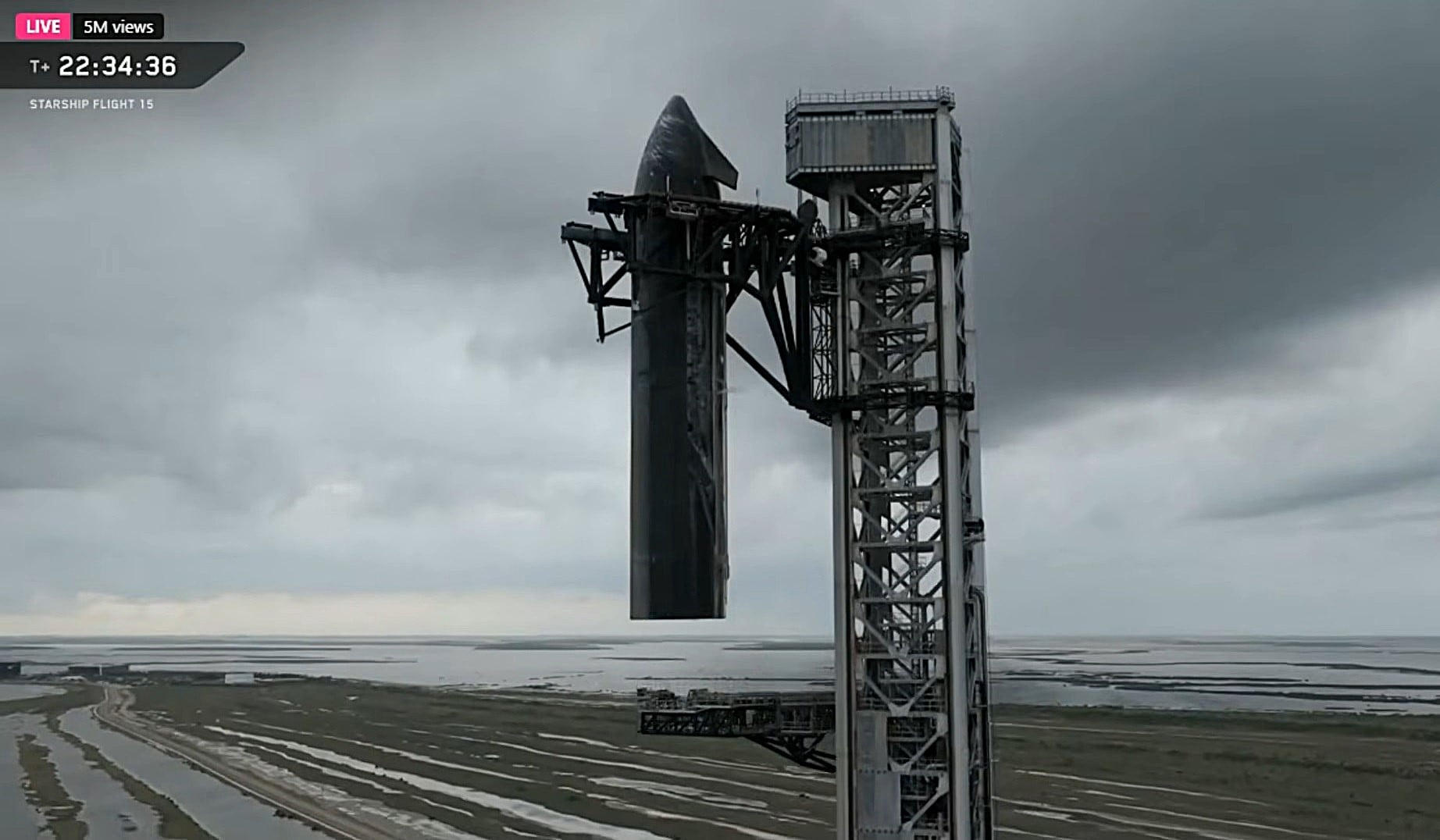
SpaceX brought back its Starship rocket's second stage today for a first-ever midair capture at its launch pad, capping a record-setting orbital flight test.
The 171-foot-tall (52-meter) space vehicle, known as Ship 42, settled between a giant pair of mechanical arms extended from the South Texas launch tower where its journey began 22.5 hours earlier. The arm-capture system, nicknamed "Mechazilla," had been used three times previously to capture Starship Super Heavy boosters during suborbital flight tests, but this was the first time for a second stage coming in hot from orbit.
"Mechazilla has caught the Starship — we've been waiting to hear that for a long time," SpaceX launch commentator Dan Huot said.
In addition to the first orbital catch, this week's test marked the longest Starship flight to date, besting Starship's three-hour orbital flight in September.
SpaceX employees around the country and hundreds of onlookers near the Texas launch site cheered as Ship 42 descended, with "Baby, Come Back" playing as the soundtrack for the webcast. "Baby, she's back," Huot joked.
Years of development — including 15 full-scale flight tests since 2023 — led up to today's orbital catch, which Huot called "the Holy Grail of spaceflight." The achievement took the sting out of the previous day's aborted effort to catch the rocket's booster using the same system, minutes after liftoff. SpaceX said the booster was diverted when its onboard system detected a fuel-system alarm. The root cause of the alarm is under investigation.
SpaceX plans to use the launch-pad arms to recover Starship's boosters and second stages on a routine basis, achieving company founder Elon Musk's goal of creating a fully reusable, orbital-class launch system.
This 15th flight test proceeded almost in textbook fashion, aside from the booster’s offshore splashdown on launch day. During the first hours of its 14-orbit flight, Starship deployed 26 more next-generation satellites for SpaceX's Starlink broadband internet network. All of the satellites were in good health and beginning to raise their orbits to operational altitude, the company said.
Bringing Starship into full operation is expected to speed up deployment of Starlink satellites. More importantly, Starship is slated to serve as a landing system for NASA's crewed moon missions starting as early as 2028. Starship and Blue Origin's Blue Moon landing system are scheduled for testing in low Earth orbit next year during NASA's Artemis III mission.
In a post to X, NASA Administrator Jared Isaacman congratulated Musk and the SpaceX team on today's successful catch. "It was almost magic ... Making more believers by the day," he wrote. Using emojis, Isaacman said the achievement brought the United States "one step closer" to putting an American flag once more on the moon.
SpaceX's team will analyze the data gathered about Starship's performance, including the ability of Ship 42's heat shield to stand up to the rigors of atmospheric re-entry. The company is gearing up to expand Starship operations to NASA's Kennedy Space Center in Florida, and yet another Starship launch site is in the works for Louisiana.
In the long term, Musk envisions creating a fleet of Starships that could offer point-to-point rocket travel on Earth, as well as mass transit to Mars and other off-Earth destinations. Cryptocurrency investor Chun Wang has already announced his intention to take Starship trips around the moon and Mars.
"I don’t think you guys understand," a software engineer named Will DePue wrote in a post to X. "You will get the chance to go to space in your lifetime. New era."
"Yes," Musk replied.