Universe Today
It's a well-known fact that if humanity wishes to explore deep space and to live and work on other planets, we need to bring Earth's environment with us. This includes life support systems that leverage biological processes - aka. Bioregenerative Life Support Systems (BLSS) - but also the many species of microbes that are essential to living systems. Humans already bring microbes with them when they travel to space, in particular, to the International Space Station (ISS). These microbes become part of the natural environment, sticking to surfaces, growing in nooks and crannies, and getting into everything.
Given their constant presence, it's paramount that we understand how they survive in space. In addition, they have potential uses that could enable greater self-sufficiency in space. For example, certain types of bacteria and fungi extract minerals from rocks as a source of nutrients. In a recent study aboard the ISS, researchers from Cornell and the University of Edinburgh investigated how these species could be used to extract platinum from a meteorite under microgravity conditions. Their results suggest that this could be an effective method for obtaining mineral resources in space and lessening dependence on Earth.
The study was led by Rosa Santomartino, an assistant professor of biological and environmental engineering in Cornell's College of Agriculture and Life Sciences (CALS), and Alessandro Stirpe, a research associate in microbiology at Cornell and the School of Biological Sciences at the University of Edinburgh. They were joined by researchers from the Medical University of Graz in Austria, Rice University, Cancer Research UK, the UK Centre for Astrobiology at the University of Edinburgh, Kayser Space Ltd, and Kayser Italia. Their study was published on Jan. 30th in npj Microgravity.
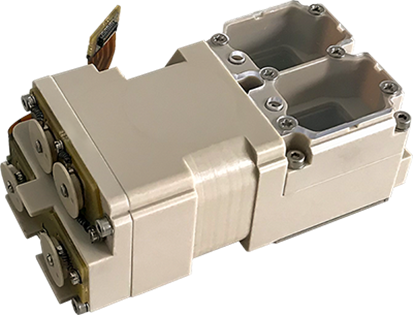 A bioreactor, produced by the BioAsteroid project at the University of Edinburgh. Credit: University of Edinburgh
The work was part of the BioAsteroid project, a collaborative effort between the University of Edinburgh and the European Space Agency (ESA). This project is led by Charles Cockell, a professor of astrobiology at the University of Edinburgh and a senior author on the study. Cockell and his colleagues developed "biomining reactors" that were deployed to the ISS in late 2020/early 2021 to investigate how gravity affects the interaction between microbes and rock in microgravity.
These reactors contained samples of an L-chondrite asteroid that were treated with the bacterium Sphingomonas desiccabilis and the fungus Penicillium simplicissimum. These microbes are promising for resource extraction because they produce carboxylic acids that bind to minerals and release them from rocks. However, there is still some ambiguity as to how this mechanism works. To this end, the experiment also included a metabolomic analysis, in which a portion of the liquid culture was extracted and analyzed for biomolecules and secondary metabolites. As Santomartino said in a Cornell Chronicle press release:
This is probably the first experiment of its kind on the International Space Station on [a] meteorite. We wanted to keep the approach tailored in a way, but also general to increase its impact. These are two completely different species, and they will extract different things. So we wanted to understand what and how, but keep the results relevant to a broader perspective, because not much is known about the mechanisms that influence microbial behavior in space.
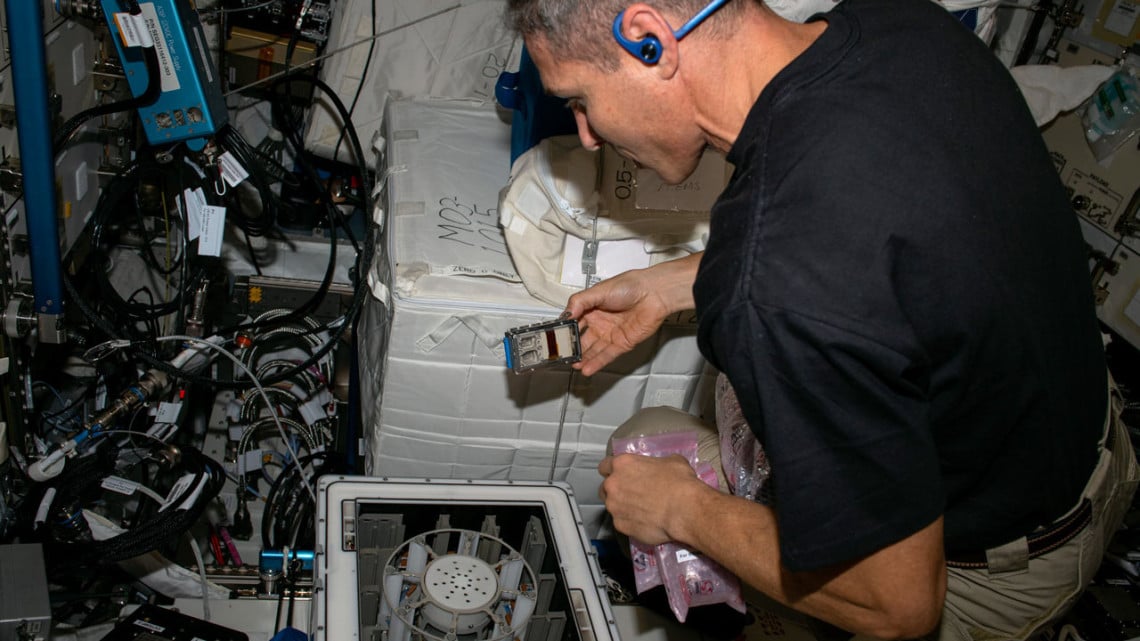
The experiment was conducted aboard the ISS by NASA astronaut Michael Scott Hopkins while the researchers conducted their own control version in the lab. This allowed them to examine how the experiment would work in microgravity compared to Earth's gravity. Santomartino and Stirpe then analyzed the experiment data, which revealed that of the 44 different elements, 18 were extracted through biological processes. Said Stirpe:
We split the analysis to the single element, and we started to ask, OK, does the extraction behave differently in space compared to Earth? Are these elements more extracted when we have a bacterium or a fungus, or when we have both of them? Is this just noise, or can we see something that maybe makes a bit of sense? We don’t see massive differences, but there are some very interesting ones.
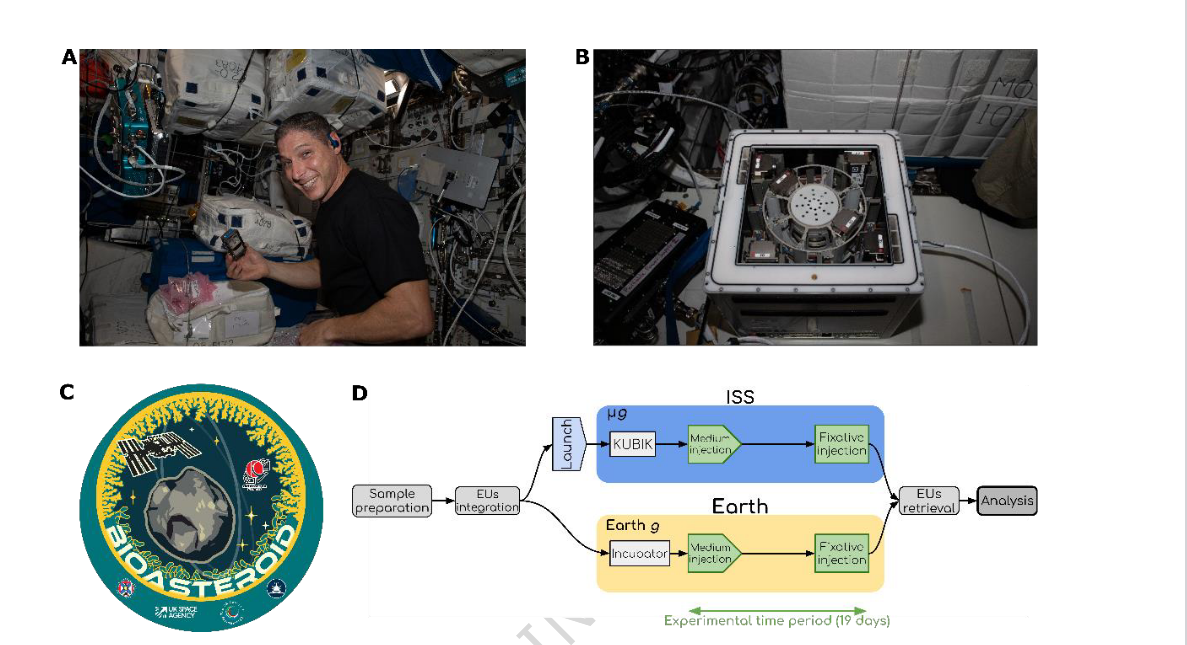 NASA astronaut Michael Scott Hopkins performs the insertion of the experiment containers in KUBIK (left) and the six hardware units inserted into the KUBIK onboard the ISS (right). Credits: ESA/NASA/
Their analysis revealed that the microbes had consistent results in both Earth gravity and microgravity. However, it also showed distinct changes in microbial metabolism, especially with the fungus samples. In microgravity, the fungus increased its production of carboxylic acids and other molecules, leading to the extraction of more palladium, platinum, and other elements. Meanwhile, the non-biological leaching experiment proved to be less effective in microgravity than on Earth. Said Santomartino:
In these cases, the microbe doesn’t improve the extraction itself, but it’s kind of keeping the extraction at a steady level, regardless of the gravity condition. And this is not just true for the palladium, but for different types of metals, although not all of them. Indeed, another complex but very interesting result, I think, is that the extraction rate varies a lot depending on the metal you are considering and on the microbe and gravity conditions.
This experiment has successfully demonstrated the potential for "biomining," which could be used by future astronauts exploring the Moon and Mars. In addition to life support systems that rely on cyanobacteria and other photosynthetic organisms to clean the air and generate edible algae, microbes and fungi could be used to leach minerals from the local regolith. These, in turn, could be used to generate building materials for structures and tools, reducing the amount of supplies that need to be sent from Earth.
In addition, biomining has potential applications here on Earth, providing a biological means for extracting metals in resource-limited environments or from mine waste. This technique could also lead to biotechnologies that facilitate the emergence of a zero-waste, circular economy. But the team cautions that more research is required, as there are many variables and uncertainties regarding the impact space has on microbes.
“Depending on the microbial species, depending on the space conditions, depending on the method that researchers are using, everything changes,” Santomartino said. “Bacteria and fungi are all so diverse, one to each other, and the space condition is so complex that, at present, you cannot give a single answer. So maybe we need to dig more. I don’t mean to be too poetic, but to me, this is a little bit [of] the beauty of that. It’s very complex. And I like it.”
Further Reading: Cornell Chronicle, npj Microgravity.