Universe Today
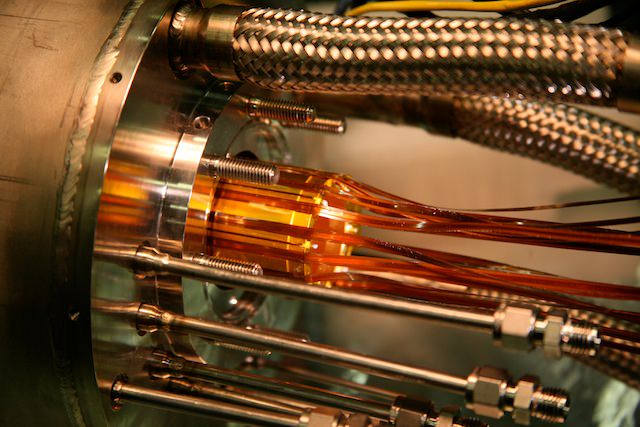
Can warp drive be far behind? A paper published in this week’s edition of Nature reports that for the first time, antimatter atoms have been captured and held long enough to be studied by scientific instruments. Not only is this a science fiction dream come true, but in a very real way this could help us figure out what happened to all the antimatter that has vanished since the Big Bang, one of the biggest mysteries of the Universe. "We're very excited about the fact that we can actually now trap antimatter atoms long enough to study their properties and see if they're very different from matter," said Makoto Fujiwara, a team member from ALPHA, an international collaboration at CERN.
Antimatter is produced in equal quantities with matter when energy is converted into mass. This happens in particle colliders like CERN and is believed to have happened during the Big Bang at the beginning of the universe.
“A good way to think of antimatter is a mirror image of normal matter,” said team spokesman Jeffrey Hangst, a physicist at Aarhus University in Denmark. “For some reason the universe is made of matter, we don’t know why that is, because you could in principle make a universe of antimatter.”
In order to study antimatter, scientists have to make it in a laboratory. The ALPHA collaboration at CERN has been able to make antihydrogen – the simplest antimatter atom – since 2002, producing it by mixing anti- protons and positrons to make a neutral anti-atom. “What is new is that we have managed to hold onto those atoms,” said Hangst, by keeping atoms of antihydrogen away from the walls of their container to prevent them from getting annihilated for nearly a tenth of a second.
The antihydrogen was held in an ion trap, with electromagnetic fields to trap them in a vacuum, and cooled to 9 Kelvin (-443.47 degrees Fahrenheit, -264.15 degrees Celsius). To actually see if they made any antihydrogen, they release a small amount and see if there is any annihilation between matter and antimatter.
The next step for the ALPHA collaboration is to conduct experiments on the trapped antimatter atoms, and the team is working on a way to find out what color light the antihydrogen shines when it is hit with microwaves, and seeing how that compares to the colors of hydrogen atoms.