 Universe Today
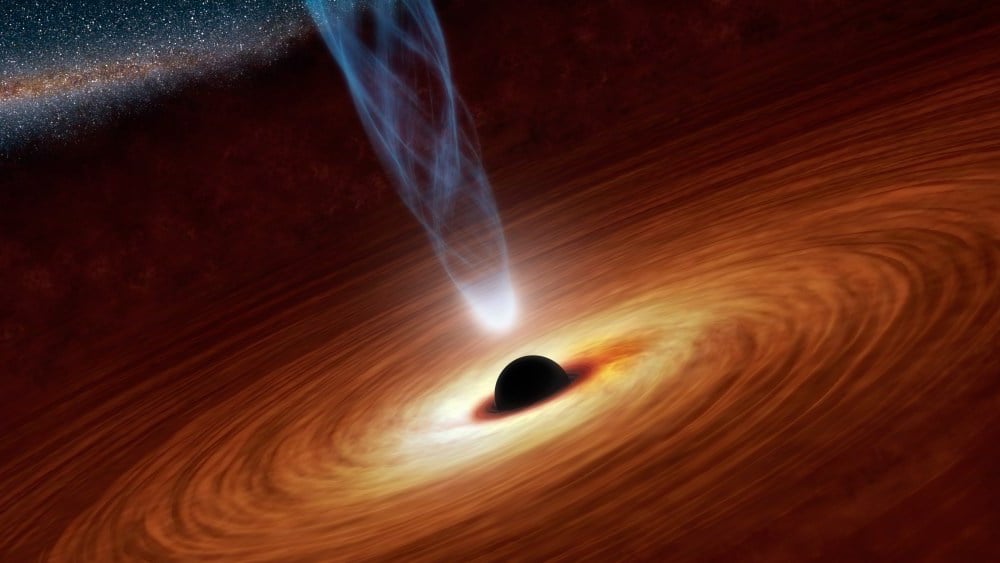
Black holes are one of the most misunderstood objects in the Universe. Much of the confusion stems from their name. When you hear the words "black hole," you might picture a tunnel in spacetime that leads to... certain death or something else. In reality, black holes are the collapsed remnants of stars that have become so dense that the gravitational force on their surfaces reaches the speed of light. As a result, nothing (including light) can escape their outer boundary, known as the "event horizon."
At MIT's Kavli Institute for Astrophysics and Space Research, Professor Erin Kara leads a group at the forefront of black hole physics. Using data from space- and ground-based telescopes, they study the properties of black holes, how they grow, and how they affect their environments. Of particular interest to the team are the supermassive black holes (SMBHs) that reside at the centers of massive galaxies, which play an important role in their formation and evolution.
Kara began her journey at the Institute of Astronomy at Cambridge University, where she pursued her master's degree in physics. After completing the year-long program, she stayed to complete her Ph.D. on the relatively new topic of black hole X-ray reverberation. Andy Fabian OBE FRS, a Royal Society Research Professor at the Institute of Astronomy and the leader of its X-ray research group, was her thesis advisor.
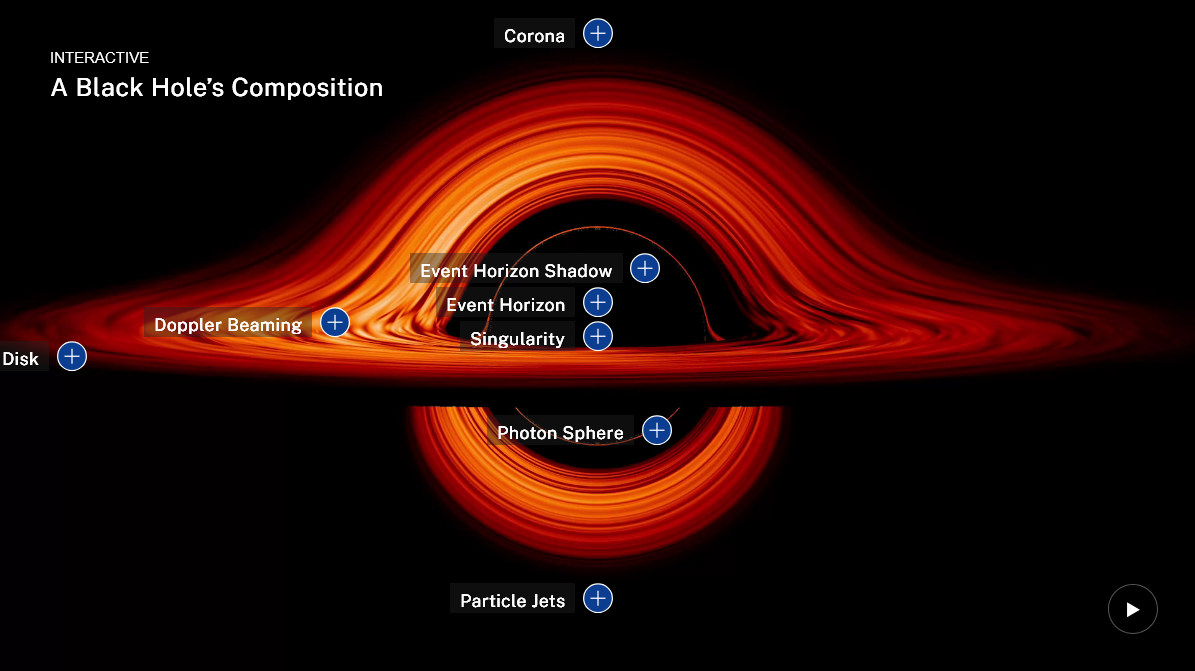 The anatomy of a black hole, emphasizing the accretion disk, event horizon, and other areas. Credit: NASA
In 2009, Fabian and his team were reviewing archival X-ray data when they noticed strange time delays from the crown-shaped, high-energy region surrounding black holes (the corona). They interpreted the signals as the first evidence of X-ray reverberations around a black hole. They further determined that these resulted from X-ray radiation generated by the black hole's corona bouncing off the swirling disk of gas and dust that circles a black hole (the accretion disk). As Kara explained:
They had only found these echoes in one black hole. But the archive was full of data of these reverberation signals that no one had analyzed in this particular way. So I had my whole PhD to kind of play with this archive, and it felt very discovery-driven.
This event led Kara to keep studying X-ray reverberations as a technique for mapping regions around black holes. After earning her PhD, she did her postdoctoral work at the University of Maryland and NASA's Goddard Space Flight Center, where she also worked on the Japanese mission Hitomi. While the mission failed after 40 days in space, the data it returned validated its microalorimeter instrument.
This technology later informed the X-ray Imaging and Spectroscopy Mission (XRISM), for which Kara leads a science group that analyzes X-ray signals emitted from SMBH coronas. In between, Kara worked with the MIT team that developed the Neutron Star Interior Composition Explorer (NICER), which is now integrated with the International Space Station (ISS) and measures X-ray timing from astrophysical sources.
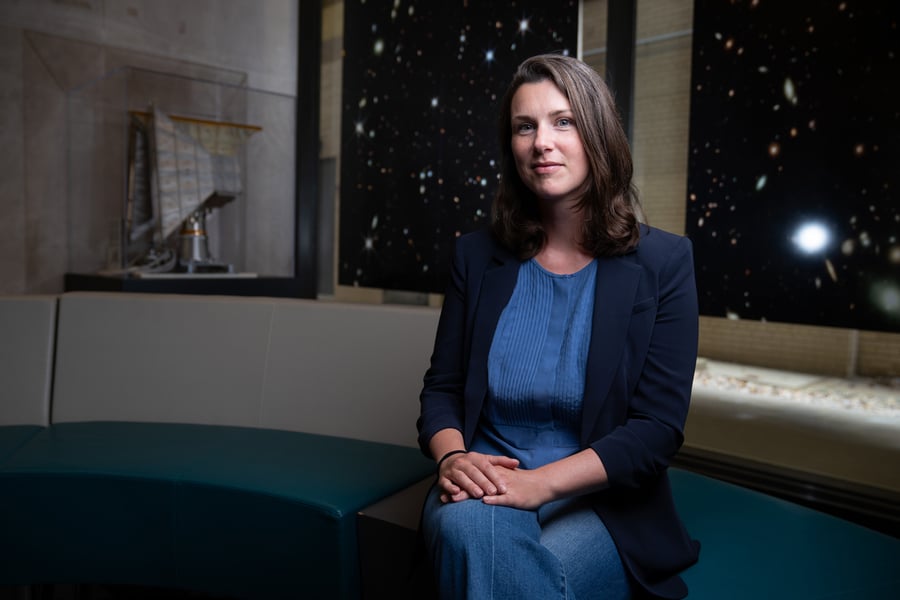 Prof. Erin Kara at MIT's Kavli Institute for Astrophysics and Space Research. Credit: Bryce Vickmark
Today, she continues to advance the X-ray reverberation technique, which has helped scientists map the extreme regions surrounding SMBHs. She and her students analyze data from XRISM, NICER, and other missions to better understand how black holes grow, evolve, and affect the galaxies around them. In addition, her group also studies other extreme X-ray sources, ranging from tidal disruption events and periodic eruptions to black hole outbursts.
Their efforts have led to some surprising discoveries about black holes that challenge previous notions. Said Kara:
It used to be that we didn't have eyes on systems all the time. Now we're seeing that they can turn on and off at rates that are much faster than we ever thought possible. We see things are getting sucked in toward black holes faster than we thought, perhaps due to stars whipping around and getting trapped in a black hole's accretion disk.
Kara's work will soon extend to future observsatories like the Ultraviolet Transiet Astronomy Satellite (ULTRASAT) and the Laser Interferometer Space Antenna (LISA). These missions will continuously scan the sky for hot, ultraviolet sources and detect low-frequency gravitational waves caused by black hole mergers.
"It’s amazing that we as humans can know anything about what’s happening billions of light-years away," she said. "There’s a lot of new open puzzles about supermassive black holes that I’m excited about."
Further Reading: MIT