Universe Today
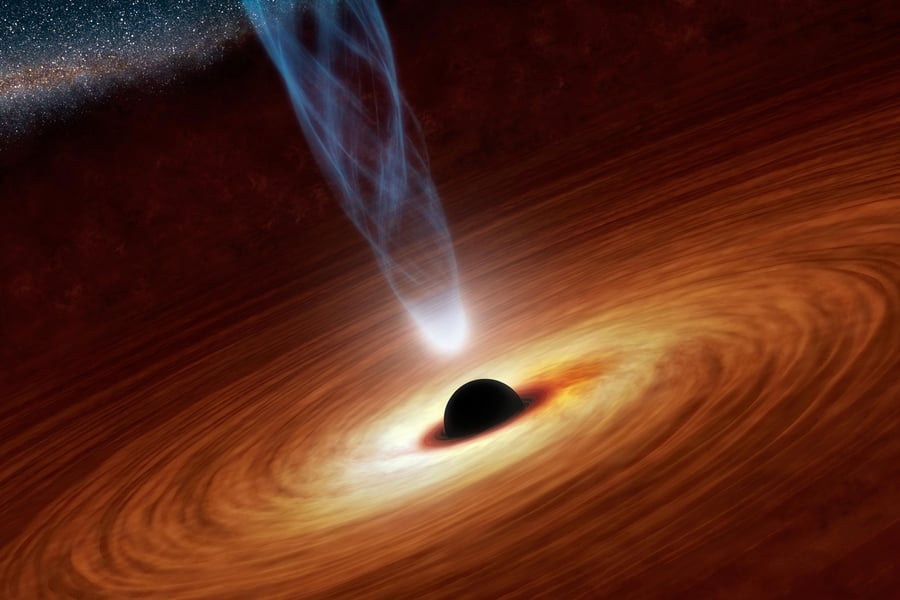
Astronomers have detected a flickering quasar called J0439+1634 as it appeared only 850 million years after the Big Bang. That discovery raises fresh questions about black hole formation and activity in the early Universe. The flickering light of this distant cosmic lighthouse showed that black hole at the heart of the quasr has a flat, pancake-shaped accretion disk. That shape is more familiar in modern-day quasars, which leads astronomers to wonder how these objects formed so quickly in the infant cosmos?
The discovery represents the earliest flickering quasar detected to date, according Gene Leung, of MIT's Kavli Institute for Astrophysics and Space Research. “Although there have been a lot of quasars found in the cosmic dawn, this is the first time we actually see one flickering,” he said.
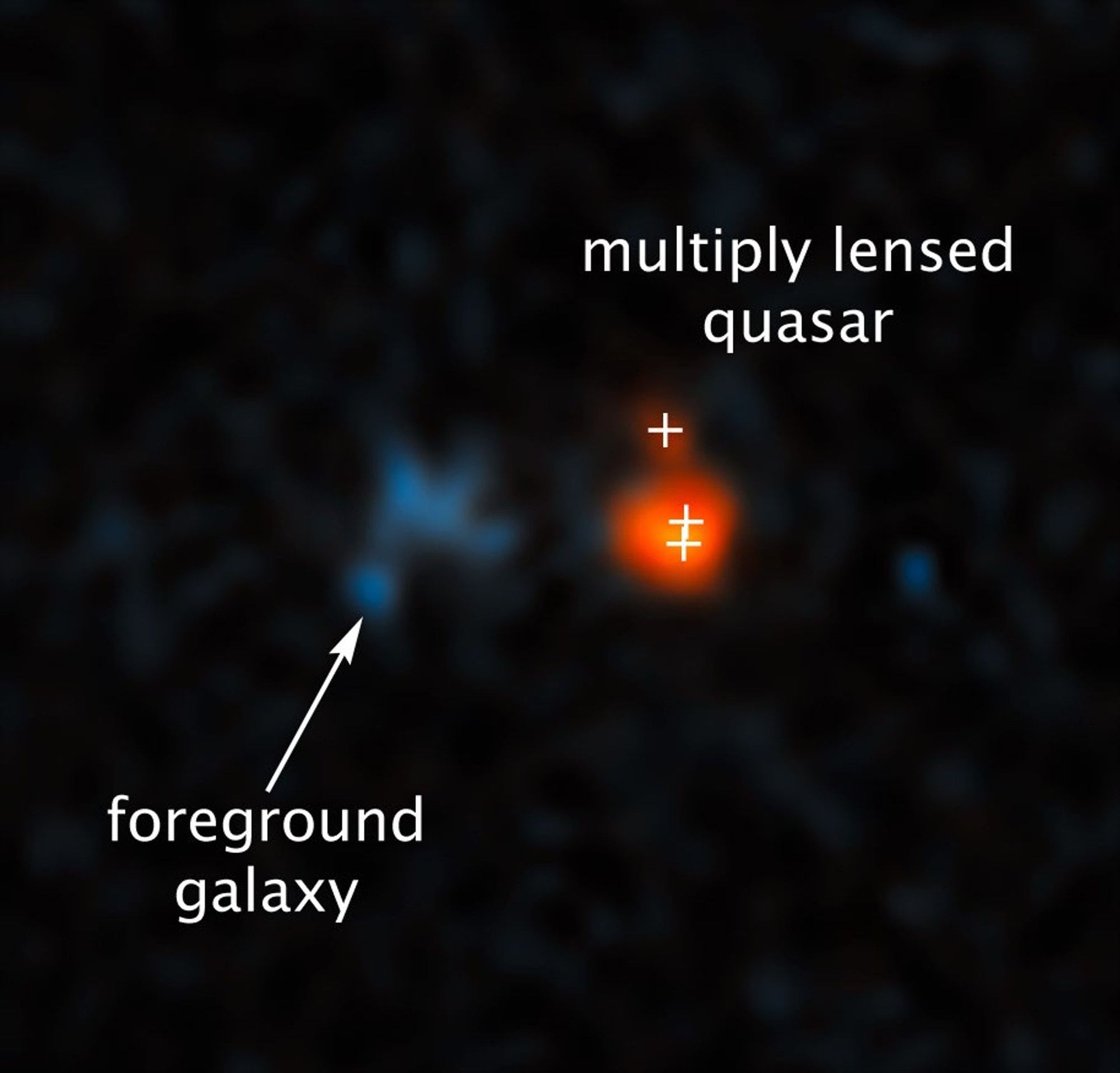 J0439+1634 first showed up in an HST image of a distant galaxy being lensed by a foreground galaxy. This view shows us what it looked like 12.8 billion years ago, not long after the Big Bang (13.8 billion years ago).
Supermassive Black Holes Across Time
The quasar J0439+1634 sports a supermassive black hole at its heart, billions of times more massive than our Sun. Essentially, it's the engine that powers the quasar. The fact that it has a flat accretion disk is puzzling, because astronomers have always thought that such a structure means that the black hole has settled down into a relatively quiescent state. Black holes that are just starting to form, like those in the very early universe, should be more unsettled systems, with accretion disks that appear more puffy and chaotic.
An active black hole sucks in material from surrounding space through a whirlpool-shaped structure containing high-temperature gas and dust. As this cosmic material piles up and falls onto a black hole, it lights up its vicinity, radiating a huge amount of energy. In many quasars, jets of energized material stream out through space. The luminosity of the material is what we see when we look at a quasar. “I think what this suggests is that all the messy, very rapid growth phases that we expect all black holes to go through at some point happen very, very early on, before we see them as these very bright luminous quasars,” says Anna-Christina Eilers, assistant professor of physics at MIT. “That’s the picture that’s emerging.”
In addition to lighting up the nearby regions, the activity of the black hole can affect star formation as well as the shape of the galaxy over time. “Without supermassive black holes, no galaxy would look the way it does today,” Eilers said. “Black holes play a major role in shaping how galactic ecosystems look.”
Spotting the Flicker
Astronomers assumed that the first galaxies would take around a billion years to settle into their mature shapes. If that were true, nobody would expect to see supermassive black holes at their hearts. But, the Universe doesn't always play well with assumptions. Observers have found more than 200 supermassive black holes in the early Universe's first billion years. They show up as tiny points of extremely bright light, which meant they were active and growing.
At the distance which early quasars lie, it's pretty tough to detect anything more than their luminosity. To get a sense of what their surroundings are like, it helps to have flickering light. That's because a quasar's flicker can give clues to its accretion disk's activity.
To detect the flicker at J0439+1634, the team had to overcome the technical challenges of distance and redshift. To spot a flickering quasar from the cosmic dawn, the team needed to observe the distant Universe at redder wavelengths (due to the stretching of light by the expansion of the Universe). They looked specifically within the infrared spectrum, and over long timescales of many years. They turned to data from the NEOWISE mission that scanned the sky for about 14 years. After reprocessing the data, the astronomers found the flicker in J0439+1634. Based on their analysis, the science team estimated that J0439+1634 is as bright as 12 trillion suns and flickers by a brightness of about 2 trillion suns. They also traced the shape of the accretion disk and found it to be very similar to more "modern" quasars.
“This provides direct evidence that the same feeding processes and structures observed in the nearby Universe were already in place at very early times, despite very different cosmic environments, which had never been seen before,” Eilers said.
Gaining New Knowledge about the Early Cosmos
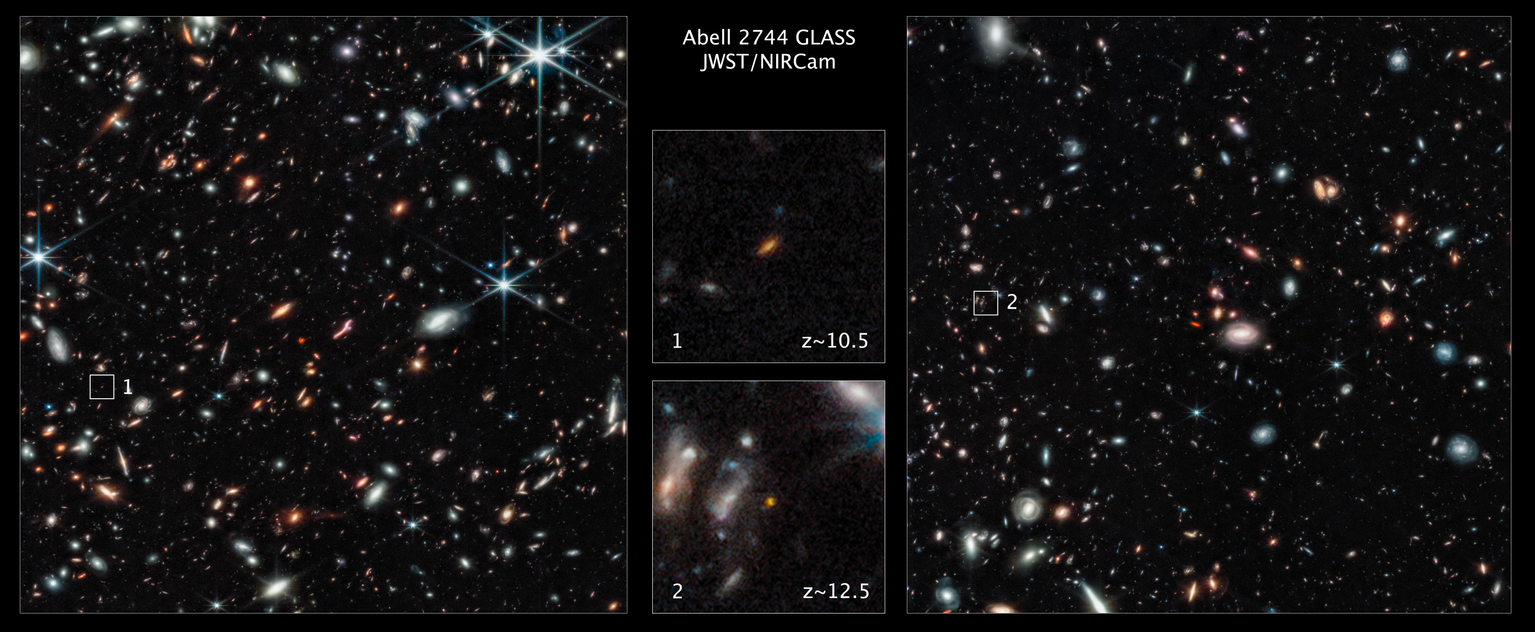 A Webb image of two early and very distant galaxies. The galaxies lie billions of light years beyond the Abell 2744 cluster (which is lensing them). The galaxy labeled 1 is shown as it appeared 450 million years after the Big Bang; the galaxy labeled 2 appears as it looked 350 million years after the Big Bang. These were not in their final form. Could supermassive black holes be forming within them, shaping their evolution? Credit: NASA, ESA, CSA, Tommaso Treu (UCLA); Image Processing: Zoltan Levay (STScI)
To put it all into perspective, the first galaxies are thought to have begun forming within the first billion years after the Big Bang. Today we know that a supermassive black hole lies within most(if not all) galaxies. Yet, astronomers also think that it takes billions of years to create a supermassive black hole. The appearance of a fairly mature one in J0439+1634 at a time when the Universe was only 850 million years old raises a lot of questions.
“This means something happened even earlier on that led to these systems to look so mature,” Leung adds. What that "something" is remains to be studied. To do that, astronomers need to look even further back in history, to a time when the galaxy that hosts the quasar was first forming.
For More Information
https://news.mit.edu/2026/mit-astronomers-discover-earliest-known-flickering-quasar-0608
Discovery of Quasar Variability and Early Accretion Disk Signatures at Cosmic Dawn
Discovery of Quasar Variability and Early Accretion Disk Signatures at Cosmic Dawn