 Universe Today
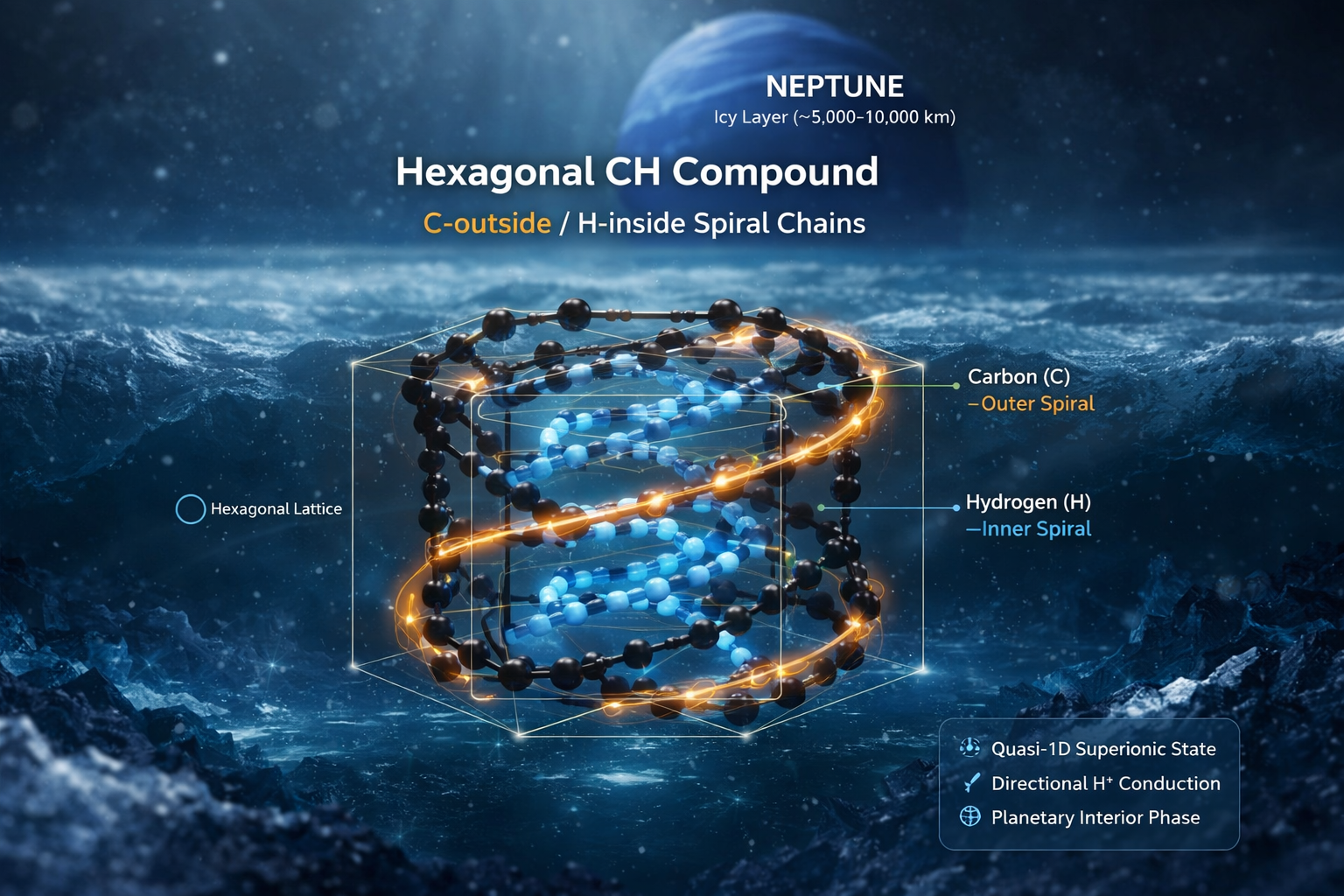
Despite outward appearances, the internal workings of ice giants like Uranus and Neptune are extremely chaotic. Pressures millions of times greater than Earth’s sea level combine with temperatures in the thousands of degrees to make some pretty weird materials. Now, a new paper from researchers at the Carnegie Institution, published in Nature Communications, describes a completely new state of matter that might exist in these extreme environments - a “quasi-1D superionic” phase.
Scientists have known for a long time these ice planets aren’t made with normal “ices” as we might think of them on Earth. Instead they are composed of a hot, dense slurry of water, ammonia and methane. But recreating the conditions that create that slurry in a lab are next to impossible. It would require terapascals of pressure at high enough temperatures to melt most containers.
Typically researchers turn to simulations to solve this problem - specifically one known as “Synthetic Uranus” that mimics the environment of the 7th planet from the Sun, including the pressure and heat. From previous chemical studies, we already knew that conventional molecules, like methane, don’t survive in their traditional forms. It breaks apart at around 95 gigapascal, creating hydrogen-rich materials alongside carbon allotropes like diamond.
Anton Petrov discusses superionic ice. Credit - Anton Petrov YouTube ChannelBut even that simulation style has its flaws, and it breaks down at even higher pressures. To rectify that problem, the paper approaches it from a first-principles standpoint, allowing the quantum mechanics of the system to build the entire environment - at least as much as quantum mechanics will allow itself to be modeled anyway. According to this simulation method, at pressures above 1100 GPa, carbon and hydrogen go on to form a stable compound, but with a highly unusual structure.
The carbon atoms at these pressures lock into a rigid, solid lattice shaped like a chiral helix - basically a microscopic, twisting spiral staircase. But the most interesting part happens when heat is added. Normally, adding heat would turn this lattice structure into a liquid, allowing the atoms to move freely. But in some other materials, like water, increasing heat causes one set of atoms (in water’s case, oxygen) to remain in a crystal solid while the other (hydrogen) starts flowing freely. This is known as a “superionic” state.
Between 1000 and 3000 Kelvin, the new CH compound enters a superionic state, but with a twist. Instead of oxygen forming the crystal structure, like it does in water, this crystal lattice is formed out of carbon atoms. The hydrogen atoms, while constrained by the carbon lattice, exhibit superionic diffusion along the helical “staircase” (the z-axis) combined with rotational motion in the transverse (xy) plane. Those hydrogen atoms can flow easily up or down the staircase, but in the other directions they seem more likely to rotate than to move. This one-directional movement with two-dimensional rotation caused the researchers to categorize it as a hybrid type of “diffusional dimensionality” - the world’s first quasi-1D superionic state.
Fraser talks about what we think might be inside UranusAll that is well in theory, but what does it mean in practice? The most noticeable impact is that the material’s properties become anisotropic - meaning they vary depending on the direction you measure them from. For example, the material seems to conduct heat and electricity very well on the “staircase” axis, but not so much on either of the other two. Also, despite the fact that it has moving hydrogen atoms (which are positively charged), the electrical conductivity seems to be still dominated by electrons moving.
At a macro scale, this helps feed into theories about why the magnetic fields of Neptune and Uranus are so weird. Conventional models explain their tilted magnetic fields by assuming the hot, superionic ices conduct heat and electricity the same in all directions. But with this new quasi-1D superionic phase, that assumption is called into question, and could better fit the experimental data we get from the planets themselves.
Obviously a basic carbon-hydrogen material is a massive oversimplification of the complex chemical and thermal dynamics going on in the cores of these worlds. But the fact that we even have a chance to model and understand how some of these materials might work in the real world shows there’s so much more that planetary science can still teach us about how the universe works.
Learn More:
The Carnegic Institute - The depths of Neptune and Uranus may be “superionic”
C. Liu, R. E. Cohen, & J. Sun - Prediction of thermally driven quasi-1D superionic states in carbon hydride under giant planetary conditions
UT - Why do Uranus and Neptune Have Magnetic Fields? Hot ice

