Universe Today
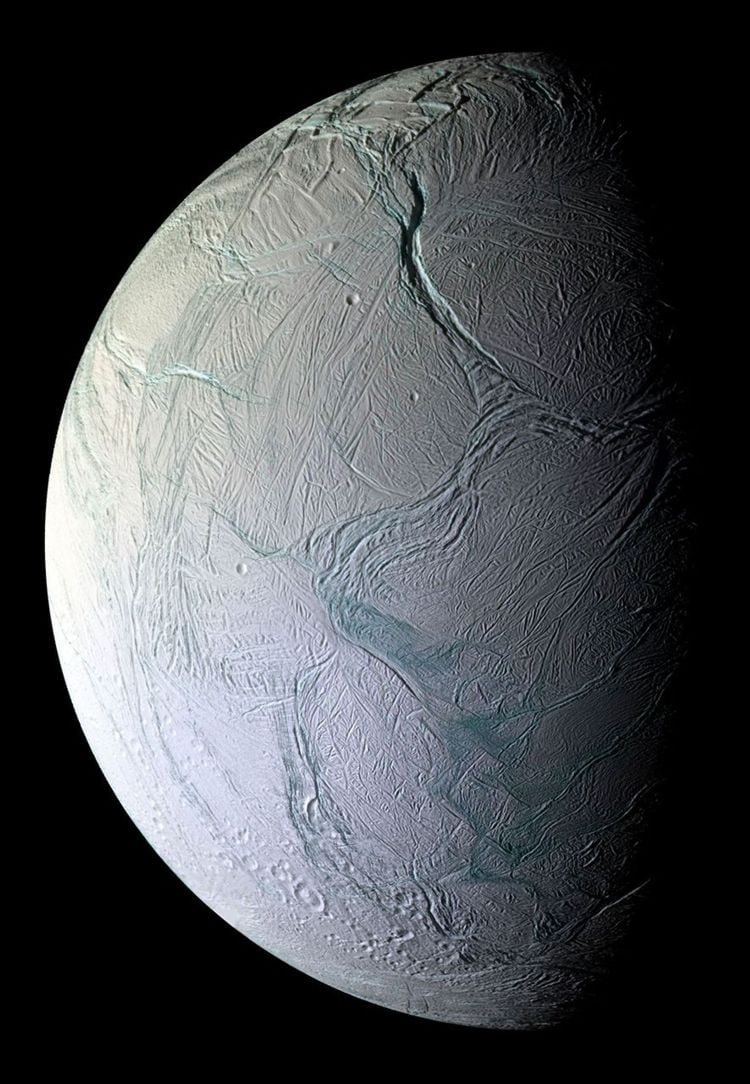
Saturn’s moon, Enceladus, has become a prime solar system target for astrobiologists. This is because the small moon, which is just over 10 percent the diameter of Earth’s Moon, harbors a vast subsurface ocean beneath its icy crust. This subsurface ocean combined with the geysers at Enceladus’ south pole that discharges bits of this ocean into the void provides scientists with a treasure trove of opportunities for scientific research into whether Enceladus could harbor ingredients for life as we know it, or even direct evidence for life.
Now, a team of researchers from the European Space Agency (ESA) have discussed the instruments and payload suite that could be a part of a flagship mission to Enceladus in 2050. This study was presented at the EPSC-DPS (Europlanet Science Congress-Division for Planetary Sciences) Joint Meeting 2025 in September 2025 and could help contribute to longstanding Enceladus research, as they had contributions to NASA’s Cassini-Huygens, spacecraft which explored Enceladus from 2004-2017. The study refers to this planned mission as an L4 mission with L1-L3 being JUICE, LISA, and the NewAthena missions, respectively, as part of the ESA’s Voyage 2050 Science Program.
Despite not slated to arrive at Enceladus until the early 2050s, the researchers discuss an impressive list of scientific instruments and payloads for both an orbiter and lander designed to determine the potential ingredients for life as we know it and potential habitability on the small moon. For the lander, these include a mass spectrometer, micro-camera, meteorological and geophysical payloads, biomarker laboratory detection, descent cameras, and a sample system. For the orbiter, the payload includes several types of imaging cameras in visible and other wavelengths, a magnetometer, ice penetrating radar, dust and gas analyzers, and a gravity and radios science experiment.
The study notes, “In parallel to these efforts, the engagement of the broader technical and technology community in Europe is necessary to begin advancing the development of their payloads, thereby enhancing the probability of their selection. For instance, miniaturization of payload designs is strongly encouraged for resource optimization. Further, it is crucial for the reliable detection of biosignatures to study processes preventing spacecraft-induced or forward contamination as well as false positives. To this end, payload teams from European universities and research institutes are invited to explore funding opportunities in coordination with their respective national space agencies and ESA technology funding programs.”
As noted, the ESA has made significant contributions to the exploration of Enceladus, most notably during the Cassini-Huygens mission. This included German researchers leading the Cosmic Dust Analyzer onboard Cassini, which was responsible for detecting sodium and potassium salts on Enceladus, thus serving as the smoking gun in confirming the existence of a subsurface ocean on the small moon. However, this L4 mission is slated to be the first ESA-led mission to Enceladus, meaning the ESA is entirely funding, managing, and leading the mission.
Discovered in 1789, Enceladus and its intriguing characteristics remained largely a mystery for almost 200 years, as it wasn’t until NASA’s Voyager 1 and Voyager 2 conducted brief flybys of Enceladus in 1980 and 1981, respectively. But this all changed when NASA’s Cassini first studied Enceladus in 2005, including its first flyby in February 2005 that noticed Saturn’s magnetic field was interacting with Enceladus. This was followed by a second flyby the following month that discovered ice particles orbiting the small moon. Finally, Cassini performed an incredibly risky low-altitude flyby only 175 kilometers (109 miles) above the surface, but revealing Enceladus in new and incredible detail, including the discovery of the now-famous “tiger stripes” at Enceladus’ south pole that discharge jets of the subsurface ocean into space.
What will this L4 mission to Enceladus teach scientists about the intriguing ocean world in the coming years and decades? Only time will tell, and this is why we science!
As always, keep doing science & keep looking up!