Universe Today
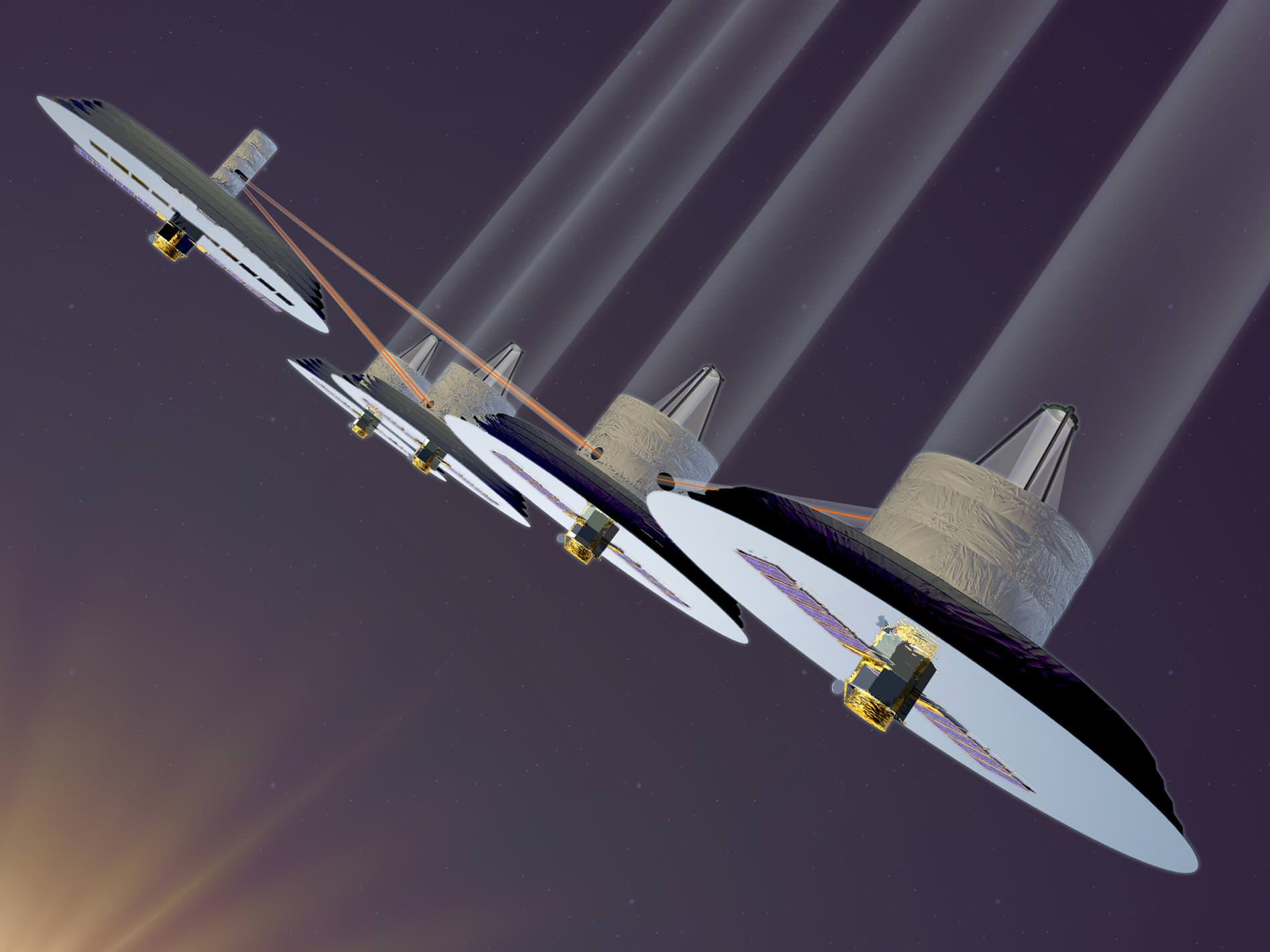
In the coming decade, a number of next-generation instruments will take to space and begin observing the Universe. These will include the
(JWST), which is likely to be followed by concepts like the
Large Ultraviolet/Optical/Infrared Surveyor
(LUVOIR), the
*Origins Space Telescope*
(OST), the
(HabEx) and the
*Lynx X-ray Surveyor*
.
These missions will look farther into the cosmos than ever before and help astronomers address questions like how the Universe evolved and if there is life in other star systems. Unfortunately, all these missions have two things in common: in addition to being very large and complex, they are also very expensive. Hence why some scientists are proposing that we rely on more cost-effective ideas like swarm telescopes.
Two such scientists are Jayce Dowell and Gregory B. Taylor, a research assistant professor and professor (respectively) with the Department of Physics and Astronomy at the University of New Mexico. Together, the pair outlined their idea in a study titled "
The Swarm Telescope Concept
", which recently appeared online and was accepted for publication by the
Journal of Astronomical Instrumentation.
[caption id="attachment_138888" align="aligncenter" width="580"]
Illustration of NASA's James Webb Space Telescope. Credits: NASA[/caption]
As they state in their study, traditional astronomy has focused on the construction, maintenance and operation of single telescopes. The one exception to this is radio astronomy, where facilities have been spread over an extensive geographic area in order to obtain high angular resolution. Examples of this include the
Very Long Baseline Array
(VLBA), and the proposed
Square Kilometer Array
(SKA).
In addition, there's also the problem of how telescopes are becoming increasingly reliant on computing and digital signal processing. As they explain in their study, telescopes commonly carry out multiple simultaneous observation campaigns, which increases the operational complexity of the facility due to conflicting configuration requirements and scheduling considerations.
A possible solution, according to Dowell and Taylor, is to rethink telescopes. Instead of a single instrument, the telescope would consist of a distributed array where many autonomous elements come together through a data transport system to function as a single facility. This approach, they claim, would be especially useful when it comes to the
Next Generation Very Large Array
(NGVLA) - a future interferometer that will build on the legacy of the
Karl G. ansky Very Large Array
and
Atacama Large Millimeter/submillimeter Array
(ALMA). As they state in their study:
https://science.nrao.edu/videos/ngvla/NgVLA_HLTau_Animation_forWebsite.mp4
This idea for a distributed telescope is inspired by the concept of
swarm intelligence
, where large swarms of robots are programmed to interact with each other and their environment to perform complex tasks. As they explain, the facility comes down to three major components: autonomous element control, a method of inter-element communication, and data transport management.
Of these components, the most critical is the autonomous element control which governs the actions of each element of the facility. While similar to traditional monitoring and control systems used to control individual robotic telescopes, this system would be different in that it would be responsible for far more. Overall, the element control would be responsible for ensuring the safety of the telescope and maximizing the utilization of the element.
"The first, safety of the element, requires multiple monitoring points and preventative actions in order to identify and prevent problems," they explain. "The second direction requires methods of relating the goals of an observation to the performance of an element in order to maximize the quantity and quality of the observations, and automated methods of recovering from problems when they occur."
The second component, inter-element communication, is what allows the individual elements to come together to form the interferometer. This can take the form of a leaderless system (where there is no single point of control), or an organizer system, where all of the communication between the elements and with the observation queue is done through a single point of control (i.e. the organizer).
[caption id="attachment_139576" align="aligncenter" width="580"]
Long Wavelength Array, operated by the University of New Mexico. Credit: phys.unm.edu
[/caption]
Lastly, their is the issue of data transport management, which can take one of two forms based on existing telescopes. These include fully 0ff-line systems, where correlation is done post-observation - used by the
Very Long Baseline Array
(VLBA) - to fully-connected systems, where correlation is done in real-time (as with the VLA). For the sake of their array, the team emphasized how connectivity and correlation are a must.
After considering all these components and how they are used by existing arrays, Dowell and Taylor conclude that the swarm concept is a natural extension of the advances being made in robotic and thinking telescopes, as well as interferometry. The advantages of this are spelled out in their conclusions:
In addition, swarm telescopes will offer new opportunities and funding since they will consist of small elements that can be owned and operated by different entities. In this way, different organizations would be able to conduct science with their own elements while also being able to benefit from large-scale interferometric observations.
[caption id="attachment_139152" align="aligncenter" width="580"]
Graphic depiction of Modular Active Self-Assembling Space Telescope Swarms
Credit: D. Savransky[/caption]
This concept is similar to the
Modular Active Self-Assembling Space Telescope Swarms
, which calls for a swarm of robots that would assemble in space to form a 30 meter (~100 ft) telescope. The concept was proposed by a team of American astronomers led by Dmitri Savransky, an assistant professor of mechanical and aerospace engineering at Cornell University.
This proposals was part of the
2020 Decadal Survey for Astrophysics
and was recently selected for Phase I development as part of the
2018 NASA Innovative Advanced Concepts
(NIAC) program. So while many large-scale telescopes will be entering service in the near future, the next-next-generation of telescopes could include a few arrays made up of swarms of robots directed by artificial intelligence.
Such arrays would be capable of achieving high-resolution astronomy and interferometry at lower costs, and could free up large, complex arrays for other observations.
Further Reading: arXiv