Universe Today
The
Cassini
orbiter revealed many fascinating things about the Saturn system before its mission ended in
September of 2017
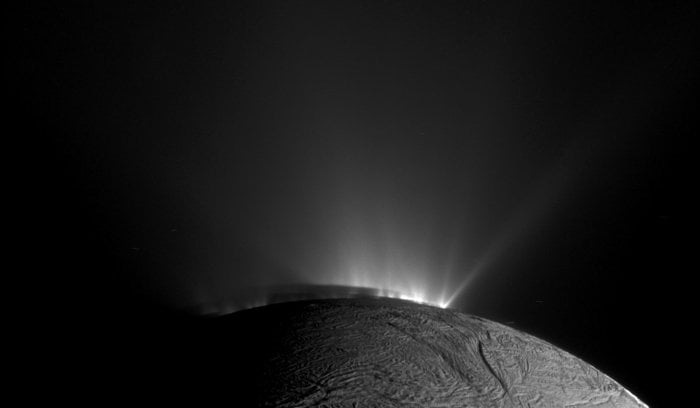
. In addition to revealing much about Saturn's rings and the surface and atmosphere of Titan (Saturn's largest moon), it was also responsible for the discovery of water plumes coming from
Enceladus
' southern polar region. The discovery of these plumes triggered a widespread debate about the possible existence of life in the moon's interior.
This was based in part on evidence that the plumes extended all the way to the moon's core/mantle boundary and contained elements essential to life. Thanks to a
new study
led by researchers from of the University of Heidelberg, Germany, it has now been confirmed that the plumes contain complex organic molecules. This is the first time that complex organics have been detected on a body other than Earth, and bolsters the case for the moon supporting life.
The study, titled "
Macromolecular organic compounds from the depths of Enceladus
", recently appeared in the journal
Nature.
The study was led by Frank Postberg and Nozair Khawaja of the Institute for Earth Sciences at the University of Heidelberg, and included members from the
Leibniz Institute of Surface Modification
(IOM), the
Southwest Research Institute
(SwRI), NASA's Jet Propulsion Laboratory, and multiple universities.
[caption id="attachment_120239" align="aligncenter" width="580"]
The "tiger stripes" of Enceladus, as pictured by the Cassini space probe. Credit: NASA/JPL/ESA
[/caption]
The existence of a liquid water ocean in Enceladus' interior has been the subject of scientific debate since 2005, when Cassini first observed
plumes containing water vapor
spewing from the moon's south polar surface through cracks in the surface (nicknamed "Tiger Stripes"). According to measurements made by the
probe, these emissions are composed mostly of water vapor and contain molecular nitrogen, carbon dioxide, methane and other hydrocarbons.
The combined analysis of imaging, mass spectrometry, and magnetospheric data also indicated that the observed southern polar plumes emanate from pressurized subsurface chambers. This was confirmed by the
Cassini
mission in 2014 when the probe conducted gravity measurements that indicated the existence of a south polar
subsurface ocean of liquid water
with a thickness of around 10 km.
Shortly before the probe plunged into Saturn's atmosphere, the probe also obtained data that indicated that the interior ocean has
existed for some time
. Thanks to previous readings that indicated the presence of hydrothermal activity in the interior and simulations that modeled the interior, scientists concluded that if the core were porous enough, this activity could have provided enough heat to maintain an interior ocean for billions of years.
However, all the previous studies of
Cassini
data were only able to identify
simp
l
e o
rganic c
o
mpounds in the plume material, with
molecu
lar masses mostly b
elow
50 a
to
mic mass units. For the sake of their study, the team observed evidence of complex macromolecular organic material in the plumes' icy grains that had masses above 200 atomic mass units.
[caption id="attachment_139539" align="aligncenter" width="580"]
Hydrothermal activity in Enceladus' core and the rise of organic-rich bubbles. Credit and Copyright: ESA; F. Postberg et al (2018)
[/caption]
This constitutes the first-ever detection of complex organics on an extraterrestrial body.
As Dr. Khawaja explained in a recent ESA
press release
:
The molecules that were detected were the result of the ejected ice grains hitting the dust-analyzing instrument aboard Cassini at speeds of about 30,000 km/hour. However, the team believes that these were mere fragments of larger molecules contained beneath Enceladus' icy surface. As they state in their study, the data suggests that there is a thin organic-rich film on top of the ocean.
These large molecules would be the result of by complex chemical processes, which could be those related to life. Alternately, they may be derived from primordial material similar to what has been found in some meteorites or (as the team suspects) that is generated by hydrothermal activity. As Dr. Postberg explained:
[caption id="attachment_136960" align="aligncenter" width="448"]
Artist rendering showing an interior cross-section of the crust of Enceladus, which shows how hydrothermal activity may be causing the plumes of water at the moon's surface. Credits: NASA-GSFC/SVS, NASA/JPL-Caltech/Southwest Research Institute
[/caption]
As noted, recent simulations have shown the moon could be generating enough heat through hydrothermal activity for its interior ocean to have existed for billions of years. This study follows up on that scenario by showing how organic material could be injected into the ocean by hydrothermal vents. This is similar to what happens on Earth, a process that scientists believe may have played a vital role in the origins of life on our planet.
On Earth, organic substances are able to accumulate on the walls of rising air bubbles created by hydrothermal vents, which then rise to the surface and are dispersed by sea spray and the bubbles bursting. Scientists believe a similar process is happening on Enceladus, where bubbles of gas rising through the ocean could be bringing organic materiel up from the core-mantle boundary to the icy surface.
When these bubbles burst at the surface, it helps disperse some of the organics which then become part of the salty spray coming through the tiger cracks. This spray then freezes into icy particles as it reaches space, sending organic material and ice throughout the Saturn System, where it has now been detected. If this study is correct, then another fundamental ingredient for life is present in Enceladus' interior, making the case for life there that much stronger.
This is just the latest in a long-line of discoveries made by Cassini, many of which point to the potential existence of life on or in some of Saturn's moons. In addition to confirming the first organic molecules in an "ocean world" of our Solar System, Cassini also found compelling evidence of a rich probiotic environment and organic chemistry on Titan.
In the future, multiple missions are expected to return to these moons to gather more evidence of potential life, picking up where the venerable
Cassini
left off. So long
Cassini,
and thanks for blazing a trail!
Further Reading: ESA
,
Nature