“Shine on, shine on Harvest Moon… Up in the sky…” Oh! Howdy, fellow SkyWatchers! The seasons are most surely showing their changes in both hemispheres and this week marks the famous “Harvest Moon”. The Moon will very much be in the eyepiece this week, so enjoy some great studies. However, don’t put away your telescopes just yet! Bright skies are a great time to catch up on double star studies and variables. Whenever you’re ready, just meet me in the back yard…
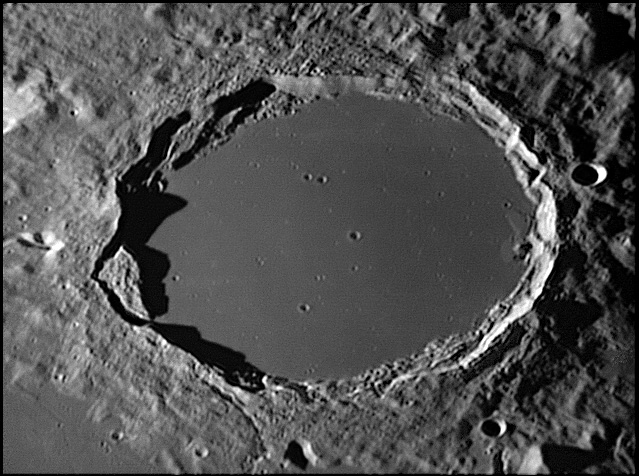
Monday, September 24 – In 1970, the first unmanned, automated return of lunar material to the Earth occurred on this day when the Soviet’s Luna 16 returned with three ounces of the Moon. Its landing site was eastern Mare Fecunditatis. Look just west of the bright patch of Langrenus. Let’s walk upon the Moon this evening as we take a look at sunrise over one of the most often studied and mysterious of all craters – Plato. Located on the northern edge of Mare Imbrium and spanning 95 kilometers in diameter, Class IV Plato is simply a feature that all lunar observers check because of the many reports of unusual happenings. Over the years, mists, flashes of light, areas of brightness and darkness, and the appearance of small craters have become a part of Plato’s lore.
On October 9, 1945 an observer sketched and reported “a minute, but brilliant flash of light” inside the western rim. Lunar Orbiter 4 photos later showed where a new impact may have occurred. While Plato’s interior craterlets average between less than one and up to slightly more than two kilometers in diameter, many times they can be observed – and sometimes they cannot be seen at all under almost identical lighting conditions. No matter how many times you observe this crater, it is ever changing and very worthy of your attention!
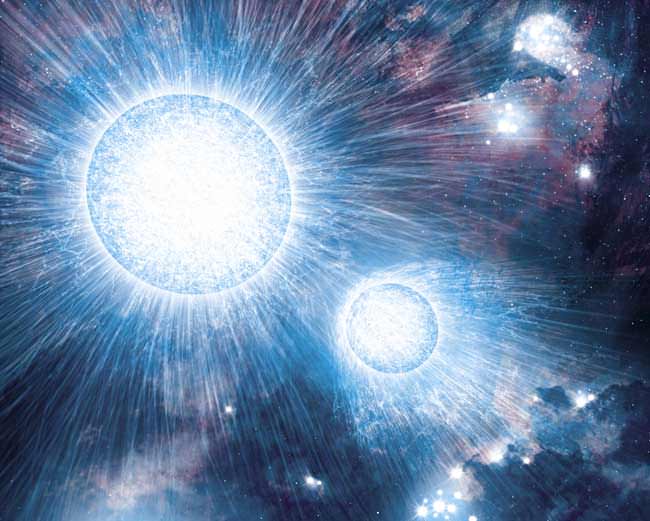
Although tonight’s bright skies will make our next target a little difficult to find visually, look around four fingerwidths southwest of Delta Capricorni (RA 21 26 40 Dec -22 24 40) for Zeta. Also known as 34 Capricorni, Zeta is a unique binary system. Located about 398 light-years from Earth, the primary star is a yellow supergiant with some very unusual properties – it’s the warmest, most luminous barium star known. But that’s not all, because the B component is a white dwarf almost identical in size to our own Sun!
Tuesday, September 25 – Tonight would be a great opportunity to take another look at crater Eratosthenes. Just slightly north of lunar center, this easily spotted feature dangles at the end of the Apennine Mountain range like a yo-yo caught on a string. Its rugged walls and central peaks make for excellent viewing. If you look closely at the mountains northeast of Eratosthenes, you will see the high peak of Mons Wolff. Named for the Dutch philosopher and mathematician, this outstanding feature reaches 35 kilometers in height. To the southwest of Era-tosthenes you may also spot the ruined remains of crater Stadius. Very little is left of its walls and the floor is dotted with small strikes. Near the twin pair of punctuations to its south lie the remains of Surveyor 2! Now let’s journey to a very pretty star field as we head toward the western wing tip in Cygnus to have a look at Theta – also known as 13 Cygni. It is a beautiful main sequence star that is also considered by modern catalogs to be a double. For large telescopes, look for a faint (13th magnitude) companion to the west… But it’s also a wonderful optical triple!
Also in the field with Theta to the southeast is the Mira-type variable R Cygni, which ranges in magnitude from around 7 to 14 in slightly less than 430 days. This pulsating red star has a really quite interesting history that can be found at AAVSO, and is circumpolar for far northern observers. Check it out!
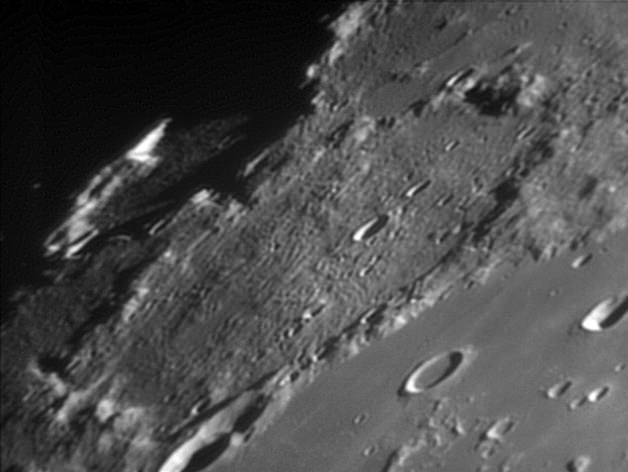
Wednesday, September 26 – Tonight on the Moon, let’s take an in-depth look at one of the most impressive of the southern lunar features – Clavius.
Although you cannot help but be drawn visually to this crater, let’s start at the southern limb near the terminator and work our way up. Your first sighting will be the large and shallow dual rings of Casatus with its central crater and Klaproth adjoining it. Further north is Blancanus with its series of very small interior craters, but wait until you see Clavius. Caught on the southeast wall is Rutherford with its central peak and crater Porter on the northeast wall. Look between them for the deep depression labeled D. West of D you will also see three outstanding impacts: C, N and J; while CB resides between D and Porter. The southern and southwest walls are also home to many impacts, and look carefully at the floor for many, many more! It has been often used as a test of a telescope’s resolving power to see just how many more craters you can find inside tremendous old Clavius. Power up and enjoy!
And if you’d like to visit an object that only requires eyes, then look no further than Eta Aquilae one fist-width due south of Altair…
Discovered by Pigot in 1784, this Cepheid-class variable has a precision rate of change of over a magnitude in a period of 7.17644 days. During this time it will reach of maximum of magnitude 3.7 and decline slowly over 5 days to a minimum of 4.5… Yet it only takes two days to brighten again! This period of expansion and contraction makes Eta very unique. To help gauge these changes, compare Eta to Beta on Altair’s same southeast side. When Eta is at maximum, they will be about equal in brightness.
Thursday, September 27 – Tonight exploring the Moon will be in order as one of the most graceful and recognizable lunar features will be prominent – Gassendi. As an ancient mountain-walled plain that sits proudly at the northern edge of Mare Humorum, Gassendi sports a bright ring and a triple central mountain peak that are within the range of binoculars.
Telescopic viewers will appreciate Gassendi at high power in order to see how its southern border has been eroded by lava flow. Also of note are the many rilles and ridges that exist inside the crater and the presence of the younger Gassendi A on the north wall. While viewing the Mare Humorum area, keep in mind that we are looking at an area about the size of the state of Arkansas. It is believed that a planetoid collision originally formed Mare Humorum. The incredible impact crushed the surface layers of the Moon resulting in a concentric “anticline” that can be traced out to twice the size of the original impact area. The floor of this huge crater then filled in with lava, and was once thought to have a greenish appearance but in recent years has more accurately been described as reddish. That’s one mighty big crater!
Tonight we’ll begin with an easy double star and make our way towards a more difficult one. Beautiful, bright and colorful, Beta Cygni is an excellent example of an easily split double star. As the second brightest star in the constellation of Cygnus, Albireo lies roughly in the center of the “Summer Triangle” making it a relatively simple target for even urban telescopes.
Albireo’s primary (or brightest) star is around magnitude 4 and has a striking orangish color. Its secondary (or B) star is slightly fainter at a bit less than magnitude 5, and often appears to most as blue, almost violet. The pair’s wide separation of 34? makes Beta Cygni an easy split for all telescopes at modest power, and even for larger binoculars. At approximately 410 light-years away, this colorful pair shows a visual separation of about 4400 AU, or around 660 billion kilometers. As Burnham noted, “It is worth contemplating, in any case, the fact that at least 55 solar systems could be lined up, edge-to-edge, across the space that separates the components of this famous double!”
Now let’s have a look at Delta. Located around 270 light-years away, Delta is known to be a more difficult binary star. Its duplicity was discovered by F. Struve in 1830, and it is a very tough test for smaller optics. Located no more than 220 AU away from the magnitude 3 parent star, the companion orbits anywhere from 300 to 540 years and is often rated as dim as 8th magnitude. If skies aren’t steady enough to split it tonight, try again! Both Beta and Delta are on many challenge lists.
Friday, September 28 – Tonight our primary lunar study is crater Kepler. Look for it as a bright point, slightly lunar north of center near the terminator. Its home is the Oceanus Procellarum – a sprawling dark mare composed primarily of dark minerals of low reflectivity (albedo) such as iron and magnesium. Bright, young Kepler will display a wonderfully developed ray system. The crater rim is very bright, consisting mostly of a pale rock called anorthosite. The “lines” extending from Kepler are fragments that were splashed out and flung across the lunar surface when the impact occurred. The region is also home to features known as “domes” – seen between the crater and the Carpathian Mountains. So unique is Kepler’s geological formation that it became the first crater mapped by U.S. Geological Survey in 1962.
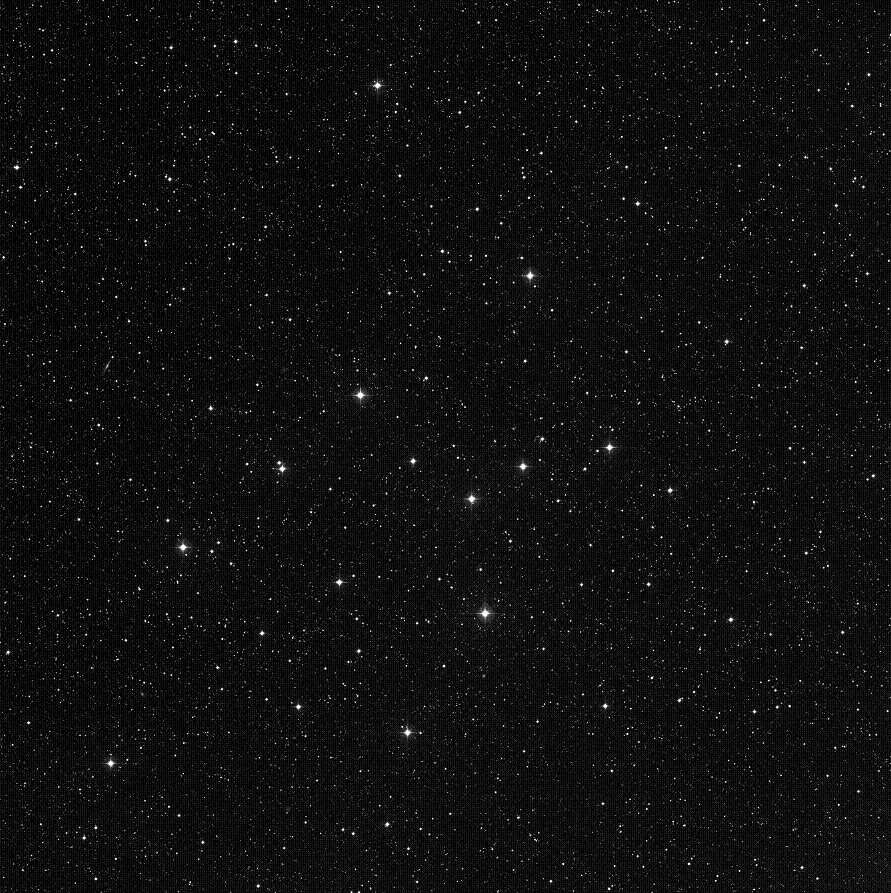
Up next, we’ll have a look at the central star of the “Northern Cross” – Gamma Cygni. Also known as Sadr, this beautiful main sequence star lies at the northern edge of the “Great Rift.” Surrounded by a field of nebulosity known as IC 1310, second magnitude Gamma is very slowly approaching us, but still maintains an average distance of about 750 light-years. It is here in the rich, starry fields that the great dust cloud begins its stretch toward southern Centaurus – dividing the Milky Way into two streams. The dark region extending north of Gamma towards Deneb is often referred to as the “Northern Coalsack,” but its true designation is Lynds 906.
If you take a very close look at Sadr, you will find it has a well-separated 10th magnitude companion star, which is probably not related – yet in 1876, S. W. Burnham found that it itself is a very close double. Just to its north is NGC 6910 (Right Ascension: 20 : 23.1 – Declination: +40 : 47), a roughly 6th magnitude open cluster which displays a nice concentration in a small telescope. To the west is Collinder 419, another bright gathering that is nicely concentrated. South is Dolidze 43, a widely spaced group with two brighter stars on its southern perimeter. East is Dolidze 10, which is far richer in stars of various magnitudes and contains at least three binary systems.
Whether you use binoculars or telescopes, chances are you won’t see much nebulosity in this region – but the sheer population of stars and objects in this area makes a visit with Sadr worthy of your time!
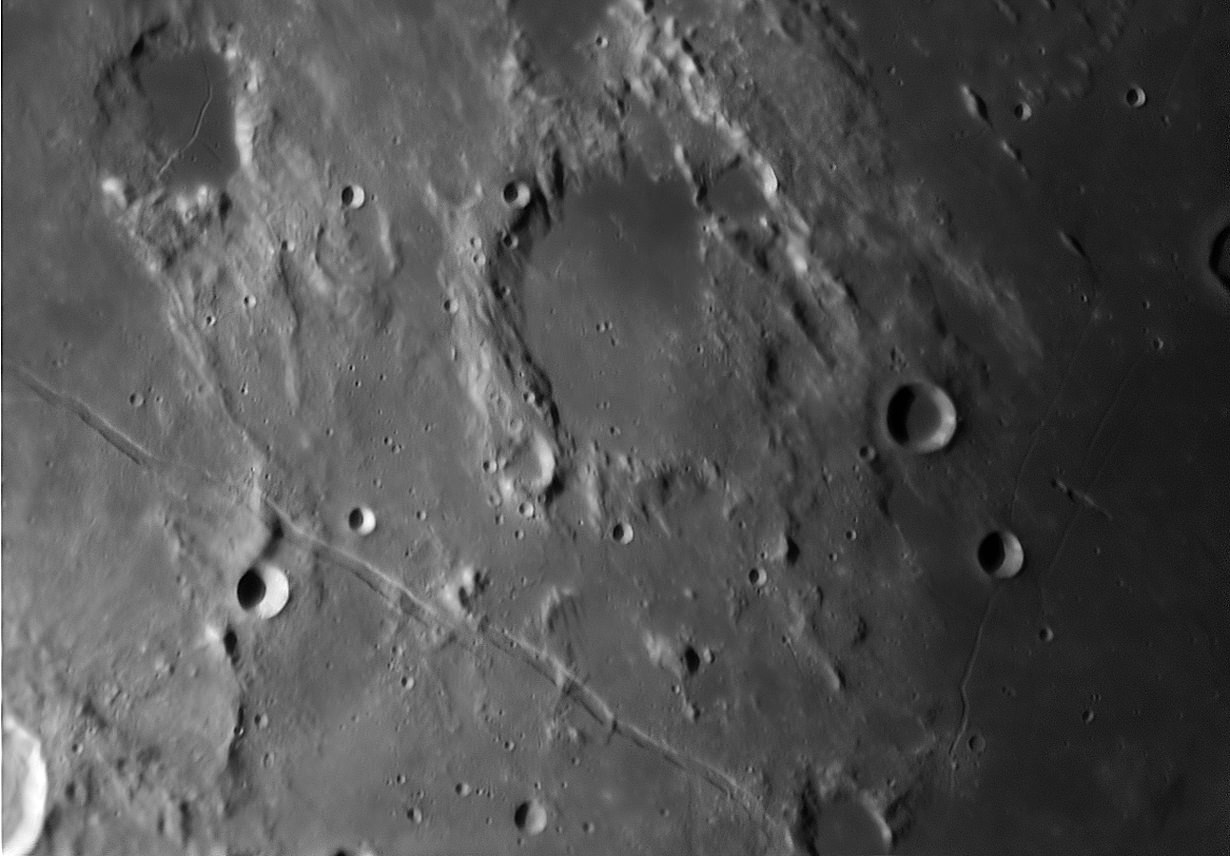
Saturday, September 29 – Tonight we’re going to have a look at a lunar feature that goes beyond simply incredible – it’s downright weird. Start your journey by identifying Kepler and head due west across Oceanus Procellarum until you encounter the bright ring of crater Reiner. Spanning 30 kilometers, this crater isn’t anything in particular – just shallow-looking walls with a little hummock in the center. But, look further west and a little more north for an anomaly – Reiner Gamma.
Well, it’s bright. It’s slightly eye-shaped. But what exactly is it? Possessing no real elevation or depth above the lunar surface, Reiner Gamma could very well be an extremely young feature caused by a comet. Only three other such features exist – two on the lunar far side and one on Mercury. They are high albedo surface deposits with magnetic properties. Unlike a lunar ray of material ejected from below the surface, Reiner Gamma can be spotted during the daylight hours – when ray systems disappear. And, unlike other lunar formations, it never casts a shadow.
Reiner Gamma also causes a magnetic deviation on a barren world that has no magnetic field. This has many proposed origins, such as solar storms, volcanic gaseous activity, or even seismic waves. But, one of the best explanations for its presence is a cometary strike. It is believed that a split-nucleus comet, or cometary fragments, once impacted the area and the swirl of gases from the high velocity debris may have somehow changed the regolith. On the other hand, ejecta from an impact could have formed around a magnetic “hot spot,” much like a magnet attracts iron filings. No matter which theory is correct, the simple act of viewing Reiner Gamma and realizing that it is different from all other features on the Moon’s earthward facing side makes this journey worth the time!
When you’re done, let’s head about a fingerwidth south of Gamma Cygni to have a look at an open cluster well suited for all optics – M29 (Right Ascension: 20 : 23.9 – Declination: +38 : 3).
Discovered in 1764 by Charles Messier, this type D cluster has an overall brightness of about magnitude 7, but isn’t exactly rich in stars. Hanging out anywhere from 6000 to 7200 light-years away, one would assume this to be a very rich cluster and it may very well have hundreds of stars – but their light is blocked by a dust cloud a thousand times more dense than average. Approaching us at around 28 kilometers per second, this loose grouping could be as old as 10 million years and appears much like a miniature of the constellation of Ursa Major at low powers. Even though it isn’t the most spectacular in star-rich Cygnus, it is another Messier object to add to your list!
Sunday, September 30 – Today in 1880, Henry Draper must have been up very early indeed when he took the first photo of the Great Orion Nebula (M42). Although you might not wish to set up equipment before dawn, you can still use a pair of binoculars to view this awesome nebula! You’ll find Orion high in the southeast for the Northern Hemisphere, and M42 in the center of the “sword” that hangs below its bright “belt” of three stars.
Our seasons are changing – and so the seasons change on other planets, too. Today marks the universal date on which Northern Autumn, Southern Spring Equinox occurs on Mars. Keep an eye for subtle changes in surface features of the red planet!
This is also the Universal date the Moon will become Full and it will be the closest to the Autumnal Equinox. Because its orbit is more nearly parallel to the eastern horizon, it will rise at dusk for the next several nights in a row. On the average, the Moon rises about 50 minutes later each night, but at this time of year it’s around 20 minutes later for mid-northern latitudes and even less farther north. Because of this added light, the name “Harvest Moon” came about because it allowed farmers more time to work in the fields.
Often times we perceive the Harvest Moon as being more orange than at any other time of the year. The reason is not only scientific enough – but true. Coloration is caused by the scattering of the light by particles in our atmosphere. When the Moon is low, like now, we get more of that scattering effect and it truly does appear more orange. The very act of harvesting itself produces more dust and often times that coloration will last the whole night through. And we all know the size is only an “illusion”…
So, instead of cursing the Moon for hiding the deep sky gems tonight, enjoy it for what it is…a wonderful natural phenomenon that doesn’t even require a telescope!
Until next week? Ask for the Moon, but keep on reaching for the stars!