
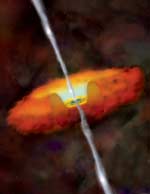
Image credit: NASA
Einstein’s General Theory of Relativity got another confirmation this week thanks to research by an astronomer from NASA. Some theorists believed that particles popping into and out of existence in space would slow light down, as if it was moving through air or water. Scientists measured the total energy of gamma rays emitted by a distant gamma ray bursts and found that they were interacting with particles on their way to the Earth in such a way that precisely matched predictions by Einstein.
Scientists say that Albert Einstein’s principle of the constancy of the speed of light holds up under extremely tight scrutiny, a finding that rules out certain theories predicting extra dimensions and a “frothy” fabric of space.
The finding also demonstrates that basic ground- and space-based observations of the highest-energy gamma-rays, a form of electromagnetic energy like light, can provide insight into the very nature of time, matter, energy and space at scales extremely far below the subatomic level — something that few scientists thought possible.
Dr. Floyd Stecker of NASA’s Goddard Space Flight Center in Greenbelt, Md., discusses the implications of these findings in a recent issue of Astroparticle Physics. His work is based partly on an earlier collaboration with Nobel laureate Sheldon Glashow of Boston University.
“What Einstein worked out with pencil and paper nearly a century ago continues to hold up to scientific scrutiny,” said Stecker. “High-energy observations of cosmic gamma rays don’t rule out the possibility of extra dimensions and the concept of quantum gravity, but they do place some strict constraints on how scientists can go about finding such phenomena.”
Einstein stated that space and time were actually two aspects of a single entity called spacetime, a four-dimensional concept. This is the foundation to his theories of special and general relativity. For example, general relativity posits that the force of gravity is the result of mass distorting spacetime, like a bowling ball on a mattress.
General relativity is the theory of gravity on a large scale, while quantum mechanics, developed independently in the early 20th century, is the theory of the atom and subatomic particles on a very small scale. Theories based on quantum mechanics do not describe gravity, but rather the other three fundamental forces: electromagnetism (light), strong forces (binding atomic nuclei), and weak forces (seen in radioactivity).
Scientists have long hoped to meld these theories into one “theory of everything” to describe all aspects of nature. These unifying theories — such as quantum gravity or string theory — may involve the invocation of extra dimensions of space and also violations of Einstein’s special theory of relativity, such as the speed of light being the maximum attainable velocity for all objects.
Stecker’s work involves concepts called the uncertainty principle and Lorentz invariance. The uncertainty principle, derived from quantum mechanics, implies that at the subatomic level virtual particles, also called quantum fluctuations, pop in and out of existence. Many scientists say that spacetime itself is made up of quantum fluctuations which, when viewed up close, resemble a froth or “quantum foam.” Some scientists think a quantum foam of spacetime can slow the passage of light — much as light travels at a maximum speed in a vacuum but at slower speeds through air or water.
The foam would slow higher-energy electromagnetic particles, or photons — such as X rays and gamma rays — more than lower energy photons of visible light or radio waves. Such a fundamental variation in the speed of light, different for photons of different energies, would violate Lorentz invariance, the basic principle of the special theory of relativity. Such a violation could be a clue that would help point us on the road to unification theories.
Scientists have hoped to find such Lorentz invariance violations by studying gamma rays coming from far outside the Galaxy. A gamma-ray burst, for example, is at such a great distance that the differences in the speeds of photons in the burst, depending on their energy, might be measurable — as the quantum foam of space may act to slow light which has been traveling to us for billions of years.
Stecker looked much closer to home to find that Lorentz invariance is not being violated. He analyzed gamma rays from two relatively nearby galaxies about half a billion light years away with supermassive black holes at their centers, named Markarian (Mkn) 421 and Mkn 501. These black holes generate intense beams of gamma-ray photons that are aimed directly at the Earth. Such galaxies are called blazars. (Refer to Image 4 for a picture of Mkn 421. Images 1 – 3 are artist’s concepts of supermassive black holes powering quasars which, when pointed directly at Earth, are called blazars. Image 5 is a Hubble Space Telescope photo of a blazar.)
Some of the gamma rays from Mkn 421 and Mkn 501 collide with infrared photons in the Universe. These collisions result in the destruction of the gamma rays and infrared photons as their energy is converted into mass in the form of electrons and positively charged antimatter-electrons (called positrons), according to Einstein’s famous formula E=mc^2. Stecker and Glashow have pointed out that evidence of the annihilation of the highest-energy gamma rays from Mkn 421 and Mkn 501, obtained from direct observations of these objects, demonstrates clearly that Lorentz invariance is alive and well and not being violated. If Lorentz invariance were violated, the gamma rays would pass right through the extragalactic infrared fog without being annihilated.
This is because annihilation requires a certain amount of energy in order to create the electrons and positrons. This energy budget is satisfied for the highest-energy gamma rays from Mkn 501 and Mkn 421 in interacting with infrared photons if both are moving at the well-known speed of light according to the special theory of relativity. However, if the gamma rays in particular were moving at a slower velocity because of Lorentz invariance violation, the total energy available would be inadequate and the annihilation reaction would be a “no go.”
“The implications of these results,” Stecker said “is that if Lorentz invariance is violated, it is at such a small level — less than one part in a thousand trillion — that it is beyond the ability of our present technology to find. These results may also be telling us that the correct form of string theory or quantum gravity must obey the principle of Lorentz invariance.”
For more information, refer to “Constraints on Lorentz Invariance Violating Quantum Gravity and Large Extra Dimensions Models using High Energy Gamma Ray Observations” online at:
http://xxx.lanl.gov/abs/astro-ph/0308214
Original Source: NASA News Release