Universe Today
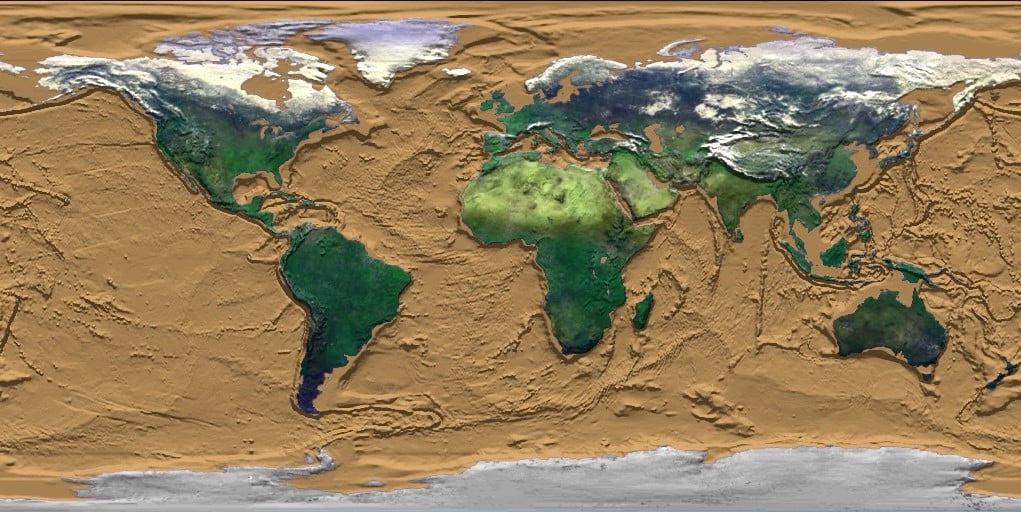
Plate tectonics, oceans, and continents might just be the secret ingredients for complex life on Earth. And if these geological features are rare elsewhere in the universe, then perhaps that explains why we haven't yet discovered intelligent alien life. New research from American and Swiss Earth scientists suggests that these ingredients represent missing variables in the famous Drake equation, devised more than half a century ago to estimate the chances of finding advanced civilizations in our galaxy. Including these new variables could completely rewrite the probability of detecting intelligent life in the Milky Way.
The impetus for this research, with its galaxy-spanning implications, began with a mystery right here at home – why did life take so long to move beyond simple organisms?
"Life has been around on Earth for about 4 billion years, but complex organisms like animals didn't appear until about 600 million years ago, which is not long after the modern episode of plate tectonics began," said Robert Stern of the University of Texas at Dallas. "Plate tectonics really jump-starts the evolution machine, and we think we understand why."
Stern and his collaborator, Taras Gerya of the Swiss Federal Institute of Technology, propose that plate tectonics – the grinding movement of the upper layers of the planet at long geologic time scales – helped speed up the transition to complex life.
Early in Earth's history, simple organisms formed in the ocean, but humanity – an advanced civilization capable of communicating across outer space – couldn't exist if ancient life hadn't transitioned to land. Vast, resource-rich continents were therefore a vital prerequisite for what Stern and Gerya call Active Communicative Civilizations (ACCs) like humanity to develop. But that alone wasn't enough: the continents needed to move.
The geologic record on Earth suggests that plate tectonics accelerated evolution on land through five distinct processes: it increased the supply of nutrients; sped up the oxygenation of both the atmosphere and the ocean; tempered the climate; caused a high turnover rate of habitat formation and destruction; and offered non-catastrophic environmental pressure that forced organisms to adapt.
The end result of all these environmental pressures: us.
If Stern and Gerya are right, plate tectonics were a requirement for eventual innovations like the wheel, the smartphone, and the Apollo program.
And for other civilizations in the galaxy to develop similar technological marvels, perhaps their planets need plate tectonics too. But as far as we know, they're rare.
Earth is the only planet in our solar system to feature plate tectonics. Volcanism exists on some other worlds, like Venus, Mars, and Io, but these worlds have a singular solid shell, rather than multiple moving plates. Similarly, ocean worlds like Enceladus and Europa are bound within an icy coating, forbidding any hypothetical life there from transitioning to land.
We don't know for sure whether distant solar systems feature planets with plate tectonics – current space telescopes don't have the resolution to make such determinations. But knowing that they might not enables a more accurate version of the Drake equation.
There are two essential factors proposed in the revised equation: the fraction of habitable exoplanets with large continents and oceans, and the fraction of those that have plate tectonics lasting more than 500 million years.
This version is much more nuanced than the original Drake equation, which simply took into account the fraction of habitable planets on which intelligent life had developed.

"In the original formulation, this factor was thought to be nearly 1, or 100% — that is, evolution on all planets with life would march forward and, with enough time, turn into an intelligent civilization," Stern said. "Our perspective is: That's not true."
Indeed. Their math reduces the percentage of these planets that develop ACCs to just 0.003% at minimum and 0.2% at maximum – a far cry from the original 100%.
When put together with all the other factors of the Drake Equation: number of stars formed annually, number of those stars with planets, number those planets that are habitable, number of those habitable planets with life, number of civilizations on those planets sending out detectable signals, and how long they send out the signals – well, the chances of finding intelligent alien life shrink considerably.
The implications of the original Drake equation were that ACCs should be common, and we should see them everywhere. But including plate tectonics in the equation changes the result, and makes it clear that it's perfectly understandable why we don't see ET all across the galaxy.
So intelligent alien life might be rarer than anyone thought. And Earth may be more special than we knew. All thanks to our planet's fragmented, unruly, and shifting upper crust.
Learn More:
Amanda Siegfried, " Geoscientists Dig into Why We May Be Alone in the Milky Way." University of Texas at Dallas.
Robert Stern and Taras Gerya, " The importance of continents, oceans and plate tectonics for the evolution of complex life: implications for finding extraterrestrial civilizations. " Nature Scientific Reports.