 Universe Today
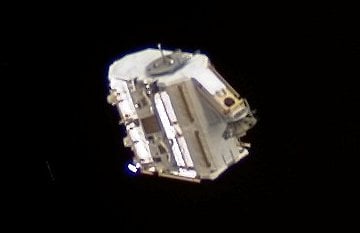
[/caption]The Early Ammonia Servicer (EAS) weighs 1400 lb (635 kg), is the size of two refrigerators and it's going to drop through the atmosphere some time tomorrow (Sunday, Nov. 2nd). Funny thing is, we don't know where, and we don't precisely know when. Will any of the defunct equipment survive re-entry? We don't know that either, but it seems highly probable.
The EAS was dropped from the International Space Station in 2007, making it the largest piece of space junk ever dropped from the orbital outpost. At the time, it was believed the ammonia coolant-filled debris would only stay in orbit for 300 days; alas this was a huge underestimation, the EAS has been in orbit for 15 months. The final hours of the large chunk of space debris are being closely tracked by NASA and the U.S. Space Surveillance Network as a precaution. Although no bits of the EAS are expected to pose a danger to people on the ground, NASA's space station program manager said "
we just need to be cautious
."
The EAS was installed on the space station during a spacewalk by the crew of
Discovery
in 2001 during the STS-105 servicing mission. It was installed as part of the station's emergency reserve coolant system, but when the mature thermal control system was activated, the EAS became surplus to requirements and NASA had to devise plans to remove the equipment. At the time, this posed a tricky problem - after all, you can't just throw junk overboard, what happens if it creates a future hazard for the ISS or other orbiting craft?
Eventually a solution was found. Astronaut Clay Anderson led a 7 hour 41 minute EVA with cosmonaut Fyodor Yurchikhin and robotic arm operator Oleg Kotov to throw the EAS overboard, toward the Earth on July 23rd, 2007. They did this just before a re-boost by the Soyuz spacecraft docked with the station at the time. By doing this, the EAS assumed a slowly deteriorating spiral orbit toward Earth whilst the space station increased its altitude, avoiding any possibility of encountering the discarded EAS on future orbits.
In July,
I reported
that the EAS had reached an ideal altitude for astronomers to catch a glimpse of it through their telescopes. The speedy +4 to +4.5 magnitude object had been spotted by many amateur astronomers.
Any observation opportunities are about to come to an abrupt end, however. Some time on Sunday, the EAS will succumb to atmospheric drag and drop toward the ground. As to whether any debris from the re-entering EAS will hit the ground, NASA believes that up to 15 pieces of the ammonia storage tank might survive the high temperatures. The pieces are predicted to range in size from 40 grams (1.4 oz) to 17.5 kg (40 lb). It is most likely these pieces will land in the ocean, but if any of the debris hits solid ground, they will be travelling at 160 km/hr (100 mph).
It is unlikely that any part of the EAS will be a risk to people or property, but Mike Suffredini, NASA's space station program manager, warns, "
If anybody found a piece of anything on the ground Monday morning, I would hope they wouldn't get too close to it
." After all, should any of the toxic ammonia stored inside the EAS survive re-entry, it could pose a health risk. (
Having said that, I would think a man-made meteorite travelling at 100 mph would also be considered a "health risk," let's just hope re-entry occurs over 2/3 of the planet covered with water
...)
Update: According to
SpaceWeather.com
, little is known about where the EAS will re-enter the atmosphere, "
At the moment, every continent except Antarctica has some favorable ground tracks
." We had a much better idea as to where and when
asteroid 2008 TC3 hit Earth
, perhaps we need to tighten up on the space junk re-entry problem (although I'd expect it's much harder to predict the upper atmospheric dynamics than orbital trajectories of incoming meteoroids).
Sources:
Space.com
,
MSNBC