It's Official: Hubble Mission to Launch May 11
Read more…
Filed under: Hubble, Missions, Space Shuttle | 5 Comments »

Even though Mercury looks like the Moon at first glance, scientists from the MESSENGER mission say it's becoming apparent that Mercury is an amazingly dynamic planet, and is actually more like Mars. For example, before this mission, scientists weren't sure if volcanism even existed on Mercury, but from the spacecraft's two flybys, they now know it is a very important part of the planet's history. Additional new findings from the second flyby of Mercury in October 2008 show that the planet’s atmosphere, magnetosphere, and geological past are all characterized by much greater levels of activity than scientists first suspected.
And by the way, isn't this a stunning picture of an impact basin? It's one of the new discoveries from MESSENGER.
Read more…
Filed under: Mercury | 124 Comments »

The blogosphere and Twitterverse has been buzzing the past couple of days with NASA what-ifs and possibilities. But that usually happens whenever there are Congressional hearings about our favorite space agency. Here's the run-down of what is really happening: No extra money has been given to extend the shuttle program as of yet but it is a possibility. NASA is not going to abandon going to the Moon. And no, President Obama hasn't named a new NASA administrator yet. Want the details?
Read more…
Filed under: Constellation, NASA, Space Shuttle | 19 Comments »

Fireworks in space? Astronomers are comparing "starbursts" from a galaxy that is in the throes of star formation to a Fourth of July fireworks display. And three particular galaxies are like my children's favorite part of a fireworks display: the grand finale. These bursts occur at a fast and furious pace, lighting up a region for a short time before winking out. But that's only part of the story. Archived data from the Hubble Space Telescope are showing that starbursts — intense regions of star formation — sweep across the whole galaxy and last 100 times longer than astronomers thought. The longer duration may affect how dwarf galaxies change over time, and therefore may shed light on galaxy evolution.
Read more…
Filed under: Hubble, galaxies | 21 Comments »

Its time once again for another Where In The Universe Challenge. The goal of this challenge is to test your skills and knowledge of the cosmos. Guess where in the Universe this image is from, and give yourself extra points if you can guess which spacecraft is responsible for the image. Post your guess in the comment section (no links to hints please!) and check back tomorrow for the answer. Good luck!
UPDATE: The answer has now been posted below.
Read more…
Filed under: Where In the Universe? | 20 Comments »
The two Mars Exploration Rovers have both seen their fair share of craters in their five years on Mars. Opportunity is currently booking it across Meridiani Planum on her way to Endeavour Crater, an ancient, huge hole in the ground (22 kilometers (13.7 miles across). But recently she came across the youngest crater either rover has ever seen. This crater is "young," in relative terms; scientists say this small crater called "Resolution" formed sometime in the past 100,000 years. Most features studied by Opportunity are much older, including rocks over 3 billion years old. In contrast to these seniors, Resolution is just a baby.
Read more…
Filed under: Mars, Missions | 4 Comments »
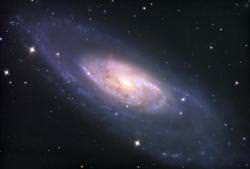
We certainly hope you had the opportunity to keep an eye on our remote telescope! Despite the weather changes in the southern hemisphere causing a little rain delay, we’ve been looking forward to a clear night and firing the telescope back up. I know it’s certainly fascinating to watch and don't be disappointed if you log on and get an error message. (That just means the scope is not operating at the moment or you need to refresh.) If you didn’t get a chance to watch the IYA telescope “live” on Galactic TV today, don’t worry. We took a video capture for you. Step inside to enjoy today’s view of Messier Object 10. We do it all for you… Read more…
Filed under: IYA Live Telescope Library | Comments Off

The future Russian capsule could land on a bright rocket plume. Credit: Anatoly Zak, Russianspaceweb.com
Filed under: Space Flight | 15 Comments »

Two of my greatest loves are coming together at the Museo de Chocolate (Chocolate Museum) of Barcelona. To celebrate the International Year of Astronomy 2009, this year's International Contest of Chocolate Figures has chosen astronomy as its theme. And the fourteen sculptures that are part of the competition –in which the designers use chocolate to embody creative astronomical interpretations, as the one seen here — will be on display at the Museo de Chocolate starting on May 7 in a new temporary exhibition, "Los Mundos Celestes-400 años del descubrimiento del sistema solar" (Celestial Worlds – 400 years since the discovery of the Solar System). I understand the exhibition as being temporary, but my question is, who gets to eat them?
Source: Pasteleria.com
Filed under: Astronomy | 6 Comments »

Credit: M. Revnivtsev
The map above details the Galactic ridge X-ray emission, first detected 25 years ago and observed recently by NASA's Rossi X-ray Timing Explorer (RXTE) observatory. The inset shows the zoomed Chandra image of the region, close to the center of the galaxy.
The mysterious — and formerly blurry — X-ray source puzzled astronomers for a quarter century, but a new paper release today by the journal Nature has helped to clear the air.
Filed under: Astronomy, milky way | 8 Comments »
Filed under: Enceladus | 6 Comments »

Scientists have long understood that satellites are at risk from bombardment by solar storms. Now, they've gotten a closer look at how the storms are punishing Earth's magnetosphere, leaving satellites exposed.
The movie above, and the solar flare video below, were released by the European Space Agency today, along with descriptions of two solar eruptions spotted using ESA’s four Cluster satellites and the two Chinese/ESA Double Star satellites.
Filed under: Earth, Solar Astronomy | 18 Comments »

Here's another "rogue black hole" theory, which hopefully doesn't set the doomsday crowd off on a new tangent. But new research suggests that hundreds of massive black holes, left over from the early galaxy-building days of the Universe, may wander the Milky Way. Astrophysicists Ryan O'Leary and Avi Loeb say that rogue black holes originally lurked at the centers of tiny, low-mass galaxies. Over billions of years, those dwarf galaxies smashed together to form full-sized galaxies like the Milky Way. But they also predict that Earth should be safe, as the closest rogue black hole should reside thousands of light-years away.
Read more…
Filed under: Black Holes | 52 Comments »
Our beloved Mars Exploration Rovers, Spirit and Opportunity have seemingly touched us all with their amazing discoveries and their apparently quite different and quirky personalities, but most of all with their durability and resilience. They've survived through two rough Martian winters and a couple of nasty dust storms, not to mention persevering through everything the JPL scientists and engineers have asked them to do (climbing hills, descending into craters, for example) and putting on more mileage than anyone ever thought possible. To honor the rovers and to commemorate their five years on Mars, one of my fellow Solar System Ambassadors, Steve Hammond, has created a video of highlights from the rovers, set to music by the very talented Marion Call with her song "Good Old Girl." Steve says in his blog, Ridiculous Thoughts, that the topic he gets the most request for as a Solar System Ambassador is Mars, and particularly the rovers. "Public interest hasn’t waned. It seems that everybody I talk to knows Spirit and Opportunity by name, and at least some highlights of their mission. People genuinely care about these little robots." Thanks to Steve for sharing the video. Enjoy!
Read more…
Filed under: Mars, Missions | 1 Comment »
Filed under: Missions, Observatories | 5 Comments »