
Another groundbreaking discovery from Mars: Phoenix has analysed martian regolith containing minerals more commonly found in soil here on Earth, and the acidity is not a hindrance for life to thrive. These new and very exciting results come after preliminary analyses of a scoop of regolith by the landers “wet lab” known as the Microscopy, Electrochemistry and Conductivity Analyzer (MECA) instrument. Although more data collecting needs to be done, trace levels of nutrients have already been detected. This, with the recent discovery of water ice, has amazed mission scientists, likening these new results to “winning the lottery.”
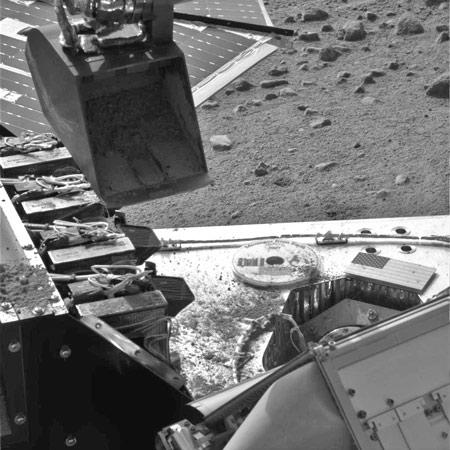
The MECA instrument is carrying out the first ever wet-chemical analysis on a planet other than Earth, and these first results are tantalisingly close to providing answers for the question: “Can Mars support life?” Taken from a scoop of top-soil, the robotic digger managed to excavate a 2 cm deep ditch, delivering the sample to the MECA where analysis could be carried out. The first results from the two-day wet-lab experiment are flooding in and mission scientists are excited by the results. “We are awash in chemistry data,” said Michael Hecht of NASA’s Jet Propulsion Laboratory and lead scientist for the MECA.
The salts discovered contain magnesium, sodium, potassium and chlorine, indicating these minerals had once been dissolved in water. The knowledge that these elements exist in martian regolith is nothing new, but the fact that they would be soluble in water means they would have been available for life to form. In fact, there are some strong similarities between the mineral content and pH level of the martian surface and soils more commonly found here on Earth.
“This soil appears to be a close analog to surface soils found in the upper dry valleys in Antarctica. The alkalinity of the soil at this location is definitely striking. At this specific location, one-inch into the surface layer, the soil is very basic, with a pH of between eight and nine. We also found a variety of components of salts that we haven’t had time to analyze and identify yet, but that include magnesium, sodium, potassium and chloride.” – Sam Kounaves, Phoenix co-investigator, Tufts University.
From the question “Has Mars supported life?” to “Can Mars support life?” – The answer seems to be an overwhelming “Yes.” Although nitrates have yet to be detected, the Mars soil appears to have an alkalinity commonly found in terrestrial soils. At a pH of eight or nine, a zoo of bacteria and plants can live comfortably. Vegetables such as asparagus and turnips are farmed in soils to this degree of alkalinity. Besides, extreme forms of bacteria have been discovered in environments that resemble the alkalinity of bleach, exceeding a pH of 12. The martian surface has suddenly become a little more hospitable for life to thrive.
“Over time, I’ve come to the conclusion that the amazing thing about Mars is not that it’s an alien world, but that in many aspects, like mineralogy, it’s very much like Earth.” – Kounaves.
Although these first results are very exciting, mission scientists are staying realistic. This is only one of several tests, plus it is a sample from a single location. As the digger only scooped a sample 2 cm deep, scientists are keen to see if the regolith deeper down has similar chemistry, so the intention is to dig deeper into the same location, possibly including ice.
Aside: The term “Mars soil”, up to this point, hasn’t been technically accurate. If we look at the definition of “soil” we get:
The material on the surface of the ground in which plants grow; earth
– Cambridge Dictionaries.
The top layer of the earth’s surface, consisting of rock and mineral particles mixed with organic matter.
– Answers.com
The stuff with a red hue on Mars is actually regolith, pulverized grains of rock from hundreds of millions of years of meteorite impacts, geological activity and weathering. Until Phoenix produced these new findings, the most accurate way to describe Mars “soil” was to call it regolith. But now, it seems, Mars regolith fulfils most of the characteristics of being a soil. It contains rock, it contains minerals and it appears to have a pH capable of sustaining plant growth. But does it already contain organic matter? Whether it contains anything “organic” now is open to debate, but it might do in the future…
Sources: Phoenix (UA), New Scientist
Hooray for Phoenix! Manifest Destiny!!!!
I’m counting the minutes until a news article pops up with the headline:
“Mars probe finds life in soil”
Fingers crossed.
Fingers crossed they find some nitrates too.
forgive this naive question, but would we be ‘allowed’ to test the Martian soil by literally trying to grow plants right in that soil? Or would it violate some galactic ‘prime directive’?
Question/remark after reading John’s reply :
isn’t one of the “problems” the low gravity, which causes gasses like co2 or hydro to be released into space instead of the atmosphere?
im not really into the technical brake down like some of you guys but this Phoenix mission really draws my attention!
There is no galactic prime directive, and I wouldn’t give a damn if there were. At * most * there are cellullar organisms there, and we can destroy every last one for all I care.
indeed^^ but a bit of a stretch
The Phoenix Landers’ Original design did have that in it’s artillery , but it eventually went to the government to which they gave the proverbial Roman thumbs down…..ahhh you should of seen the metal the mere brawn of the two Phoenix Landers’ battling out here in a Studio? , yes according to many Moon Landing Conspiratists’ , that is the best way to make the background seem more Space Like…
they fought and without remorse , the Lander with that capability succumbed to the heat of Phoenix and suffered a most gracious and mercy filled defeat ….
All glory to the one on Mar’s Now , foolishly digging away , when all that it really needs …is a bit of fertilizer , some reheated Martian Ice and to be hooked up to a transmission of 1910’s The Birth of a Flower , which would with undoubtedly reverse the atmospheric pressured that would reverse it’s tendencies for that glorious footage.
….Had to scratch my back
Can you Dig it , should be the slogan for the Lander lol
which is ironically the victorious speech that Lander shouted at the defeat of the one that could plant trees
Mars will be colonized but not in the sense that you think. I see domed cities in which people, live some domes will be to recycle the water supply – some will be to grow food and even the outer shell of the dome will be made up of solar panels for energy along with wind turbines. The dust storms that occur would collect enough energy for years. We are adaptable, the only thing I worry about is ancient martian diseases.
Surely the scientists are not that surprised to find “soil” with a near to neutral pH.
Did they really expect to find “soil” either as strong or stronger than bleach or sulphuric acid, and the mineral content should not come as a big surprise either!
The water content livens things up some what but what they need to do is show us the nitrates! That will point to possible amino acids and the breakdown of organic materials… That is when it will get very interesting!
My fingers are crossed!
The Nitrates will be found at or close to the bottom of the frozen ocean that must mimic the frozen ice on Antarctica where, if you read the February 2008 edition of Scientific American, there is a thin film of water lubricating the interface between the land surface and the base of the ice sheet. Remember, depending on the thickness the pressure at the bottom of the ice will create conditions that will increase the temperature. You do not need that much pressure to increase the temperature by 70C.
The upper surface will be the result of the continuous sublimation of the ice under the dusty covering. So we can assume the surface layers have been bathed in an upward flow of water vapour for long periods. But that also means there will have been a constant renewal of the water vapour at the surface and as we all know, water vapour tends to congregate at the bottom of valleys.
So the next place to visit must be the bottom of a deep valley. There we might well find conditions where surface microbes have been able to grow and survive. Remember Adiabatic pressure gradients will increase the atmospheric temperature by +3C for every 1,000 feet. down into the valley and there are valleys on Mars many tens of thousands of feet deep.
Another thought is that while the surface ice under the Phoenix Lander will be at a temperature of -70C, there must be a temperature gradient down into the ice and the ice may well be much closer to 0C the deeper we dig.
I suspect no one considered the possibility of their standing on the surface of a frozen ocean, or, for that matter, that they would be dealing with samples of material we would describe as frozen mud. Mud, moreover that has been washed with a continuous flow of water vapour.
Very exciting news.
I cannot see why we don’t just send a lander with a series of small airtight greenhouses on board. Small plexiglass or lexan domes could be used, into which the digging tool could pour a soil sample. Then, add a modest amount of heat to the soil/water mix, and see if anything grows. If nothing grows, then, next, add a higher level of atmosphere to the domed mini-biosphere. See what happens then. If nothing happens, add a few seeds of various different earthly plants to see if they can grow in the soil and with the level of sunlight on Mars. The plexiglass can be made impermeable to the ultraviolet C rays that might, otherwise, kill the plants, both Martian and Earthly. Frankly, if there is frozen air, in the soil on Mars (we know there is a huge reservoir of frozen carbon dioxide, at least) and frozen water, too, the only thing we need to do to make the planet habitable, again, is to add heat. That will release the atmosphere, which would auto-create its own ozone protective layer, as well as a greenhouse effect, from the huge amount of CO2, and allow things to grow again. For all we know, Mars has a cyclic climate, based on position visa vi the sun. It may periodically warm enough for the atmosphere and water to be released, naturally, and life, there, might be in hibernation, waiting for the next warm period. The seeds of complex plants and animals might even be waiting for us, right in the soil, in the form of spores left by animals and plants that have adapted to this cyclic existence. If no current complex life exists on Mars, either in existing or sporic form, it now seems clear that the ingredients are still there to terra-form the planet for our own use. By releasing greenhouse gases from the Martian poles, using a large nuclear reactor, we could easily put a process into motion that would become self-reinforcing, and transform this frozen planet back to life.
If you think about it clearly if the microbes cant be contained they’ll have to be destroyed.There is no way we can be allowed in the same room with anything alien without 100% assurances that it is not harmful to that person or any one around that person.
This is very exciting!
I’ve always suspected that if the ingredients to sustain life are present, and you have enough time, then life will find a way. Certainly on Earth life has found a niche in the most inhospitable of places. But I’m not sure that Phoenix has the capacity to determine if life is actually present – so I’m not expecting any announcements yet!
Also – to John : Mars cannot support an atmosphere regardless of how much CO2 is released through because it has no magnetic field to protect it from the solar wind which would simply strip it off the surface, even if it did, it’s (relatively) low mass means the atmosphere would be far more tenuous than the Earths. That said – surface features suggest that water did flow on the surface in the dim and distant past (though much of that water would have been lost as the atmosphere evaporated off into space)
Now with this new soil info, I’m waiting to here from the Viking lander people about its findings from back in the 70’s.
They claimed it detected life but the argument was the soil was strange and caused false positives for life. We may know the answer already for the past 30+ years!
It has nothing to do with the U.S. It should be a global thing.
Why is the U.S. always looked on as the aggresor I think we play a better role than that in the global community. We give so much and yes we do anger alot of our peers but look at it this way would you have wanted the USSR to have come out on top after the cold war.
IM NOT CRAZY JUST A FEW PLUTOIDS SHORT OF A SOLAR SYSTEM……………………………………………….
No!? I’m shocked! What a surprise!
I’m with you, Alan. The only stated reason that Mars was sterile from the Viking results was that the Viking biologists claimed the soil oxidized organics. Were down to that question being the only barrier to life on Mars. Hopefully Phoenix will answer that question soon and “Imminent Discovery” can be updated to have a happy ending……
By the way, I’m still waiting to hear the results of the atmospheric composition test (was there any methane?, as was discovered in 1969 and again in 2004), and see the actual soil surface temperature and soil temperature gradient (not the air temperature at one meter high….what microbe living in the soil would ever care about that?)
Good Luck Phoenix
in order to terra farm mars we would have to set off it’s vulcanism again and get the plates moving somehow. In all likelyhood that would restore some form of magneto sphere to the planet.
correction: Terraform
What about the lethal radiation from the sun?
There is no magnetic field to protect living DNA or any human who makes it to mars.
Bringing organisms from Earth to Mars is totally off limits until any life on Mars itself can be ruled out.
Even if it’s “just” microbes, they will most likely be totally differnt to life on earth, having a completely different chemical setup and genetics.
Biochemists don’t care if an organism has one or more cells, the complexity is about the same.
There would be an awful lot to learn about life this
way. (Think of at least 50 years worth of studies)
We shouldn’t ruin that by planting daisies on Mars…
my question is… will it be coming back to earth?
Honestly I would be extatic should (if) we find out that there is life on Mars – no matter if it’s complex or not. It could be a microbe, a lichen or a Martian gnat and I would feel so happy to know that our planet is not the only round stone with life on it in the Solar System at least. To think we could call any form of life on another planet an astrobiological cousin is mind-boggling to me.
If we build a civilization on another planet, one object crashing into it a thousand miles per hour could pretty much ruin everything.
I think investing in any permanent or long-term habitats for humans on another space body (moon, mars…) would be pretty dangerous and maybe even dumb? Unless the odds of getting hit by one are way less than I’m thinking.
I do support a one-manned mission to Mars, though…one human could discover more in a day than Phoenix is going to discover in its whole trip. And I’m pretty sure a ton of people would offer their life for science. I mean, I would. Of course, the legality of the situation would probably never work out.
On the subject of life on mars, isn’t there a severe lack of liquid water and oxygen to sustain life? Microbes and things live in only an atmosphere full of oxygen, under the ocean, or in moist soil? I’m thinking Mars has the minerals, but it doesn’t have everything.
Correct me if I’m wrong on any of this, please. I’m just trying to inspire thinking.
Any life that is detected on Mars should immediately be destroyed as thoroughly as possible, lest it be a threat to us or our effort to colonize the planet. I’d love to see the US make the destruction of any discovered alien life a mandatory facet of our space program.
Yeah, right. Let’s nuke Mars, just in case…
You’re a troll.
John A. was being sarcastic, I think. LLDIAZ is just crazy. There are ways to test the safety of the microbes without wiping the entire planet of them.
The original post discussing destroying life on Mars was referring to * inadvertent * destruction resulting from competing life forms that we bring there ourselves (Earthy flora and fauna).
I have no problem with allowing our bacteria and viruses to destroy the ones on Mars if its part of the process of colonization.
To kill it all “just to be sure” is of course a pointless waste of time and money.
While we are at it lets destroy all the “lesser” forms of life here on Earth lest they get the idea to migrate to Mars when it is ready for colonization. Only the elite get to go… No wonder we can’t have peace on Earth!
Let’s be more CREATIVE and Less DESTRUCTIVE!
Every life form can be useful to us. To simply destroy or invade with our life forms is foolish and hasty. If there are any bacterias there, they are far more adapted to life on its native planet (duh) and so we should find a way for symbiosis, coexistence with lifeforms there. Oxygen is NOT primary perquisite for life.
We were inpatient with this planet and look what have we done to it. Just because it could take 50 years or more to do the tests and most of u wont live to see that, doesn’t mean we should just skip that to satisfy our curiosity… I sure would like to go to Mars one day, but not at the price of lost life and knowledge..
If there is any life on Mars, it may have already been contaminated by previous landers contaminated with germs from Earth.
Not only that, but there is a good possibility that cross contamination has happened due to meteorite impacts shooting debris into space. Didn’t someone prove that certain microorganisms can survive atmospheric entry?
LLDIAZ always has some arguable points to make, somehow more obviously the case than anyone else. Allright I have picked on her/him enough.
Why should we not have a prime directive for space? mass effect/star trek anyone? Come on lets have fun.
Dark Gnat is right. Mars will have been subjected to a slow but steady barrage of meteorites from Earth, some of which will contain terrestrial microbes. In all likelihood any life that is on Mars will be related to Earth life. It will have evolved to a point where it’s comfortable on Mars, but still be based on our DNA.
I’m even tipping we have some very distant relatives in the ocean of Europa.
You have a point there.
There’s some research going on right now on Earth btw to try and find “alien” life forms that use different chemistries than our “normal” life.
If humans ever settle in the harsh Martian environment, the most dominating aspect of daily life will be the form of our architecture over there. Will it be futuristic an sky scratching or small and poor and shacks like.
upps … I am already one step too far
“If there are any bacterias there, they are far more adapted to life on its native planet (duh) and so we should find a way for symbiosis, coexistence with lifeforms there.”
Right, so the entire argument is pointless. Our life won’t overwhelm the native life because it’s far better adapted to the Martian environment. Survival of the fittest. Would take millions of years before anything we bring would be well-suited to the environment (barring some generous genetic engineering anyway).
“Would take millions of years before anything we bring would be well-suited to the environment (barring some generous genetic engineering anyway)”, said the penicillin to the microbe. But what about no natural enemies?
Certain Earthly life could be as deadly to certain certain Martian life as Martian life could be to it.
When we start terraforming Mars (and I say “when” not “if” because I regard it as a near certainty) things will rapidly become very unpleasant for any native life.
hd Says:
June 27th, 2008 at 9:42 am
Yeah, right. Let’s nuke Mars, just in case…
Its the only way to be sure….
I agree with Nexus, Mars is downwind from the Earth and in all probability, has the same microbes as earth based upon the same evolutionary road map, but instead based upon the difference in local environments. Take the difference between Australian and North American species here and you will see what I mean. There is a permanent atmospheric connection between all the planets and always there is sufficient atmosphere at the surface of any object in space to be certain that life can exist in many places where conventional thinking says is impossible.
Nexus, I believe the surface marking on Europa is caused by lichen. We will both be glued to our TV’s when a mission arrives at that frozen surface.
Some microbes from our world could have survived inside of the “Phoenix “. They would be protected from the rough radiation which bombards the surface outside. When Martian winter comes and packs the whole vehicle in ice its structure could be damaged or broken up and life from earth could start with its Martian branch on the tree of evolution.
Its difficult to know if life exists on mars without going there and spending many years shoveling through dirt to find it. The mission to send humans and their equipment will certainly contaminate mars with earth style life forms.
Unfortunately for the mars purists, the survival of our species and creatures from this planet will eventually take priority over anything growing on mars.
The preservation of a mossy rock will be of little consolation if we lose the best chance at saving our own species.
Go Phoenix, go! Fantastic discoveries and great job so far. I’m sure the lander and the spectacular NASA team will have more great finds from this neck of the Mars ‘woods’ before the winter freeze.
Cheers.
William Millard, you don’t need to force your vocabulary. You sound just a tad pretentious. Let’s try to keep this a little, hm, colloquial.
I felt like I was reading Charles Dickens.
As far as these people who are saying “Oh man, that mossy rock has no idea what we’ve got in store for it!” Chill, guys. I remember reading that Phoenix was isolated in its development and storage and should contain nothing biological on it. And sure, human contact with mars will contaminate the planet, but you guys are acting like you know the exact chain of events.
We might never inhabit the entire planet of mars. Current ideas involve taking up an area smaller than a car (aside from explorations). We might have a negative impact on life in the close vicinity, but for us to wipe out the entire planet’s life? Not very likely? At least not in our early explorations (which will be the greater portion of the next hundred years or more). And, in worst case scenario, we would most definitely create a reservation or keep a living sample of any endangered life. While our species can be destructive in our curiosity, we’ve become concerned with not annihilating entire species.
Don’t break out the champagne just yet. The Phoenix Lander last week conducted its first wet chemical analysis through its Microscopy, Electrochemistry and Conductivity Analyzer (MECA), which mixes the soil sample with water and bakes the mud to 1,832 degrees Fahrenheit to test for chemical composition. The results show the martian soil had a pH between 8 and 9, meaning it is alkaline — the kind of soil you could grow vegetables in if you brought it back to Earth, tossed in some cow manure, and watered regularly. MECA detected the presence of magnesium, sodium, potassium and chloride but no organic carbon, the crucial ingredient necessary for life on Earth (alright, maybe silicon might also work). Interestingly, JPL tells us that the mineral content of the soil is not much different from the upper dry valleys in Antarctica. What Phoenix’ wet chemical analysis (still ongoing) shows is that there is no life in the soil sample tested by MECA. They’re going to dig down further in the next few days. The Phoenix Lander’s follow-the-water strategy for searching for organic compounds is, however, exactly the right strategy for NASA or other space agencies to pursue. Here’s a hint — if tomorrow we could land the Phoenix Lander or Mars Science Laboratory on Enceladus or Titan or any other body in this sun system, the test results would show that there is no life in this sun system other than on Earth. It takes more than liquid water for life to emerge. But the Milky Way galaxy is teeming with life and with intelligent life. As Mulder used to say, “the truth is out there.â€
~hd Says:
June 27th, 2008 at 4:59 pm
You have a point there.
There’s some research going on right now on Earth btw to try and find “alien” life forms that use different chemistries than our “normal” life. ~
Good because I have always thought that our searches for life were a close-minded search for carbon based life forms. I’m glad we’re searching for possible life with different chemical make-ups.
I don’t believe life exists on Mars. Look at the Earth. Over the eons, life on this planet has evolved and adapted to every conceivable ecological niche. And you’re trying to tell me that, in the same amount of time, no Martian life has evolved to live on the surface? I don’t buy it.
You make a really good point, Andy, but maybe the Earth was simply more suitable for all these ‘larger’ forms of life like mammals and plants.
Maybe Mars could and can only support teeny microbes. If the Earth lacked our big oceans, would life as we know it exist? It may have stayed in the microscopic form.
And, they say water once covered Mars, so maybe there was other life, but at one point it became unable to survive the environment.
I think there are far too many possibilities to make any definite conclusions. I completely understand your logic, but I’m going to keep an open mind on the situation.
Oh, and as another theory, who knows how the first clump of inanimate matter became animate and was life. The process could have happened recently on Mars, leaving no time for evolution.
And on that note, that question has always annoyed me. How does a bunch of junk just…become alive?! I’m not turning to religion for the answer, either. I think science will answer it…one day.
Why do people get hung up over whether life evolved on Mars? When scientists look at an island, do they ask if life evolved there? no – they know life is there because physics moved it there – ovcean currents, wind currents, whatever. Space is no different…but the physics may get more complicated. Life can be moved by solar radiation (Arrhenius, 1908), magnetospheric plasmoids (Dehel, 2006), or meteor impact ejecta (unknown). Of course, life did originate somewhere….but that potentially took billions of years – not enough time for it to have evolved from rock on Earth before the first ancient signs of life appear. So does Mars have life? Of course.
“Mars belongs to the Martians — even if they are only microbes.” — Carl Sagan
Andy,
Why would you or anybody think that life could never have existed on Mars? Our solar system is around 4.x billion years old. Some say that life started on earth around 3.x billion years ago. Life could have very well been on Mars then also. When the volcanism stoped life could have (probably) stopped as well. If it topped on Earth, life would most likely halt as well.
You have to remember that to the best of our knowledge, the materials that made life possible here on Earth came from comets and such. Keeping this in mind means that it is very likely that life could also exist else where in the Universe. And more than likely would be eerily similar to life here, whether it’s micro organisms or sentient life.
There are over 100 billion stars (suns) in our galaxy, and there is over 100 billion galaxies. The odds say life is out there, so why not Mars as well? I don’t ask if, I ask when?
In all probability life will be discovered on mars. The Pope has addressed his church on the subject, maybe he knows about some early findings? In any case it seems to be a mathematical impossibility for life not to exist elsewhere in the galaxy~universe. Even the growing number of UFO sightings leans toward this. A race of beings 1,000s to 1,000,000s of years ahead of our technology could easily close the distance from their world to ours. I personally think we are in a universe that is teaming with life in all stages of evolutionary advancement. Then what is life, some ask. Well since partical matter is just a stationary measurement of electromagnetic radiation that comprises all of existance, then life must be the universe looking back upon itself, through a telescope, a microscope or a miror.
Seriously…. what better expiriment could we conduct on Mars than detonating 10 of our most powerful nuclear warheads on the planet? It would make for a fun light show, would give us a lot of information on what happens during multiple ground blast nuclear detonations and would kick up very large quantities of water ice which would sublimate into water vapor and allow us to see whether water vapor induced global warming is possible there. Beside that… it would be FUN!!!