
In the first few moments of the Universe, enormous amounts of both matter and antimatter were created, and then moments later combined and annihilated generating the energy that drove the expansion of the Universe. But for some reason, there was an infinitesimal amount more matter than anti matter. Everything that we see today was that tiny fraction of matter that remained.
But why? Why was there more matter than antimatter right after the Big Bang? Researchers from the University of Melbourne think they might have an insight.
Just to give you an idea of the scale of the mystery facing researchers, here’s Associate Professor Martin Sevior of the University of Melborne’s School of Physics:
“Our universe is made up almost completely of matter. While we’re entirely used to this idea, this does not agree with our ideas of how mass and energy interact. According to these theories there should not be enough mass to enable the formation of stars and hence life.”
“In our standard model of particle physics, matter and antimatter are almost identical. Accordingly as they mix in the early universe they annihilate one another leaving very little to form stars and galaxies. The model does not come close to explaining the difference between matter and antimatter we see in the nature. The imbalance is a trillion times bigger than the model predicts.”
If the model predicts that matter and antimatter should have completely annihilated one another, why is there something, and not nothing?
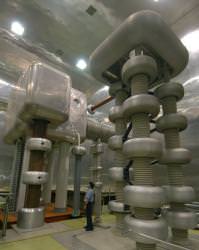
The researchers have been using the KEK particle accelerator in Japan to create special particles called B-mesons. And it’s these particles which might provide the answer.
Mesons are particles which are made up of one quark, and one antiquark. They’re bound together by the strong nuclear force, and orbit one another, like the Earth and the moon. Because of quantum mechanics, the quark and antiquark can only orbit each other in very specific ways depending on the mass of the particles.
A B-meson is a particularly heavy particle, with more than 5 times the mass of a proton, due almost entirely to the mass of the B-quark. And it’s these B-mesons which require the most powerful particle accelerators to generate them.
In the KEK accelerator, the researchers were able to create both regular matter B-mesons and anti-B-mesons, and watch how they decayed.
“We looked at how the B-mesons decay as opposed to how the anti-B-mesons decay. What we find is that there are small differences in these processes. While most of our measurements confirm predictions of the Standard Model of Particle Physics, this new result appears to be in disagreement.â€
In the first few moments of the Universe, the anti-B-mesons might have decayed differently than their regular matter counterparts. By the time all the annihilations were complete, there was still enough matter left over to give us all the stars, planets and galaxies we see today.
Original Source: University of Melbourne News Release
can we see anti matter?
and if you can’t is that something astronauts in the future will have to worry about.
We can “see” anti matter as in it leaves tracks on detectors just like matter. We can capture antimatter and have used it in accelerators to create higher energy collision. There was even an article on this sight that talked about antimatter being create by natural processes.
I don’t think that astronauts, in our usual definition of the word have much to worry about. Once we leave the cozy confines of our solar system or galaxy, that might be a different story
The difference between B-mesons and anti-B-mesons is known as “CP violation”, and it means that they decay into the same things, but in different ratios. This can create more baryons than anti-baryons, but not *enough* to explain the amount of baryons we have in the Universe today. As far as we know, there needs to be new physics to create the observed amount of matter that we have.
This may be a long way off the point of Fraser’s article, but the first paragragh raised the issue in my mind. He says the annihilation generated the energy that drove the expansion (inflation?) of the universe.
The April issue of Astronomy has an article on the shape of the universe that is suggesting that the inflation (expansion?) of the universe occured prior to the annihilation and the generation of the energy followed.
Am I just confusing the same view?
And this is really off the subject, but that same article when talking about strings and Calabi-Yau manifolds says that strings were initially regarded as having diameters in the order of Planck scale (10 to the -33 centimeters) but current thinking is that they are 10,000 trillion times larger than this. Can someone illustrated how much 10,000 trillion times larger would make the strings? Just mind boggling.
Way off the subject, thanks for any comments
well if 10,000 trillion = 10^16
then that much larger than 10^-33 cm is 10^-17 cm, which is only a couple orders of magnitude smaller than the theoretical diameter of electrons.
Thank You
saturday night, 10pm. i am reading universetoday. i seriously love this stuff! fascinating!
I heard that when u do a “PET” scan in the hospital, ur body actually interacted with anti-matter(s) (we are the anti-matter?), is that true?.
Wikipedia’s entry for PET states: The positron is the antiparticle or the antimatter counterpart of the electron. The positron has an electric charge of +1, a spin of 1/2, and the same mass as an electron. When a low-energy positron collides with a low-energy electron, annihilation occurs, resulting in the production of two gamma ray photons (see electron-positron annihilation).
Indeed, PET is all about real antimatter. Mapping of the brain functions sounds much more benign than – “We’re gonna watch antimatter annihilations in your brain today”, so the general population still envisions the existence of antimatter as Star Trek pie in the sky, unfortunately.
Anti-matter is rather ubiquitous. Several radioactive isotopes decay by positron emission
carbon-11, potassium-40, nitrogen-13, oxygen-15, fluorine-18, and iodine-121.
Each of us has some potassium-40 (half life of 1.248 billion years) in our bones so chances are you are making a bit of anti-matter right now.
Why doesn’t this article mention CP-violation?
this whole issue is solved not by physics and theoretical laws, but the answers are found in the Holy Bible. I quote: “In the begging God created the heavens and the earth.” The origin of all matter and anti-matter are explained in the first sentence of the Bible. All things exists because God said a couple words. No science can prove it, but so far science can’t prove the origin of the universe either! Both are accepted by faith.
Nate,there is no n further need to read hard as God seems to have solved everything.
Nate Says:
March 29th, 2008 at 3:43 pm
“…this whole issue is solved not by physics and theoretical laws, but the answers are found in the Holy Bible. ”
Nate, God thinks you’re a moron.
“God has no place within these walls, just like facts have no place in organised Religion!” – The Simpsons.
Sorry, I was busy talking with billions of people in private while creating matter, energy and intervening with some dice games and curing a few sick children who happened to be under medical treatment. Only a few that is. Gosh, it’s really a busy schedule.
Astrofriend is right. I do think Nate is a moron. I am even questioning my own capabilities regarding my intelligent design. I must have made a huge mistake somewhere in the blueprints. The only thing I provide is proof. Everywhere in creation. But these lunatics insist that everything is a matter of faith. Well, I suggest that these enlightened people jump off a high building to test my faith. Do it by thousands. There must be some people I deem decent enough to provide with a magic trampoline.
On a second thought, please don’t. I am much more invisible than you can imagine. Your ignorance won’t save you from that.
The only reason that this world has any problems (medical or even death) is because of US! None of you who read these articles can say that you NEVER did anything wrong; if you do then you are lying and that’s something wrong in it self. Do you think that this world in all of it’s complexity’s (example: cells, ecosystem’s, the correct position of the earth from the sun etc.) do you honestly believe, leaving all prejudices behind, that the universe was a huge accident!?! that our top scientists can’t figure out even with billions of dollars in there pockets a year !?!
I love science, and I love to learn about the things of God’s universe. God created us so that we might bring honor and glory to Him. And no, He is not being self centered. He later took the form of a man; 100% man, 100% God. They called Him: Jesus. Jesus saw that we were sinful and man asked Him for grace. The perfect sacrifice was required. Jesus died a horrible painful death so that his sinful creation could survive the judgment to come.
In conclusion:
The simplicity of creation, to you, may seem too easy or too non-scientific. The answers are as simple as I quoted. “God created the heavens and the earth.” It is simply a matter of faith.
first off…Nate, why are you commenting on this page? Did god tell you to come try and convert all us non-believers by leaving blanket faith statements on forums.
Now to respond to you saying that since things are so perfect in the universe for us to be here means that there must be a god who designed it all. There are equivalent scientific theories about that. Please go read about the Anthropic Principle, which states that any universe humans observe will naturally be one that supports life and has all of its physical constants perfectly tuned for the observers (us) to exist.
So if the universe, multiverse, or cosmos in general is basically infinite or really really big. That means eventually the right set of conditions will occur for intelligent life and then we find ourselves asking why us? But really, we are just an eventuality…at least that’s one theory. God is another
I do believe in God but why should that stop me from trying to learn about this universe … Has HE said anywhere that be ignorant !!! ….
Few centuries back so many diseases were there we had no cure for …. and we simply had one explanation that God wants to punish us for our sins…
but now because we have medicines so God no longer punishes us 🙂 .. may be HE is happy that we have more knowledge now
OK Fraser, there you go again. Another fine article which concludes with the definitive statement to prove your story that something “might have decayed differently.”
Nate, not surprising that you restated your premise. Religion has been saying the same tired things over and over again for nearly 2000 years because there’s only one book to get your info out of, (if you ignore the other texts that got booted from the “Official, and Certified” edition) Do you mind if we, in our ignorance, and lack of faith, try to figure out how “God” did it? It’s an interesting question and we’re just curious, like we were when we developed the polio vaccine.
P.S. No one is talking about being perfect but you. Frankly, it is perfectly clear that we were put here to sin, as there are so many rules and even more ways to break them.
Cheers, you might have noticed somewhere along the way, that Ian’s articles are a simplification of the original text? Hmmm??
If you want to know more, there’s more out there, but these are written for fools like me who are interested but not scientifically minded enough to appreciate the math and the specific jargon.
I got the basic idea and now have an idea why the universe might be more matter than anti. In my mind: good article.
Nate: We’re just following orders to tend to, and name, the Universe. See Genesis 2:19 and 2:20.
If God didn’t intend for us to inquire, why bother giving us a brain or freewill.
It’s a pity that my fans think I am a concerning invisible wizard with a plan because of some badly quoted anecdotes from the stone age, mixed with some common knowledge and wisdom. Seen everywhere around the globe.
Nate and co. Abandon believing in invisible things which only become visible if you have faith and follow strict faith rules that claim goddidit. Religion is delusion and blind acceptance of wild anecdotes and biased interpretations. Science is not. It is based on objective observation, worldwide skepticism and absolute freedom of thought. The odd thing is that nobody ever comes up with a goddidit hypothesis. That means there must be more plausible, simple and logical explanations. Invoking invisible wizards from the bronze age is overkill.
“God created us so that we might bring honor and glory to Him”
What a pathetic creature this god must be! So insecure that he creates an entire universe simply to glorify himself! Any creature who would command another sentient being to worship him or else is no more than a bully and deserves no more respect. You should remember this site is devoted to science and should not be used as a soapbox for your pathetic beliefs. Read your book of lies and grovel before your make believe god if you must but kindly shut your mouth and keep your beliefs to yourself.
Nate: by the COINCIDENCE of one sperm succeeding to fertilize the egg while MILLIONS of others failed…we at universe today have to deal with one of the ironies of that race; a BELIEVER named NATE whose answer to EVERYTHING is the trite and hackneyed refrain “god did it.”
Answer me this Nate:
Did your god predetermine which sperm would win the race up your momma’s vagina?
Or did your god cause all the sperm to line up at the ejaculatory starting line and then let them race( with the fittest and luckiest succeeding)?
Why did your god not DESIGN ONE SPERM that always worked, that always fertilized the egg?
In other words, why the race? Why the waste?
Why the WASTE of millions of sperm cells, when one INTELLIGENTLY DESIGNED sperm could be DESIGNED( by an omnipotent omniscient creator) to ALWAYS do the job?
WHY THE RACE?
WHY—it sounds a lot more like evolution at work—randomly, coincidentlay throwing a lot of possibilities in an environment—
WHY THE WASTE?
Now extrapolate from the sperm cell level to the cosmic level…
WHY THE WASTE?
Nate :
Belief…is
just that
MERELY BELIEF!
..and NOTHING more~~~
NATE: This is not the appropriate forum for this, but ponder you the following:
Why is your Bibl;e-based BELIEF any more REAL, any more substantive than the theistic BELIEFS of the ancient Aztecs’,Mayans’ or Incans’?
Why is your BELIEF any more real or substantive than the theistic BELIEFS of the ancient Greeks’, Romans’, Egyptians’.
The answer:
merely because you are EXTANT today and
MERELY because you BELIEVE it~~~only this and NOTHING MORE!
I understand the point of view that you all come from. I understand that this is not the BEST place to be having these type of conversations, but I thought it necessary. In respect of the forum I will get off and leave it alone. Dont bother writing back I wont check the entrys.
I’m not giving up. I could (and probibly will) write on other pages of this site.
I have learned lots form your entrys.
I’m praying for you all, whether you like it or not 🙂
N8
Sub:Cosmology-Orderliness
From Highvoltage to Particle-Physics-Planck Scale and a lot more touching -Nature,Creation- This is a very interesting discussion.
Why not search origins to remove the cob-webs ?
Why not search Cosmic Function of the Universe?
Why not Define Cosmology?
A search from the Center of the Universe forms the HEART OF COSMOLOGY for
Scientists and Philosophers. Nature provides a Solution-
Intellectual enlightened Spirit to understand the Mysterious Functions with a Comprehension.See my books for orderly growth of this subject and welcome interaction
http://www.cosmologytrust.blogspot.com
did everyone really stop talking when this nate guy left, i liked this topic and then like always it turned into an argument not a discussion…the only thing keeping you people coming back to talk was the insult nate and after then u just stopped posting stuff, all u people really care about is proving your pathetic little selves right and not even considering anything else, anyways does anti matter create electric fields acording to its charge just like a moving electron, for example would moving positrons create the same electric field as electrons?
I loved the info I just wish there was more
I’m like 16 jeers old and I don’t understand really anything about the creation of the universe and how particles and atoms work and I’m not to shore about anti mater but I had one day sum sort of crazy theory what if their is sum sort of neutral mater like the nucleus of a atom that ceeps the antimater and the mater apart from each uther like sum sort of glue I have bin wandering about this for sum time so even when this is sum sort of crazy idea
Plz reply on this idea so that I can stop wandering about it