After 5 years afloat, the gigantic B-15A iceberg has broken up off the coast of Antarctica's Cape Adare. This image of the iceberg was taken using ESA's Envisat satellite Advanced Synthetic Aperture Radar (ASAR). The bottle-shaped iceberg had run aground, and probably flexed and strained until it broke up into 9 pieces along fault lines on October 27. The largest pieces have been named B-15M, B-15N and B-15P.
Continue reading
Cassini's latest flyby of Titan on October 28, 2005 took it directly over Huygen's landing site, allowing scientists to match up images from the two spacecraft. This mosaic was created from 10 images taken by Cassini as it swept past Titan. The view gives a resolution of 1 km (0.6 miles) per pixel, and has been labeled with names that imaging scientists have been devising.
Continue reading
The launch of Inmarsat-4 F2 from the floating Sea Launch platform has been pushed back a day because a software glitch halted its countdown. Flight controllers say they've resolved the problem, and the countdown should progress smoothly now. Once launched, the Inmarsat-4 F2 will be one of the largest and most powerful communications satellites ever deployed, providing coverage for most of the Americas and into the Pacific and Atlantic Oceans.
Continue reading
The European Southern Observatory has released a beautiful high resolution image of Robert's Quartet; a group of 4 very different galaxies located about 160 million light-years from Earth. Its member galaxies are NGC 87, NGC 88, NGC 89 and NGC 92. Robert's Quartet is one of the best examples of a compact group of galaxies, which can contain anywhere from 4 to 8 galaxies, and interact with each other from time to time. One galaxy in the group, NGC 87, has large regions of furious star formation because of its interactions with its neighbours.
Continue reading
The European Space Agency's upcoming Venus Express mission to our planet's "evil twin" should reveal a planet of extremes, and more than a few surprises. One question revolves around the identity of a mysterious "unknown ultraviolet absorber", which seems to limit the amount of sunlight that reaches the planet's surface. Scientists are also hoping to find out if the planet still has active volcanoes. Venus Express is due to lift off from the Baikonur Cosmodrome on November 9th and arrive at Venus in April 2006.
Continue reading
After gathering data on Greenland for more than a decade, ESA scientists have reported that the island's ice sheet is actually growing at its interior. Data collection began in 1991 with the radar altimeter instrument on board ESA's ERS-1, followed by ERS-2, and most recently Envisat, which has 10 instruments to measure various properties of the Earth from orbit. Greenland's ice sheet seems to be thickening at a rate of 6.4 cm (2.6 inches) a year above altitudes of 1,500 metres (5000 feet). Below that altitude, the ice sheets are decreasing in thickness.
Continue reading
Cassini snapped this photograph of Saturn's moons Tethys and Dione separated by Saturn's rings seen nearly edgewise. Even though they're roughly the same size, it's easy to see they have much different surfaces, indicating different evolutionary histories. Cassini took this image on September 12, 2005 when it was 2.4 million kilometers (1.5 million miles) from Saturn.
Continue reading
The Hubble Space Telescope snapped this high resolution image of Mars on October 28, 2005; one day before the Red Planet made its closest approach to Earth. Clearly visible near the middle of the planet is a large dust storm that has been growing and evolving over the last few weeks. This dust storm measures about 1,500 km (930 miles) across, and is actually visible in many amateur telescopes. Some of the smallest craters visible in this image are approximately 20 km (12 miles) across.
Continue reading
Have you seen some really bright meteors in the sky? You might have been lucky enough to see a fireball from the Taurid meteor shower. Every year in late October, early November, the Earth slams into the dust trail left behind Comet Encke. The tiny grains strike our atmosphere traveling at 105,000 kph (65,000 mph) and explode, leaving a bright trail that we see in the sky. 2005 could be a very special year for the Taurid meteor shower, which is due to peak between November 5th and November 12th.
Continue reading
We only see material in the Universe when it's hot enough to glow, like stars, hot clouds of gas or galaxies. The material which isn't glowing is practically invisible. But astronomers from the Harvard Smithsonian Center for Astrophysics have developed a method to detect the reflected starlight bouncing off of normally dark clouds of material. This "cloudshine" allows astronomers to see the shape of a cloud forming nebula in tremendous detail.
Continue reading
Astronomers have used the National Science Foundation's continent-wide Very Long Baseline Array (VLBA), to peer deeper into the heart of the Milky Way than ever before. This image brings astronomers tantalizingly close the supermassive black hole believed to lurk there called Sagittarius A*. The strong pull of this black hole should create a distinctive shadow on the surrounding material, which should be visible if astronomers can double the sensitivity of this instrument.
Continue reading
NASA's Spitzer Space Telescope might have captured images of the first stars in the Universe, glimpsing an era more than 13 billion years ago; a time when the glow of the Big Bang faded. A 10-hour observation by Spitzer's infrared camera array in the constellation Draco captured a diffuse glow of infrared light. It's believed this glow is coming from the first stars, more than a hundred times more massive than our Sun, which survived for only a few million years before exploding as the first supernovae.
Continue reading
Researchers have discovered methane-producing microbes in some of the most inhospitable deserts here in Earth, bolstering the theory that methane detected in the Martian atmosphere was caused by life. The scientists collected soil samples near the Mars Desert Research Station in the Utah desert. They added a growth medium to the soil, and detected methane gas being released. This isn't conclusive evidence of life on Mars, but it helps make the case that microbial life can and might exist on the Martian surface.
Continue reading
Astronomers were expecting that a massive star in the Westerlund 1 star cluster should have collapsed into a black hole. Instead, it became a neutron star. Since this star was 40 times the mass of the Sun before it collapsed, it should have been a prime black hole candidate. So why did it end up as a neutron star? It's possible that the star blew off most of its mass at the end of its life, so there just wasn't enough material to form a black hole.
Continue reading
When Mars Express' Planetary Fourier Spectrometer (PFS) malfunctioned a few months ago, mission controllers weren't sure they could get it working again. Well, they were wrong. It turns out that the pendulum motor, which drives various parts of the PFS had failed, and they were able to recover by using a back-up motor. PFS is a very sensitive instrument capable of detecting minute traces of various gasses in the Martian atmosphere, including methane which could indicate current life on the Red Planet.
Continue reading
During Cassini's recent Titan flyby on October 28, 2005, it imaged the area where Huygens landed earlier this year. Of course it couldn't see the probe, but scientists were able to match up Cassini's images to Huygen's images to show exactly where it landed. The colour image is was actually taken in infrared (red areas are brighter and blue is darker, and the the black-and-white image was produced by Cassini's synthetic aperture radar.
Continue reading
Eta Carinae is one of the most massive and unusual stars in the Milky Way, and now NASA's Far Ultraviolet Spectroscopic Explorer satellite has detected a hot companion. This mysterious star, which scientists think is in the final stages of life, is located 7,500 light-years from Earth in the constellation Carina. Its companion star completes an orbit every 5.5 years, and FUSE was able to detect when it passed behind Eta Carinae, briefly dimming the amount of high-end ultraviolet radiation coming from the pair.
Continue reading
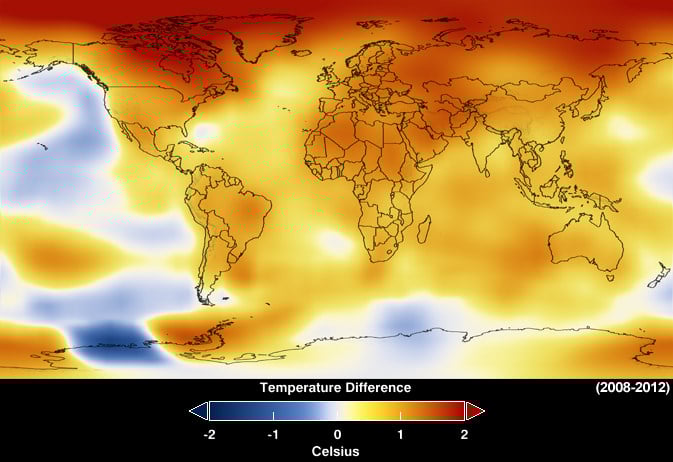
Scientists at the Lawrence Livermore National Laboratory have developed a detailed model of the Earth's climate over the next few centuries to answer the question... what if we burned all the fossil fuels by the year 2300. The answer, of course, isn't a pretty picture. In their model, global temperatures will rise 8-degrees Celsius (14.5 F), and melting polar caps will raise the oceans 7 metres (23 feet). The damage would be even worse in the polar regions, which could grow by 20-degrees C (68 F).
Continue reading
This photograph of Saturn's moon Dione was taken by Cassini on Sept. 20, 2005 from a distance of 2.1 million kilometers (1.3 million miles). The image shows the many canyons that crisscross the surface of the 1,126-kilometer (700-mile) moon, as well as its bright southern pole.
Continue reading
Time to revise your idea of Pluto. New images gathered by the Hubble Space Telescope have revealed that this distant planet could two additional moons. If this is true, Pluto will be the first Kuiper Belt Object found to have multiple moons. The candidate moons have been provisionally named S/2005 P1 and S/2005 P2, and are approximately 44,000 km (27,000 miles) away from Pluto.
Continue reading
 Universe Today